Biotechnology and genetic modification
Bacteria are useful in biotechnology and genetic modification due to their rapid reproduction rate and their ability to make complex molecules.
Bacteria are useful, as they have few ethical concerns over their manipulation, they reproduce rapidly and have plasmids.
Biotechnology
Yeast anaerobically respires in the production of ethanol for biofuels.
Bread making with yeast:
- Bread is made from dough. Flour is mixed with water, salt and yeast.
- The dough is left aside under optimum temperature.
- Amylase breaks down some starch in dough to sugar.
- Yeast cells use sugar for anaerobic respiration, producing carbon dioxide.
- The bubbles of carbon dioxide are trapped inside the dough and make it rise.
Fruit juice with pectinase:
- Adding pectinase to the chopped up fruit releases more juice.
- It breaks down a chemical called pectin that is found in plant cell walls.
Biological washing powders with enzymes:
- Detergents can remove stains, but it can take a lot of time/effort & need high temperatures.
- Biological washing powders contain enzymes that help to break down large food molecules.
- Proteases → break down protein stains
- Lipases → Breaks down grease stain
- Amylase → break down starch
- Cellulase → break down cellulose fibre on the outside of cotton fabrics to remove the dirt
- Advantages:
- Quickly breaks down large, insoluble molecules & smaller, soluble ones
- Effective at lower temperatures
- Can be used to clean delicate fabrics that would not be suitable for washing at high temperatures
Milk with lactase:
- Lactose is the sugar found in milk.
- Some people are lactose intolerant.
- Milk can be made lactose free by adding the enzyme lactase to allow the enzyme to break down the lactose.
Fermenters
Fermenters can be used for the large-scale production of useful products by bacteria and fungi, including insulin, penicillin and mycoprotein.
- The fermenter is inoculated with suitable fungus.
- Fermentation vessel is filled with nutrients.
- Sugars provide energy for respiration.
- Ammonium salts are used by fungus to make proteins.
- Stirrer keeps microorganisms suspended so they always have access to nutrients & oxygen.
- Air supply provides oxygen for aerobic respiration of fungus.
- Water (cooled jacket) removes heat produced by fermentation to keep constant temperature of 26°C.
- Probes monitor temperature & make sure pH is constant at 6.5.
Genetic modification
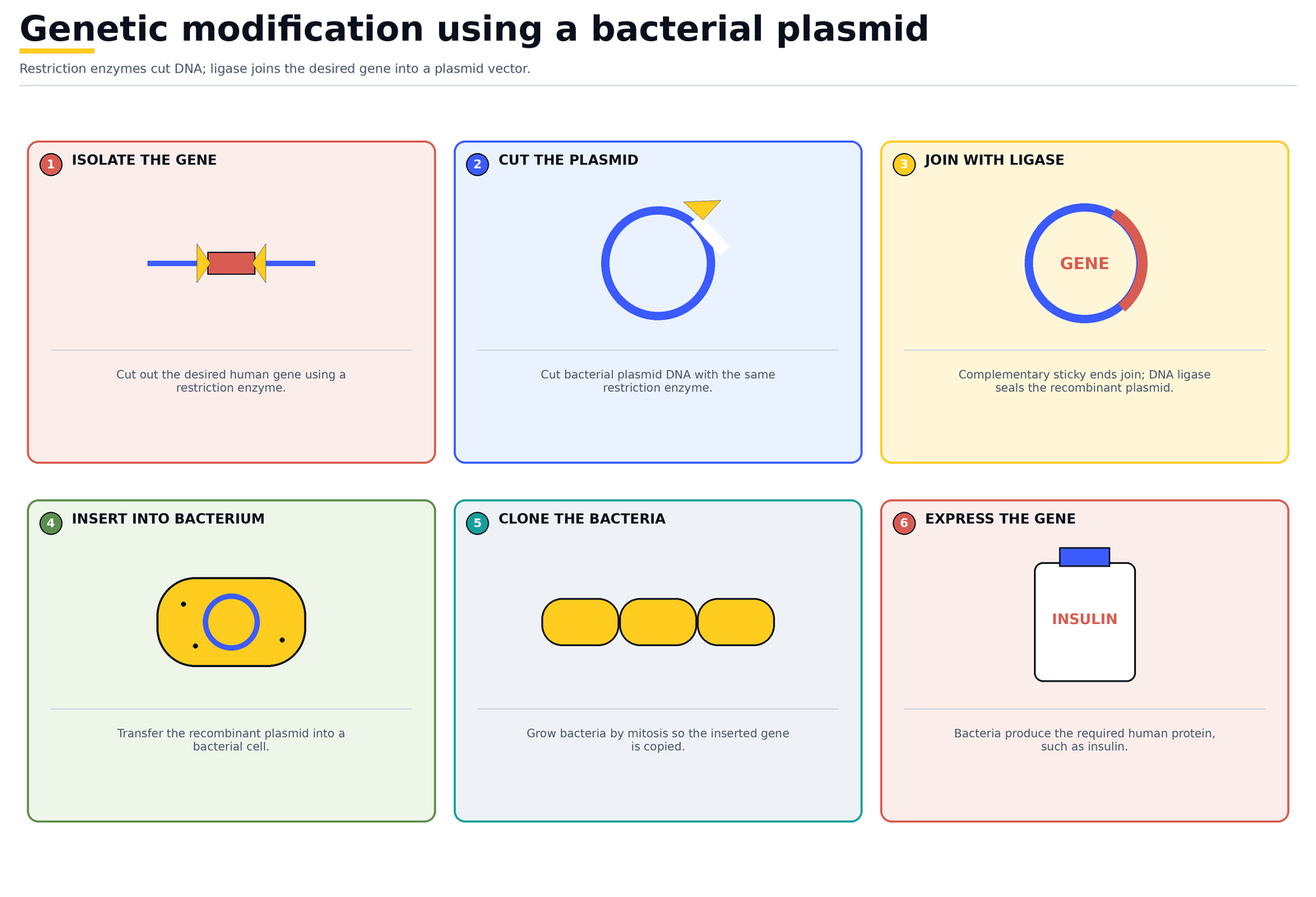
Genetic modification – Changing the genetic material of an organism by removing, changing or inserting individual genes.
Process of genetic modification:
- Isolation of the DNA making up a human gene using restriction enzymes, forming sticky ends.
- Cutting of bacterial plasmid DNA with the same restriction enzymes, forming complementary sticky ends.
- Insertion of human DNA into bacterial plasmid DNA, using DNA ligase to form a recombinant plasmid.
- Insertion of recombinant plasmids into bacteria.
- Multiplication of bacteria containing recombinant plasmids.
- Expression in bacteria of the human gene to make the human protein.
Examples of genetic modification:
- Insertion of human genes into bacteria to produce human proteins.
- Insertion of genes into crop plants to confer resistance to herbicides.
- Insertion of genes into crop plants to confer resistance to insect pests.
- Insertion of genes into crop plants to improve nutritional qualities.
Genetically modifying crops
| Advantages | Disadvantages |
|---|---|
| Increase crop yield | Risk of inserted genes being transferred to wild plants by pollination could reduce the usefulness of the GM crop |
| Environmentally friendly | New gene combinations -> unknown effects -> harmful substances produced -> health risks |
| Consumer benefits | Reduce genetic variation |
| Not affordable |
Notes by: Vernice