Characteristics of living organisms
7 Characteristics of living things (MRS GREN):
- Movement — an action by an organism or part of an organism causing a change of position or place.
- Respiration — the chemical reactions in cells that break down nutrient molecules and release energy for metabolism.
- Sensitivity — the ability to detect and respond to changes in the intel or extel environment.
- Growth — a permanent increase in size and dry mass.
- Reproduction — the processes that make more of the same kind of organism.
- Excretion — the removal of the waste products of metabolism and substances in excess of requirements.
- Nutrition — the taking in of materials for energy, growth and development.
Concept and uses of classification systems
Organisms can be classified into groups by the features that they share.
Classification - systems aim to reflect evolutionary relationships
- Sequences of bases in DNA are used for classification.
- They classify organisms by using their genetics to trace their evolutionary relationships.
- Many species have similar features that allow us to put them into groups.
- Organisms who share a more recent ancestor (i.e. more closely related) have DNA base sequences that are more similar than those who only share a distant ancestor.
- Species — A group of organisms that can reproduce to produce fertile offspring (with organisms sharing similar characteristics and living space.)
- Binomial Naming — an intetionally agreed system in which the scientific name of an organism is made up of two parts showing the genus and species. E.g. homo (genus) sapiens (species)
- Dichotomous key — used to classify animals based on their visible characteristics
Features of Organism
Kingdom -> phylum -> class -> order -> family -> genus -> species
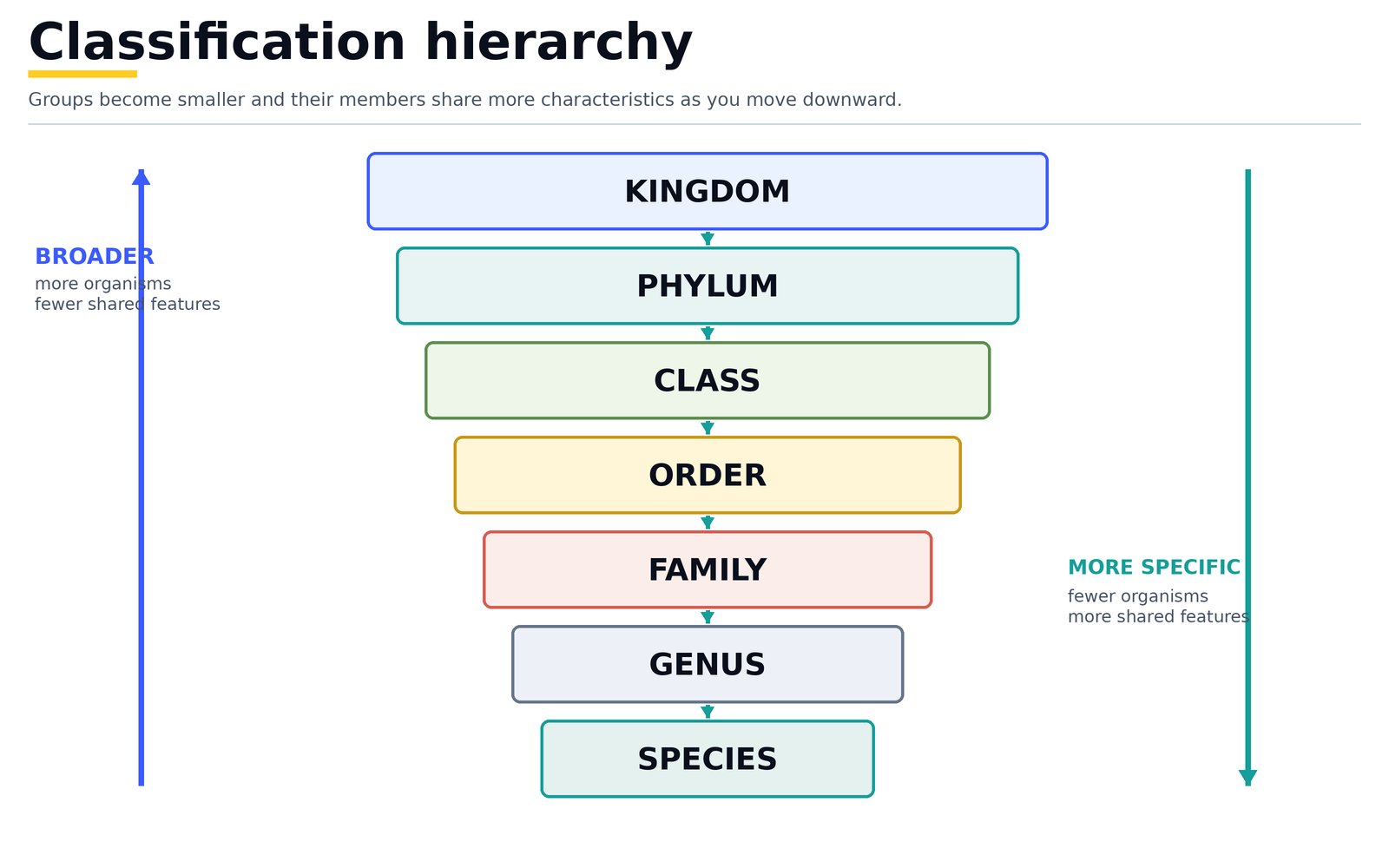
All living things are classified into five kingdoms:
- Plants — multicellular, contains nucleus, chloroplasts & cell walls.
- Animals — multicellular, contains nucleus, no chloroplasts/cell wall.
- Fungi — multicellular, contains nucleus & cell walls.
- Protoctists — unicellular, contains nucleus.
- Prokaryotes — unicellular, contain cell walls, no nucleus.
Animal kingdom
Main groups of vertebrates (animals with a backbone): mammals birds, reptiles, amphibians, fish
| Vertebrate class | Body | Movement | Reproduction | Sense organs | Blood | Examples |
|---|---|---|---|---|---|---|
| Fish | Scales | Fins | Jelly-covered eggs | Eyes | Cold blooded | Herring Shark |
| Amphibians | Moist skin | 4 limbs Webbed feet | Jelly-covered eggs in water | Eyes Ears | Cold blooded | Frog Newt |
| Reptiles | Dry scales | 4 legs (apart from snake) | Rubbery-shelled eggs | Eyes Ears | Cold blooded | Lizard Snake |
| Birds | Feathers | 2 wings 2 legs | Hard shelled eggs, laid on land | Eyes Ears | Warm blooded | Chicken Penguins |
| Mammals | Fur | 4 limbs | Produce live young | Eyes Ears with pinna | Warm blooded | Cow Cat |
Main groups of arthropods (invertebrates — animals with no backbone): myriapods, insects, arachnids, crustaceans
Traits:
- Most have a firm/hard extel skeleton made up of chitin.
- Jointed limbs
- Arachnid: 8 legs
- Crustaceans: 10 legs
- Insects: 6 legs
- Myriapods: uncountable
- Body segmentation (2 or 3).
- Arachnid and Crustaceans: cephalothorax, abdomen.
- Insects: head, thorax and abdomen.
- Myriapods: not obviously divided.
- Eyes
- Arachnids & Myriapods: simple eyes.
- Insects & Crustaceans: compound eyes.
Plant kingdom
- Ferns — the first plants to adapt to living on land. They have evolved to have roots, stems, complex leaves and vascular tissues.
- Angiosperms — plants with flowers and seeds. They have evolved most recently.
| Monocotyledon | Features | Dicotyledon |
|---|---|---|
| Narrow & elongated | Leaf shape | Round / broad |
| Parallel | Leaf vein | Net - like, reticulate, branching |
| Only one seed leaf | Cotyledon (seed leaf) | Double |
| 3 | Grouping of flower parts | 5 |
| Fibrous / branched | Roots | Tap (one main root) |
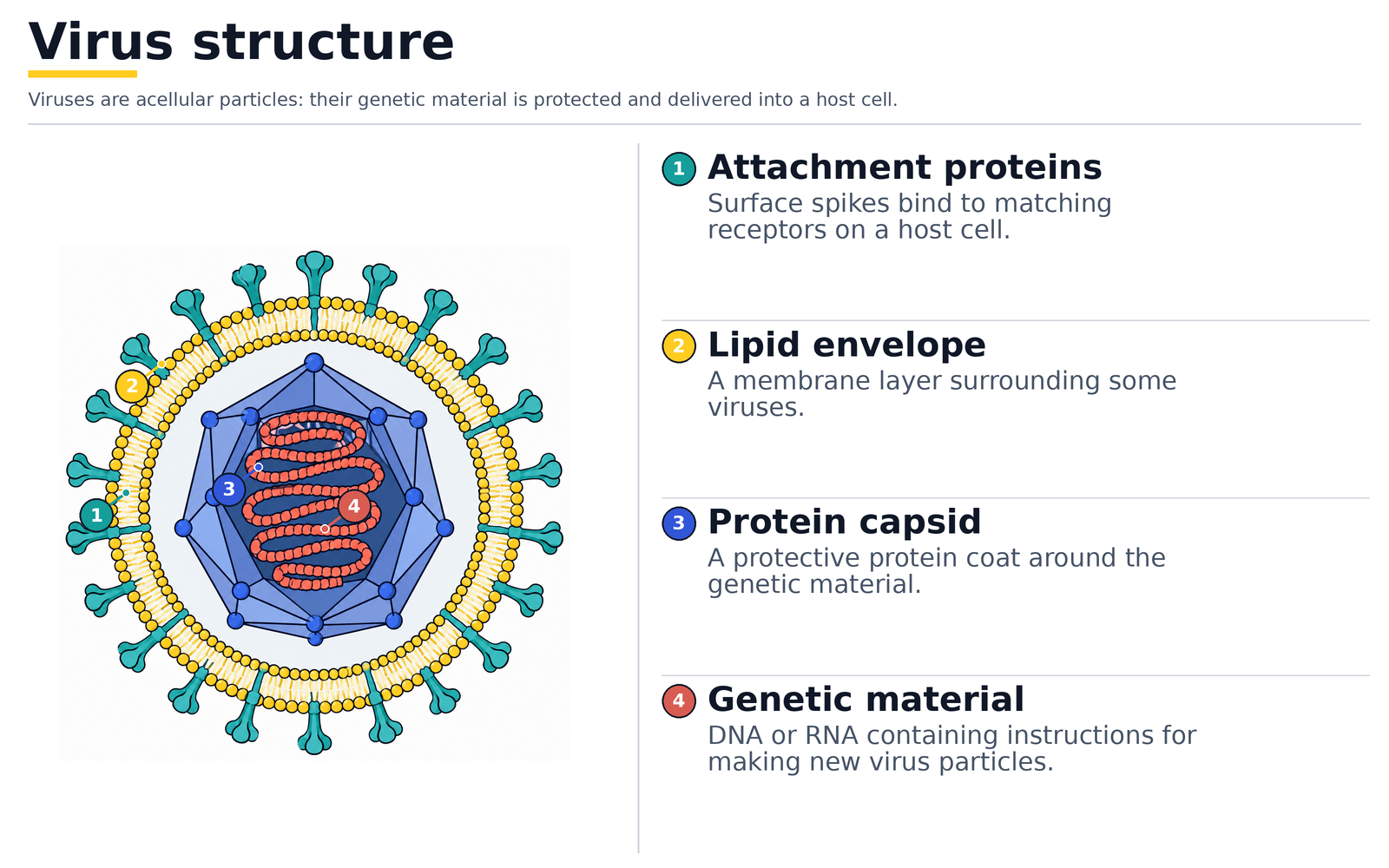
Viruses
- Viruses are not considered as living things.
- They DO NOT display the 7 characteristics of living things.
- They need a living host cell in order to make copies of themselves.