Coordination & response
Nervous system – A complex collection of nerves & cells that carry messages to coordinate & regulate body functions. It is made of billions of nerve cells called neurons. Signals travel along neurons as electrical impulses.
Nervous system is made of:
- Central nervous system (CNS): the brain and the spinal cord
- Peripheral nervous system (PNS): nerves outside of the brain and spinal cord
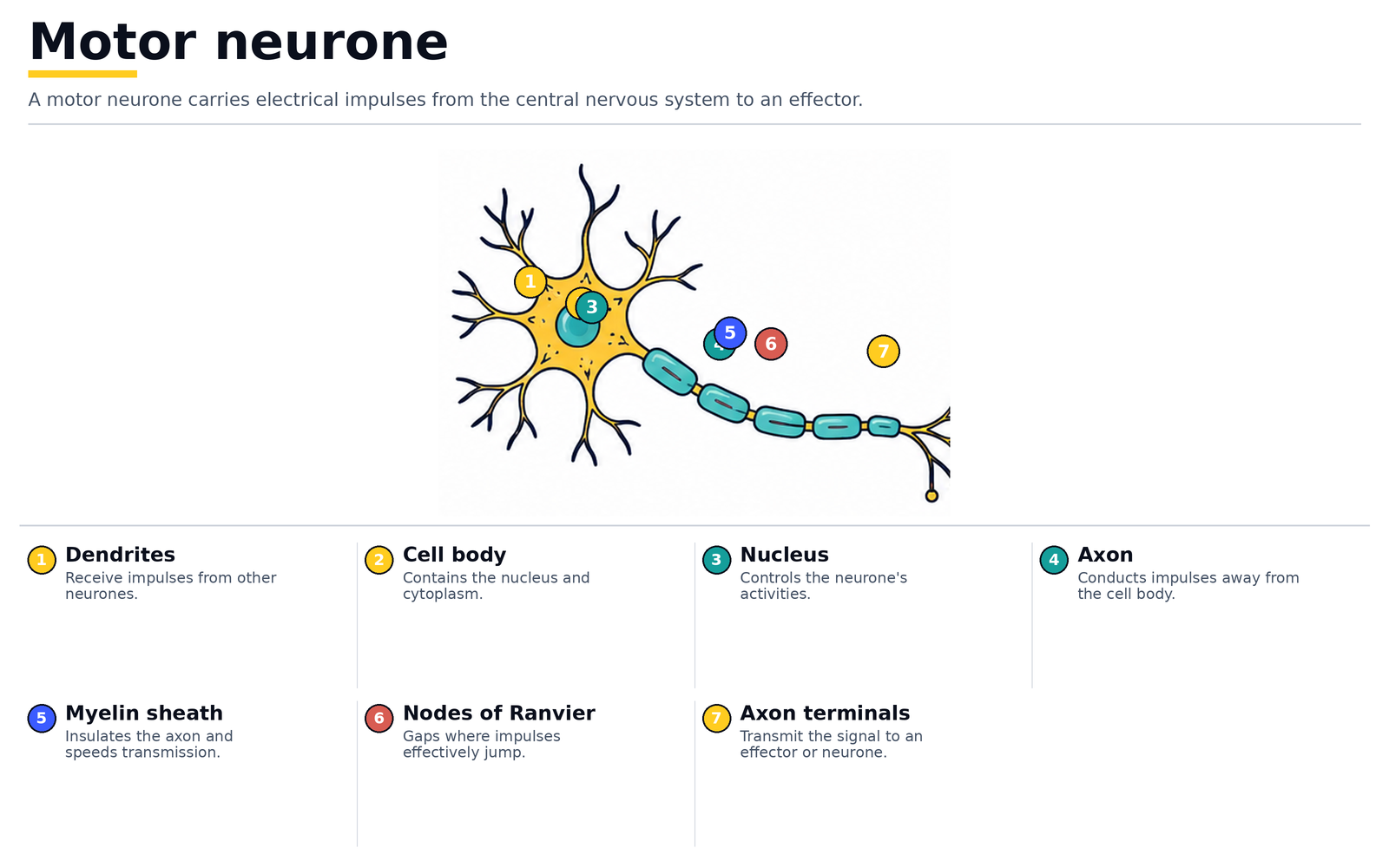
| Sensory neuron | Relay neuron | Motor neuron |
|---|---|---|
| Long | Cell body branching off the middle of axon | Long |
| Small cell body at one end | Short | Large cell body at one end |
| Many dendrites | Long dendrites. |
| Differences | Voluntary actions | Involuntary actions |
|---|---|---|
| Type | Non automatic - with awareness | Automatic - without awareness |
| Nervous pathway | Receptor -> spinal cord -> cerebrum -> spinal cord -> effectors | Receptor -> spinal cord -> medulla oblongata -> spinal cord -> effectors |
| Speed | Slow | Fast |
| Examples | Speaking, hearing, walking | Heartbeat, peristalsis, respiration, blinking |
- Stimulus – A change in the environment detected by receptors
- Receptor – Cells that detect a stimulus and convert it into an electrical impulse
- Effector – muscle or gland that responds to a stimulus
Reflex action – automatically and rapidly integrating and coordinating stimuli with the responses of effectors (muscles and glands)
Reflex arc: receptor -> sensory neurone -> relay neurone -> motor neurone -> effector
Benefits of reflexes:
- Fast response because the brain is not involved
- Keeps us safe e.g. finger in flame reflex action to move it away
- Minimises damage to the body from harmful conditions
- Doctors can use reflex reactions to check if a patient's nervous system is functioning properly
Structure of a synapse
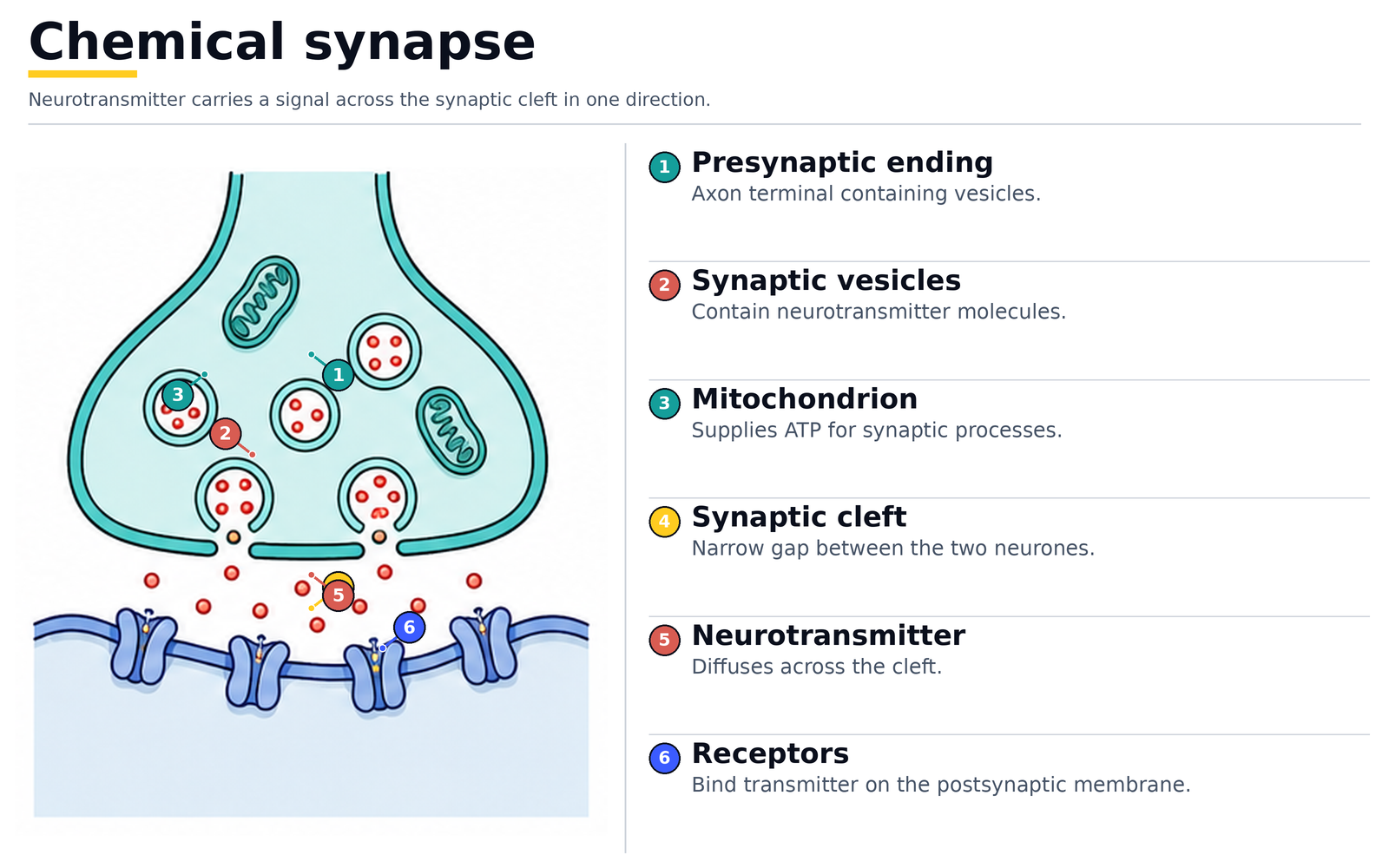
- Vesicles containing neurotransmitter molecules
- Synaptic gap
- Receptor proteins
Events at a synapse
- An impulse stimulates the release of neurotransmitter molecules from vesicles into the synaptic gap
- The neurotransmitter molecules diffuse across the gap
- Neurotransmitter molecules bind with receptor proteins on the next neurone
- An impulse is then stimulated in the next neurone
Synapses ensure that impulses travel in one direction only as they only have receptors on one end of the synapse.
Sense organs
Sense organs – groups of receptor cells responding to specific stimuli: light, sound, touch, temperature and chemicals
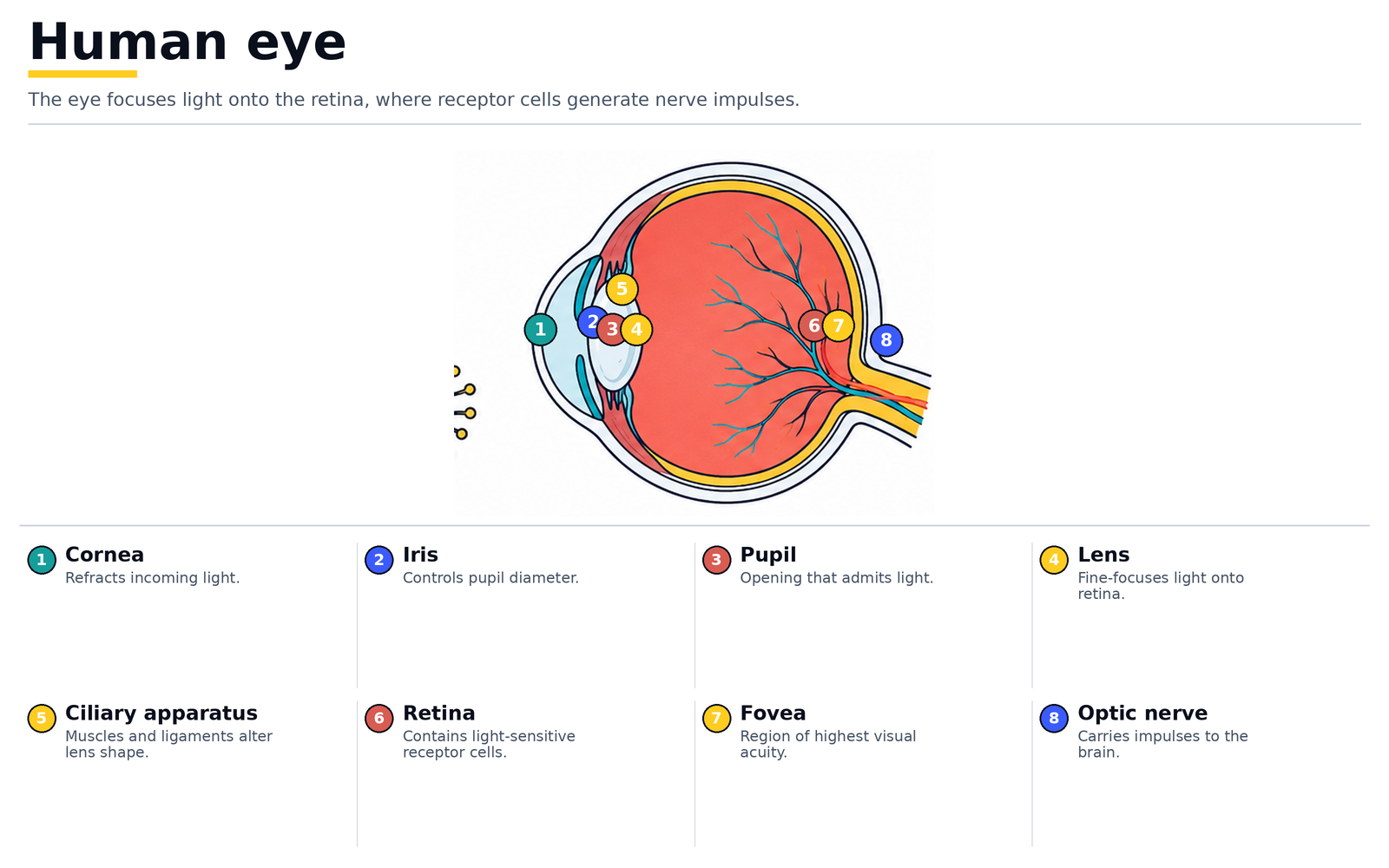
| Structure | Function |
|---|---|
| Cornea | Refracts light |
| Iris | Controls how much light enters the pupil |
| Lens | Focuses light onto the retina |
| Retina | Contains light receptors (rods & cones) |
| Optic Nerve | Carries impulses to the brain |
| Fovea | Central part of retina where cones are concentrated. |
Bright light: Circular muscles contracts, radial muscles relax -> pupil reduces in size -> reduces amount of light reaching retina
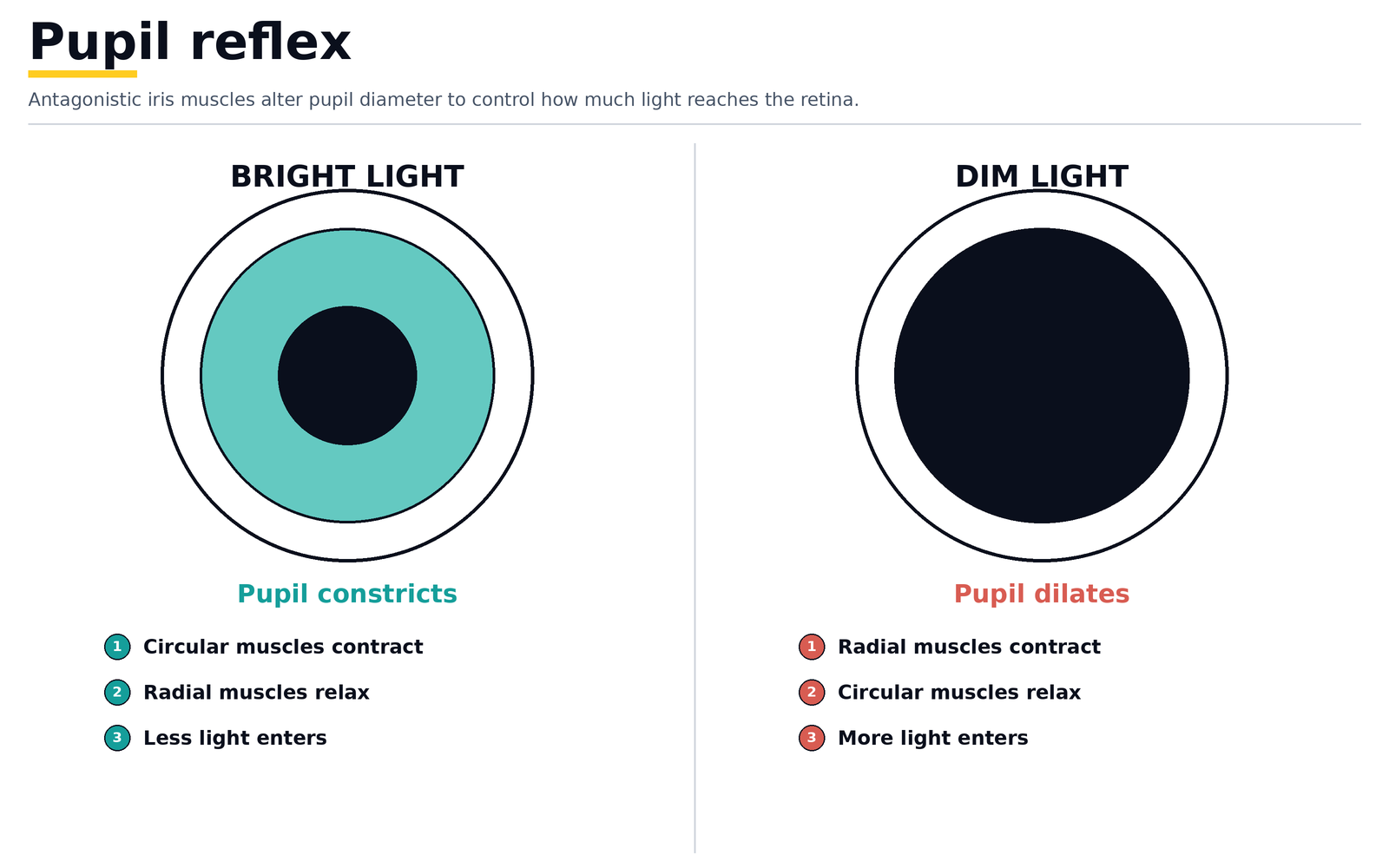
Dim light: Circular muscle relax, radial muscles contracts -> pupil increase in size -> increase the amount of light reaching retina
| Rods | Cones |
|---|---|
| Black & white images | Colour images |
| Sensitive in dim light | Works in high light intensity |
| Low detail | High detail |
| 3 types: red, green, blue |
Accommodation
- Near objects: ciliary muscles contract, suspensory ligaments relax -> lens becomes thicker
- Distant objects: ciliary muscles relax, suspensory ligaments contracts-> lens becomes thinner
Hormones
Hormone – A chemical substance, produced by a gland and carried by the blood, which alters the activity of one or more specific target organs.
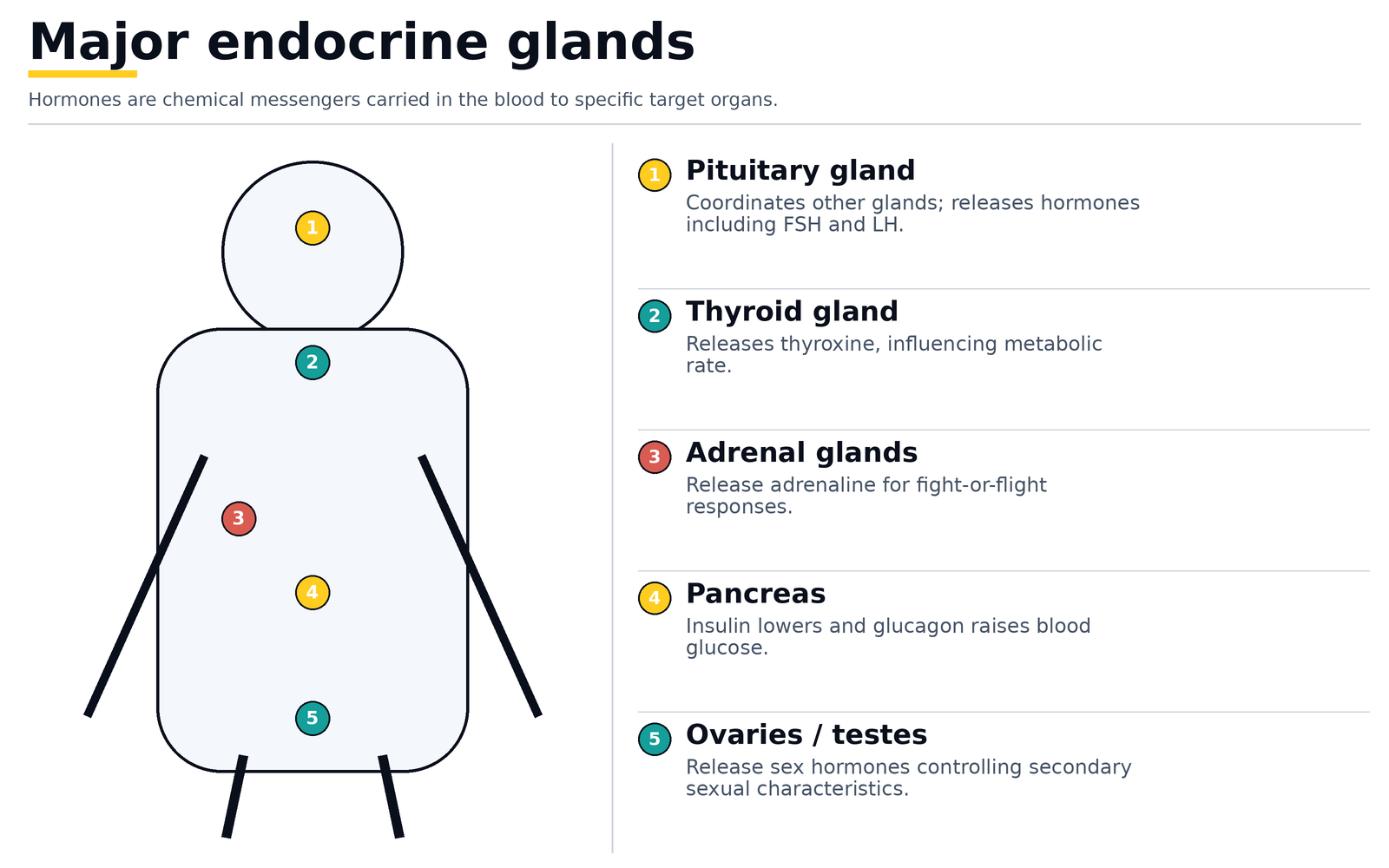
Adrenaline – The hormone secreted in 'fight or flight' situations and is released from adrenal glands.
Adrenaline effects:
- Increased breathing rate (for more oxygen to be absorbed for energy)
- Increased heart rate (so blood moves faster and delivers more oxygen for energy)
- Increased pupil diameter (to see clearer)
- Increasing the blood glucose concentration (used in respiration for energy)
| Hormonal control | Nervous control | |
|---|---|---|
| Form of info | Hormones / glands | Nerves (neurons), brain, spinal cord |
| Type of message | Chemical hormone | Electrical impulse |
| Transmission | Hormones transported by blood | Impulses transmitted by neurons |
| Speed of response | Slower | Very fast |
| Duration of effect | Short (adrenaline) or long (growth hormone) - until hormone is broken down | Short - until nerve impulses stop |
| Area of response | May affect more than one target organ | Usually localised |
Homeostasis
Homeostasis – Maintenance of constant intel environment.
- Positive feedback - Body adds to the action being experienced by your body. E.g. uterine contraction during labour to increase the contraction to facilitate childbirth
- Negative feedback - Body counteracts the action being experienced by your body to bring it back to normal conditions. E.g. thermoregulation, osmoregulation, glucoregulation.
Blood glucose level is detected at the islets of Langerhans in the pancreas and controlled by these two hormones: Insulin & glucagon.
Insulin
- Blood glucose level gets too high
- Stimulates enzyme production in pancreas
- Insulin stimulates liver to change glucose to glycogen
- Blood glucose concentration decreases
- Glycogen stored for energy
Glucagon
- Blood glucose level gets too low
- Stimulates enzyme production in pancreas
- Glucagon stimulates liver to change glycogen back to glucose
- Blood glucose concentration increases
Type 1 diabetes
- No/little insulin in blood, so cells can't take glucose.
- Treatment: Regular monitoring of blood glucose levels (up to 6x/day), lifelong insulin injections (up to 6x/day), healthy diet, regular exercise
Maintenance constant intel body temperature
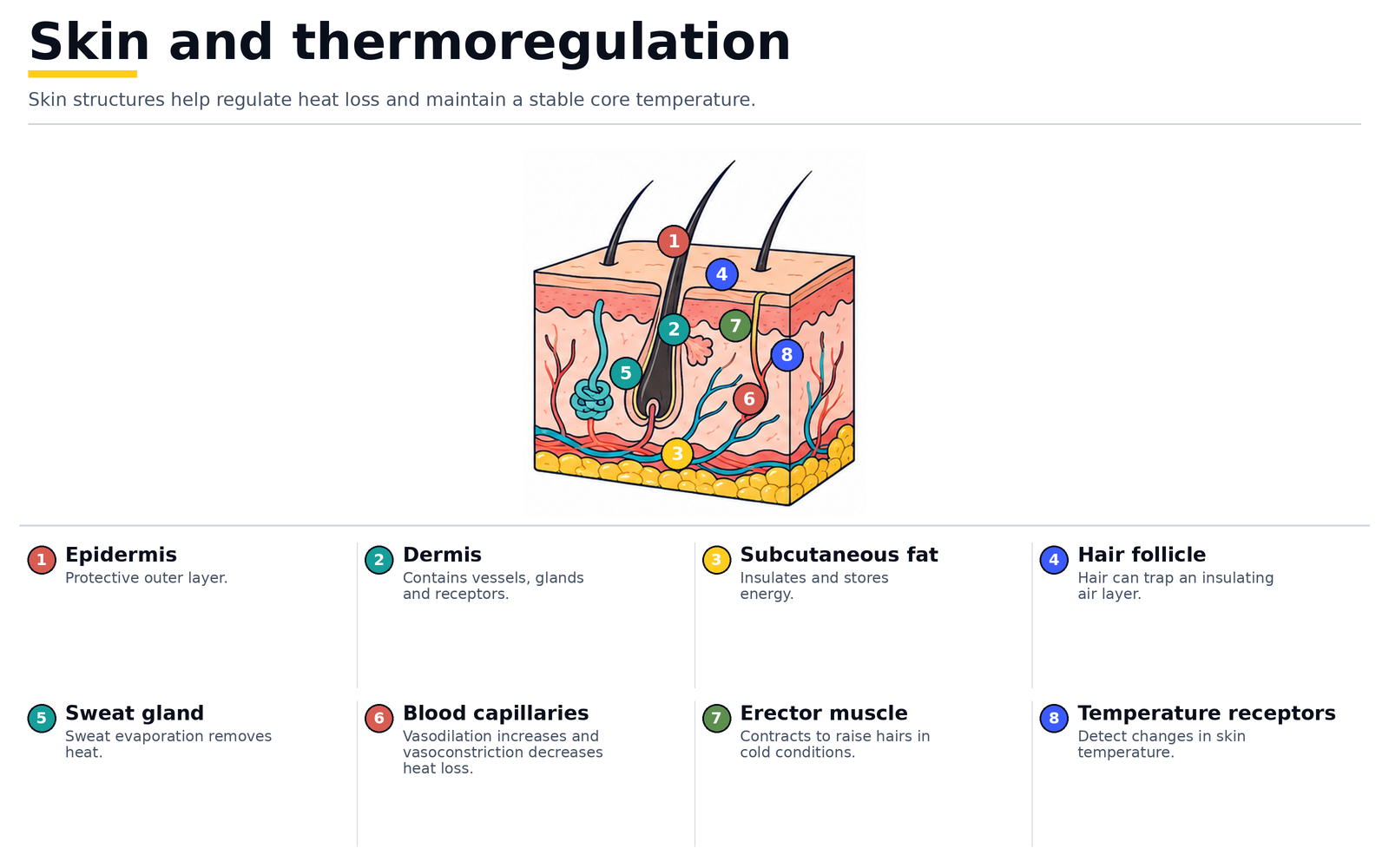
Receptors detect change in temperature and carry impulses to hypothalamus.
| Hot | Cold |
|---|---|
| Sweating (cools body via evaporation). | No sweating. |
| Blood vessels dilate (to release heat). | Blood vessels constrict (to reduce heat loss). |
| Muscles relax - hair is flat (so no air is trapped to provide insulation). | Muscles contract - hairs erect. |
| Vasodilation | Shivering |
| Vasoconstriction. |
| Vasodilation | Vasoconstriction |
|---|---|
| 1. Arterioles dilate, shunt vessels constrict | 1. Arterioles constrict, shunt vessels dilate |
| 2. More blood flows to skin through capillaries | 2. Less blood flows to skin through capillaries |
| 3. Heat is taken to surface | 3. Heat loss is reduced |
| 4. Blood carries heat | |
| 5. Heat lost from skin |
Tropic Responses
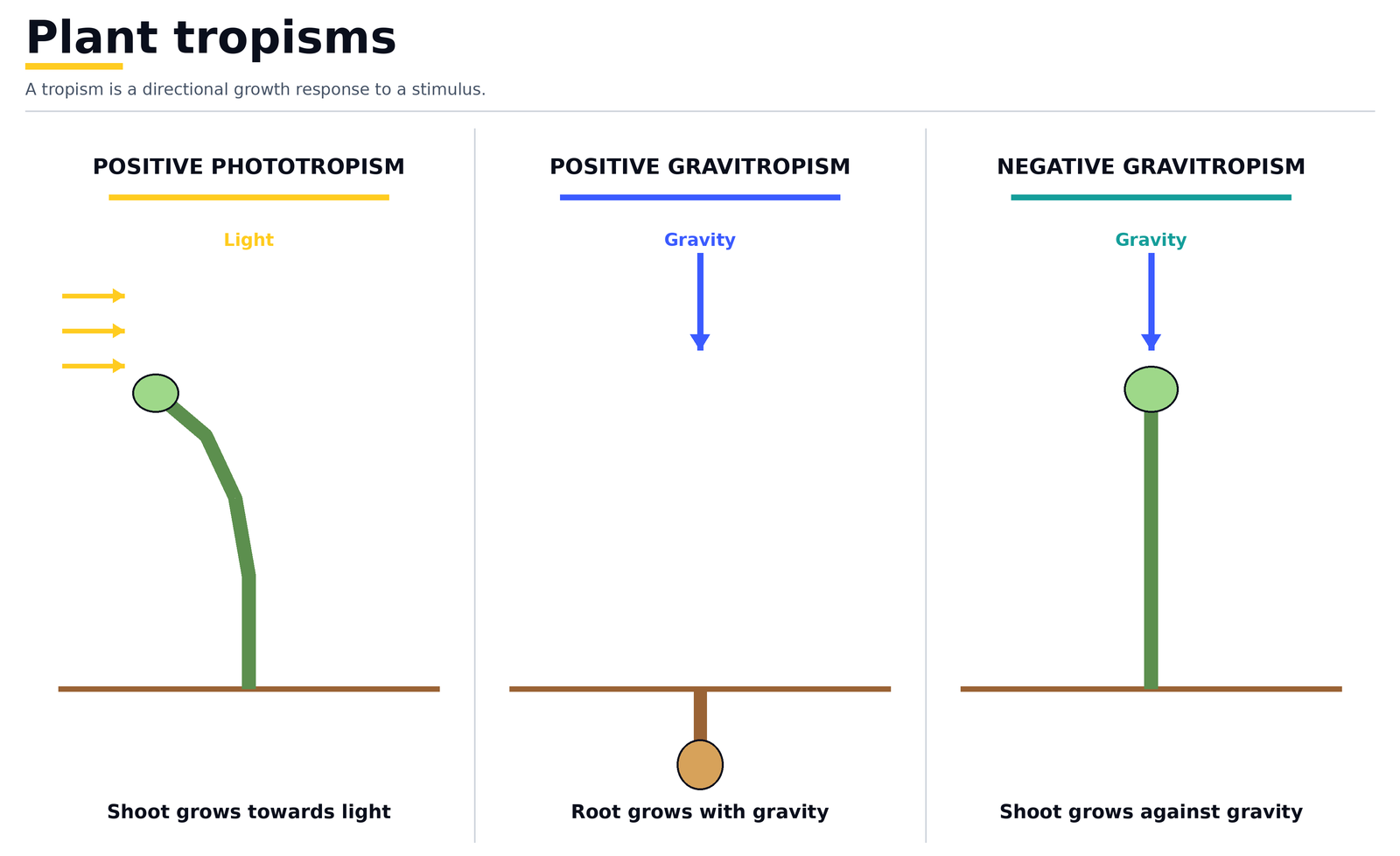
- Tropism – a growth response in which parts of a plant respond to the direction of a stimulus (moving towards or away)
- Gravitropism – response where parts of plants grow towards/away from gravity
- Phototropism – response where parts of plants grow towards/away from direction of light source
Auxin - a family of growth hormones that control cell elongation.
- Auxin made in shoot tip
- Diffuses through plant from shoot tip
- Unequally distributed in response to light/gravity
- Stimulates cell elongation
In phototropism auxin moves to the shade, stimulating cell elongation and bending the plant towards the light