Diffusion
Diffusion - the net movement of particles from a region of their higher concentration to a region of their lower concentration down a concentration gradient, as a result of their random movement.
The energy for diffusion comes from the kinetic energy of random movement of molecules and ions
Examples:
- CO2 for plants diffuse from air to leaves, through the stomata
- O2 (waste product of photosynthesis) diffuses out of the plant
- Products of digestion are absorbed from the ileum of mammals
- Some substances move into and out of cells by diffusion through the cell membrane
Factors that influence diffusion:
- Surface Area (Increased surface area, increases the rate of diffusion)
- Temperature (Higher the temperature, the higher the kinetic energy (mobility of the particles), therefore the higher the rate of diffusion.)
- Concentration Gradients (The greater the difference in concentration, the higher the rate of diffusion.)
- Diffusion Distance (The closer the distance, the higher the rate of diffusion.)
Diffusion helps living organisms to:
- Obtain many of their requirements (glucose, vitamin B & C)
- Get rid of waste products
- Gas exchange for respiration
Osmosis
Osmosis - the net movement of water molecules from a region of higher water potential to a region of lower water potential down a concentration gradient, across a semi permeable membrane
The number of sugar molecules stays the same. Only water molecules travel.
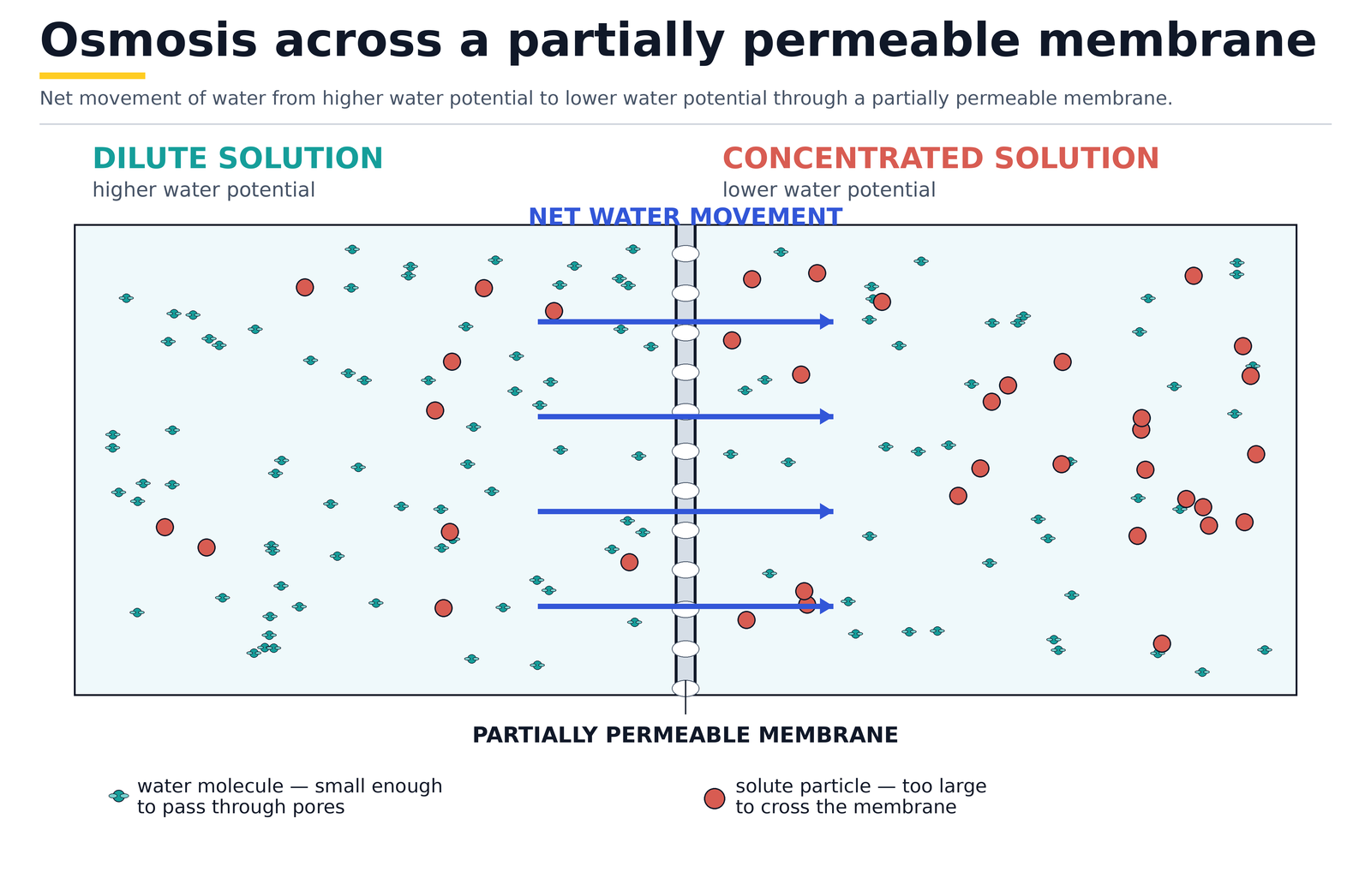
Osmosis can affect the tissues of organisms by causing them to lose or gain water.
| Condition | Water potential |
|---|---|
| Isotonic | water potential inside = water potential outside |
| Hypotonic (diluted solution) | water potential inside > water potential outside |
| Hypertonic (concentrated solution) | water potential inside < water potential outside |
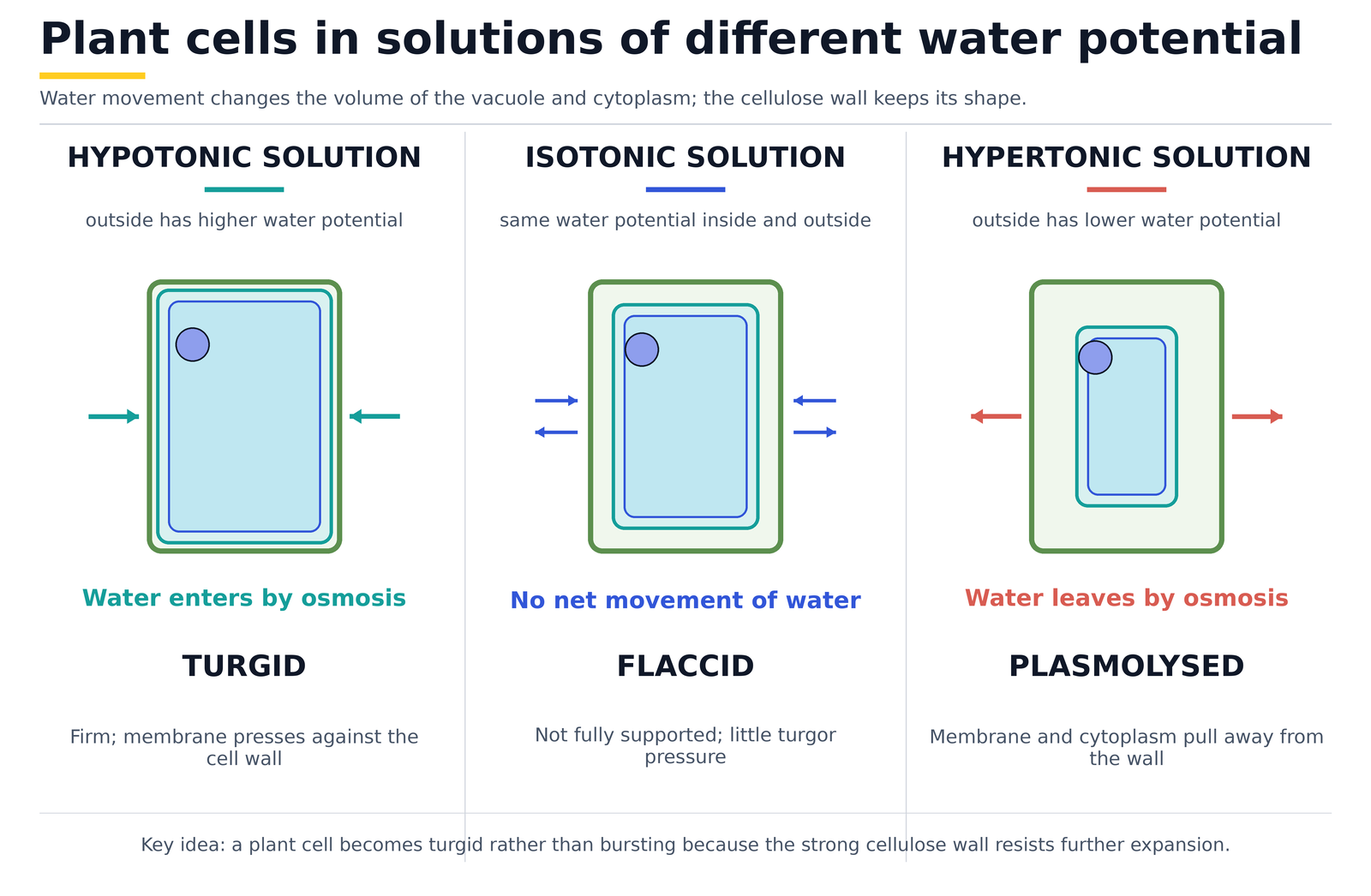
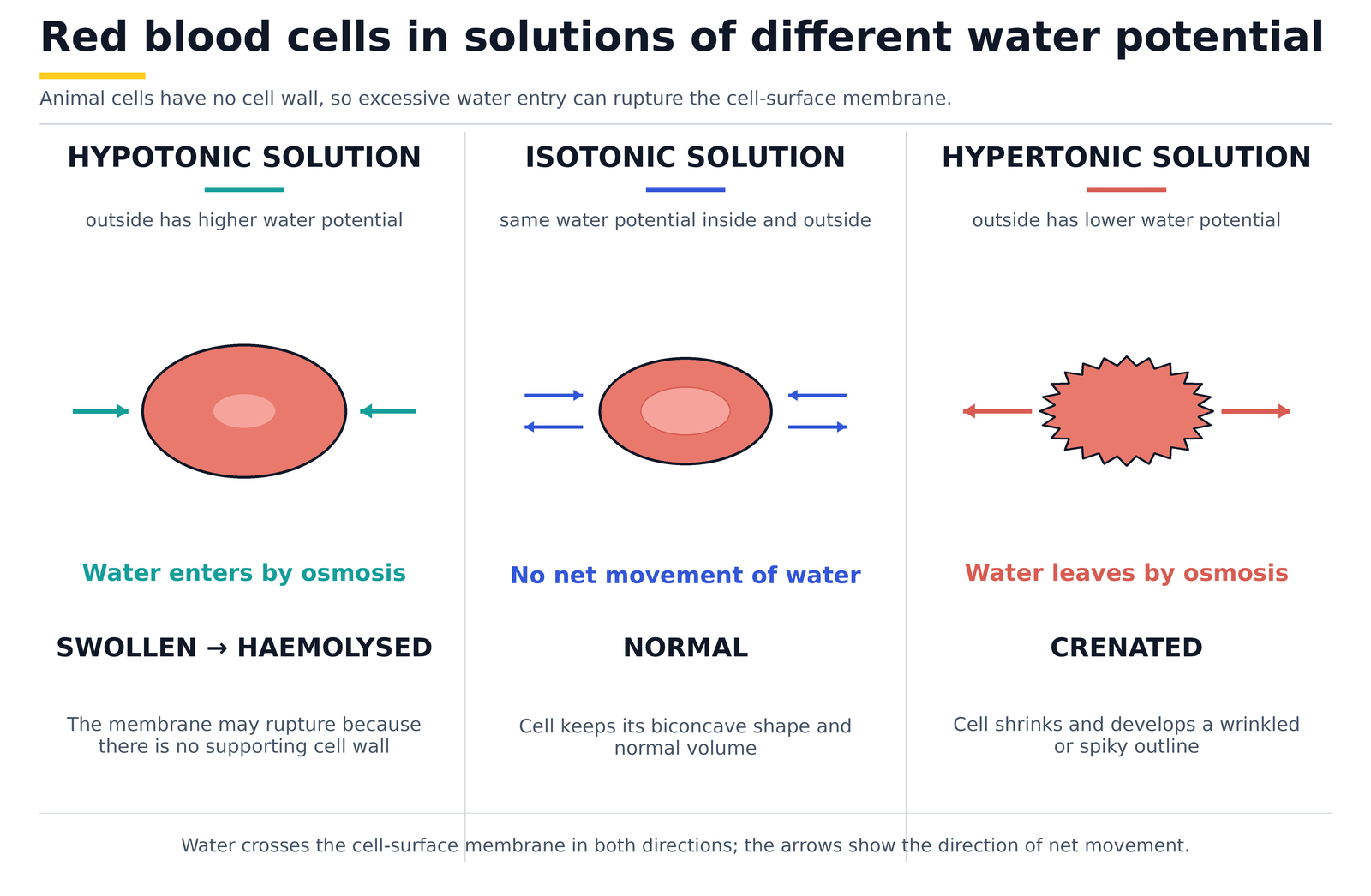
Plasmolysis occurs when a plant cell shrinks due to a loss of water. Plants can become flaccid.
Importance of osmosis:
- Water is a solvent in organisms for digestion, excretion and transport.
- Plants are supported by the turgor pressure from water inside the cells pressing outwards on the cell wall.
Active transport
Active transport - the movement of particles through a cell membrane from a region of lower concentration to a region of higher concentration (against a concentration gradient), using energy from respiration, through a carrier protein.
Importance of active transport:
- Movement of molecules/ions across membranes. Examples:
- Ion uptake by root hairs cells.
- Glucose uptake by epithelial cells in the villi of the small intestine and kidney tubules.
Protein carriers move molecules or ions across a membrane during active transport.