Xylem & phloem
| Feature | Xylem | Phloem |
|---|---|---|
| Function | Transport of water and mineral ions through plants, and support. | Transport of sucrose and amino acids. |
| Cell structure | Hollow dead cells. | Living cells which lost many organelles. They have companion cells to keep them alive and transfer energy needed to transport sugar into phloem. |
| Are the cells continuous tubes? | Yes, they have continuous cell tubes strengthened by lignin, which gives support to plants and helps withstand water pressure in tubes. | No, they have end walls with pores, so that cell sap can move between cells. |
| Direction of flow of contents | From roots to leaves. | From leaves to growing areas and storage organs. |
| Process substances are moved | Transpiration - loss of water vapour from leaves pulls water through the xylem. | Translocation - movement of dissolved sugars. |
- Vascular bundles - a group of xylem vessels and phloem tubes.
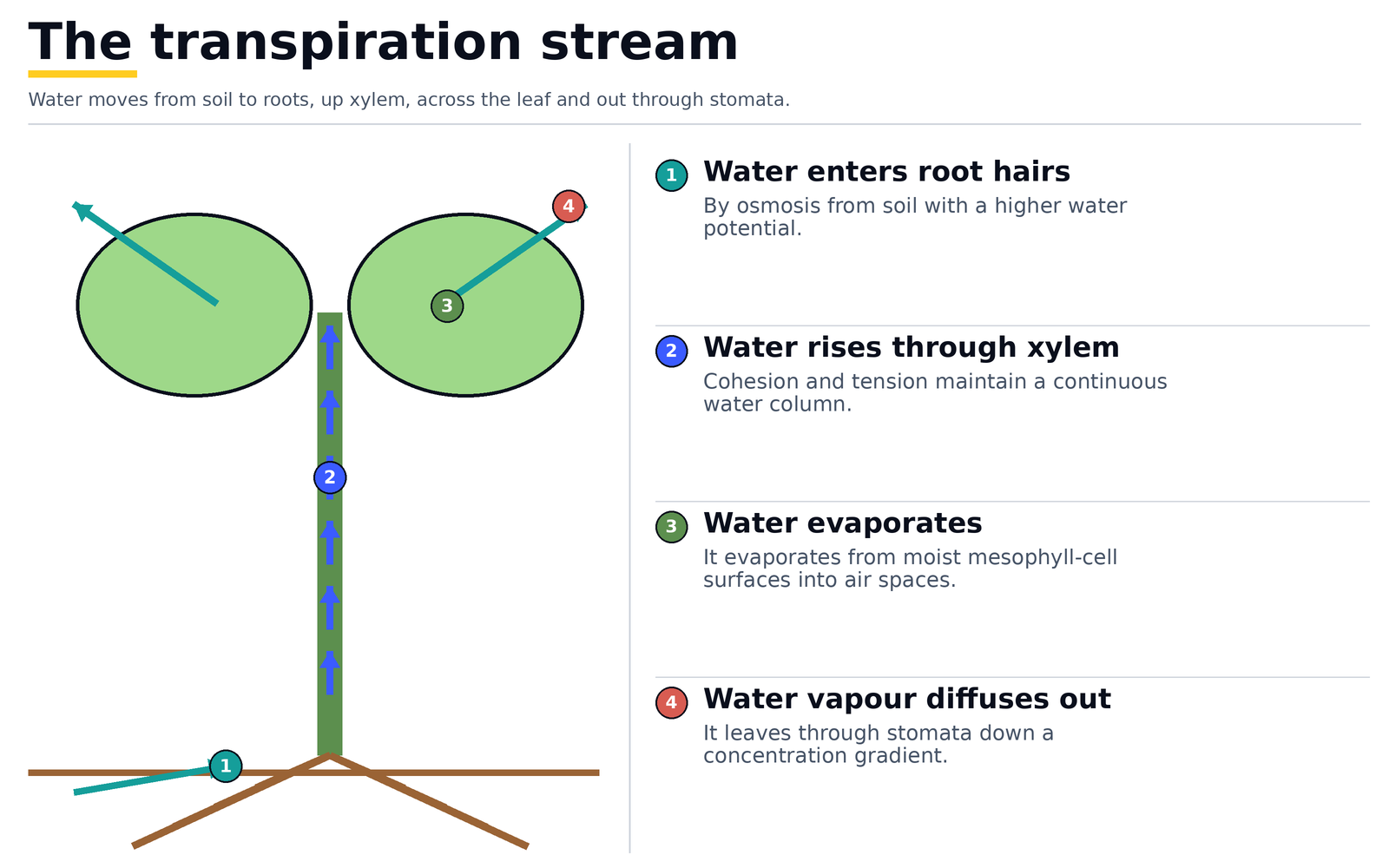
Water uptake
Water uptake:
- Plants take in water ions, by osmosis, and mineral ions, by active transport, from the soil through the root hairs.
- The large surface area of root hairs increases the uptake of water & mineral ions.
- Water travels across the root hair cells, to the root cortex, to the xylem vessels, transporting it to the stem and leaves.
- Water moves up the xylem by transpiration pull that draws up a column of water molecules, held together by cohesion force between water molecules.
- Water enters the mesophyll cells.
Transpiration
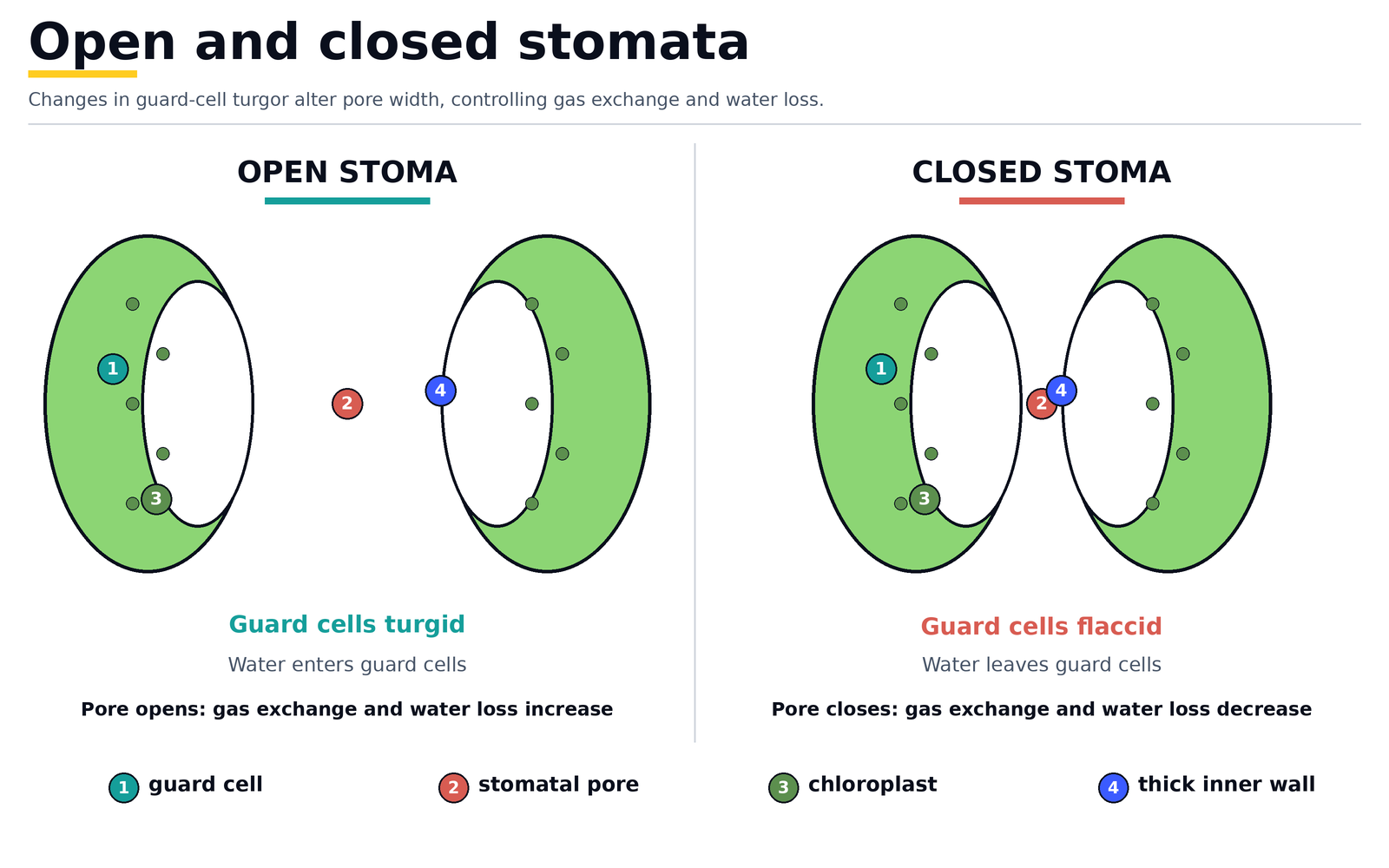
Transpiration - The loss of water vapour from leaves. Water evaporates from the surfaces of the mesophyll cells into the air spaces and then diffuses out of the leaves through the stomata as water vapour. Temperature, wind and humidity affect transpiration rate.
Water vapour loss is related to the large intel surface area provided by the interconnecting air spaces between mesophyll cells and the size and number of stomata.
Water moves up the xylem by transpiration pull that draws up a column of water molecules, held together by cohesion force between water molecules.
Cohesion force
Cohesion occurs when water molecules are attracted to each other. As water molecules move up the vessel, they pull other water molecules with them.
Transpiration pull
Water is drawn up by xylem vessels, as transpiration is removing water from the top of them and pressure at the bottom stays high. The pressure difference is called the transpiration pull.
Factors on the rate of transpiration
- Temperature: Increase in temperature leads to more kinetic energy of water particles. Water evaporates faster and the rate of transpiration increases.
- Wind speed: Increase in wind speed causes water to get carried away. Rate of transpiration increases.
- Humidity: Increase in humidity leads to a smaller concentration gradient. Rate of transpiration decreases.
Wilting occurs when a plant cell shrinks due to a loss of water. Plants can become flaccid.
Translocation
Translocation – The movement of sucrose & amino acids in phloem from sources to sinks.
- Sources - Parts of plants that release sucrose or amino acids.
- Sink - Parts of plants that use or store sucrose or amino acids.
Some parts of a plant may act as a source and a sink at different times, because of seasonal changes and their growth cycle.