Electrolysis
Electrolysis — the breakdown of an ionic compound in aqueous or molten state through passage of electricity.
Key terms
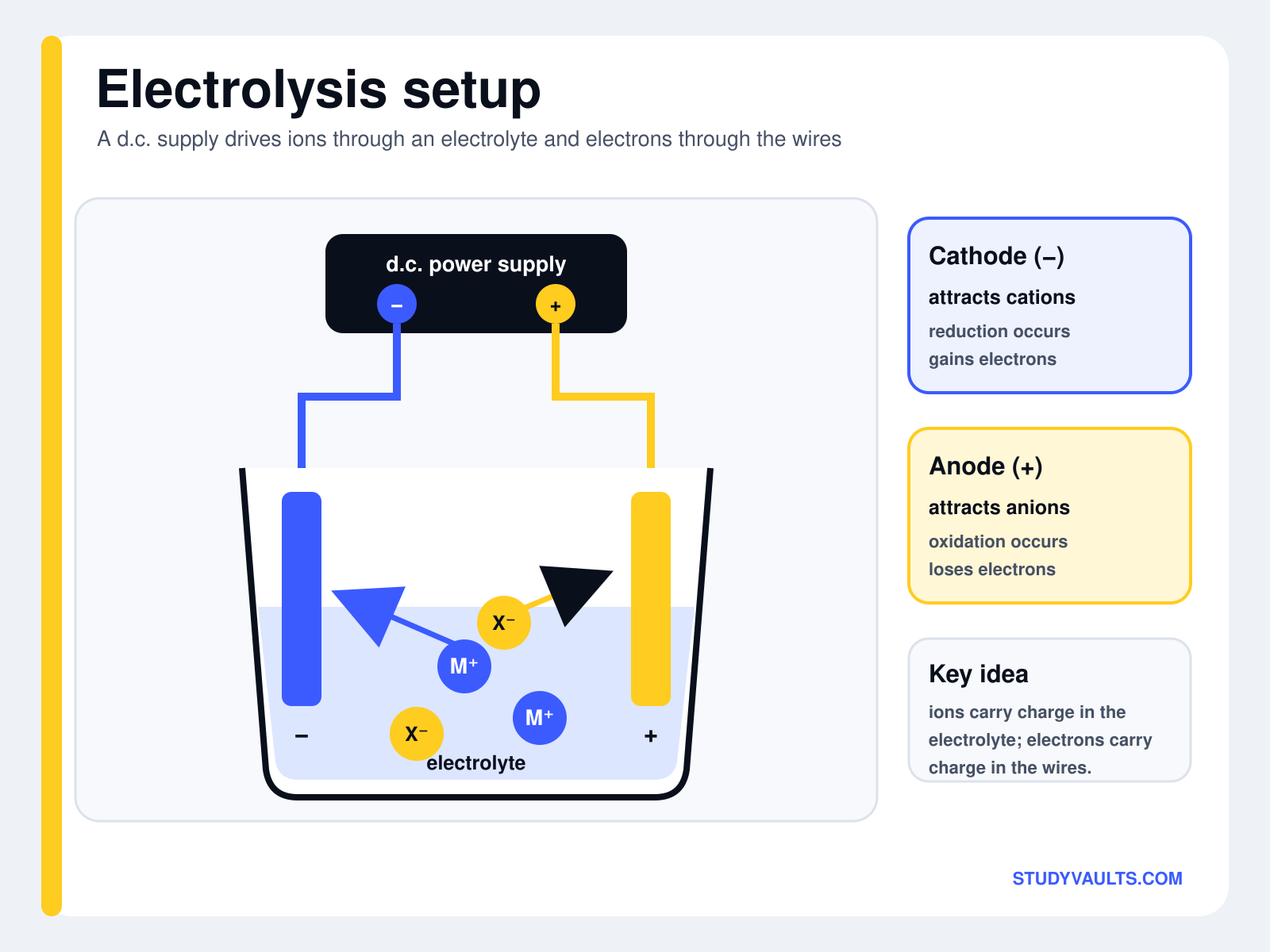
- Anode — positive electrode, attracts anions (negative ions), where oxidation takes place.
- Cathode — negative electrode, attracts cations (positive ions), where reduction takes place.
- Electrolyte — the molten/aqueous substance that is being used for electrolysis.
Transfer of charge
Where each charged particle acts in the system:
- The external circuit — movement of electrons.
- The electrodes — loss or gain of electrons.
- The electrolyte — movement of ions.
Why are carbon/graphite electrodes used?
- Graphite conducts electricity.
- Graphite is inert.
Molten electrolysis
- A metal (cation) and non-metal (anion) are always produced.
E.g. 1. Aluminium oxide
- Anode (oxidation) = oxygen gas produced.
- Cathode (reduction) = aluminium solid formed.
E.g. 2. Lead bromide
- Anode (oxidation) = bromine gas produced.
- Cathode (reduction) = lead solid formed.
Half equations — equations that show reduction or oxidation.
Aqueous electrolysis rules (not molten!)
- Dilute solution — OH- (oxygen) and H+ (hydrogen) are attracted to the anode and cathode respectively.
- Concentrated solution — halogen produced at the anode (if no halogen present, oxygen is produced), and a metal less reactive than hydrogen at the cathode (if no suitable metal is present, hydrogen is produced).
Worked examples:
| Electrolyte | Cathode | Anode |
|---|---|---|
| Concentrated hydrochloric acid | hydrogen | chlorine |
| Concentrated aqueous copper nitrate | copper | oxygen |
| Dilute hydrochloric acid | hydrogen | oxygen |
Electrolysis of aqueous copper sulphate
| Feature | Carbon (inert) electrodes | Copper (reactive) electrodes |
|---|---|---|
| Copper concentration in electrolyte | Reduces | Stays the same |
| Colour | Loses colour (blue -> colourless) | Does not change (stays blue) |
| Source of ions | Ions taken from the electrolyte | Ions move from anode to cathode, not from electrolyte |
| Electrode mass | — | Anode loses mass, cathode gains mass |
Electroplating
Purposes:
- To enhance appearance.
- To prevent corrosion.
Example: 1. Electroplating jewellery in silver
- Anode — metal used for plating. Loses mass.
- Cathode — metal to be plated. Gains the lost mass.
- Ions move from anode -> cathode.
Hydrogen–oxygen fuel cells
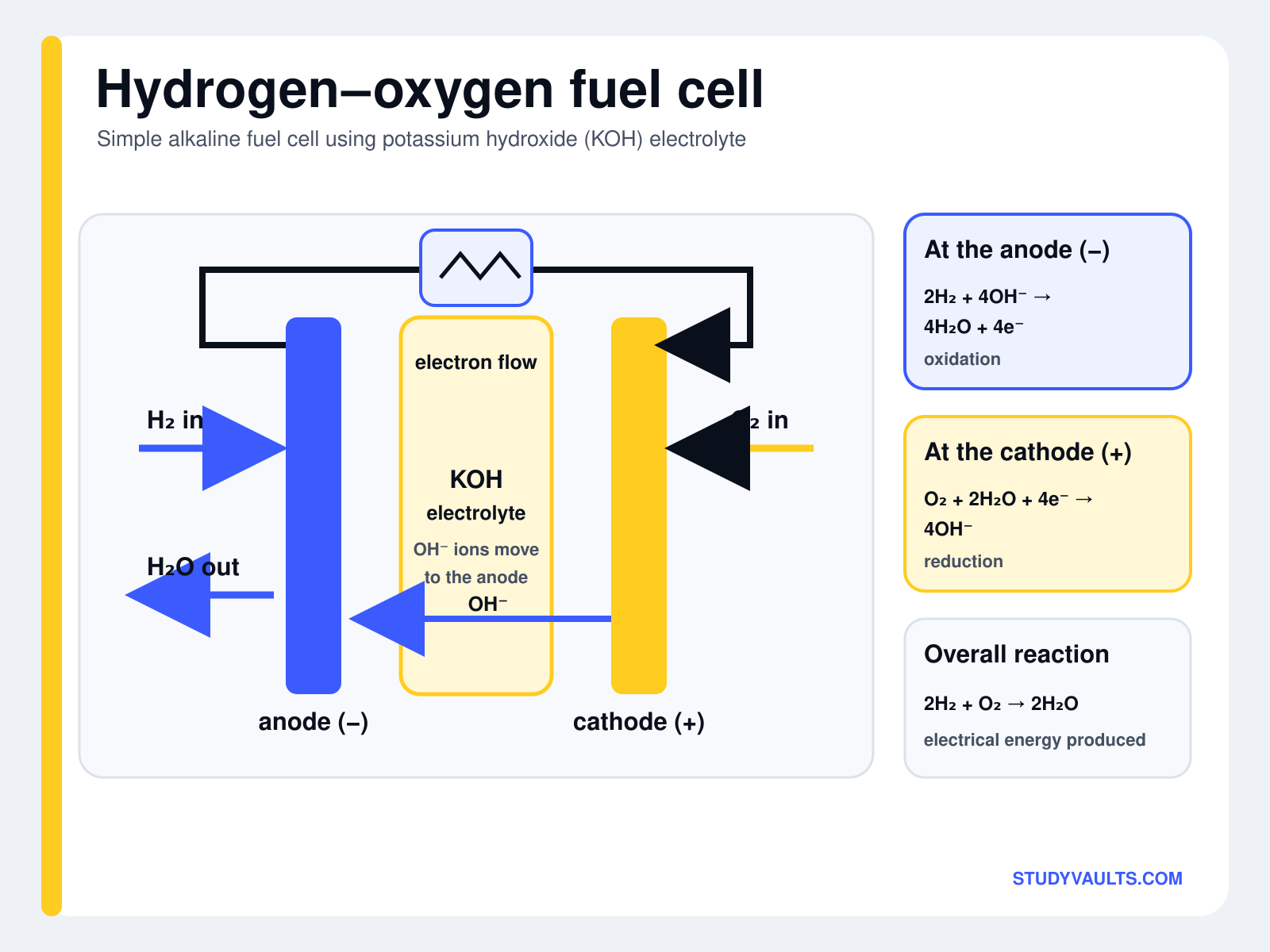
Using hydrogen and oxygen to produce electricity, with water as the only chemical product. By feeding in hydrogen and oxygen at the electrodes, in what we know as a galvanic cell (not in syllabus), we can create a complete circuit, where oxidation and reduction (redox) creates a flow of electricity through the wire.
| Advantages | Disadvantages |
|---|---|
| Does not have to be recharged | Flammable |
| No pollution made, unlike liquid gasoline/petrol engines | It is hard to store gas |