Experimental design
Apparatus:
- Stopwatches — measuring time
- Thermometers — measuring temperature
- Balances — measuring mass
- Burettes — measuring liquid volume
- Volumetric pipettes — measuring a fixed volume of liquid
- Measuring cylinders — measuring liquid volume
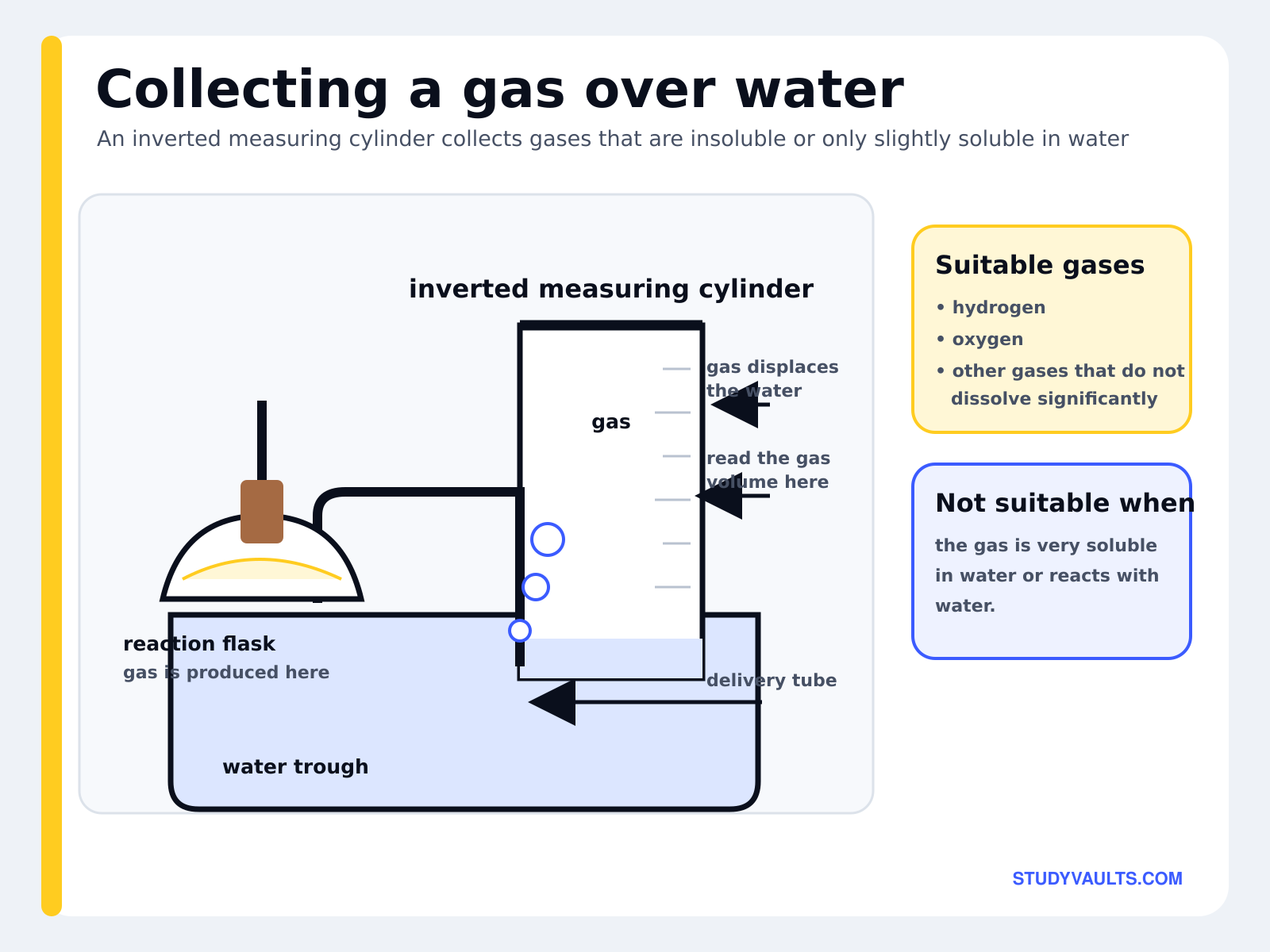
- Gas syringe — measuring gas volume
Key terms:
- Solvent — dissolves a solute
- Solute — the substance getting dissolved
- Saturated solution — solution with the maximum concentration of dissolved solute at a temperature
- Residue — the substance left after filtration of a solution
- Filtrate — the substance produced after successfully passing through the filter
Acid–base titrations
Titration is the neutralisation of a soluble base (potassium, ammonium and sodium hydroxides) and acid.
Equipment:
- Burette
- Volumetric pipette
- Indicator
Method:
- Fill a burette with acid
- Fill a conical flask with a known volume of an alkali (using volumetric pipette)
- Add a few drops of indicator into the alkali (e.g. thymolphthalein)
- Drop the acid from the burette into the alkali, swirling the solution as you go
- Stop when the colour of the indicator changes (it has reached its end-point)
- Record the volume of acid used
- Repeat the experiment without the indicator, using the known volume of acid
Chromatography
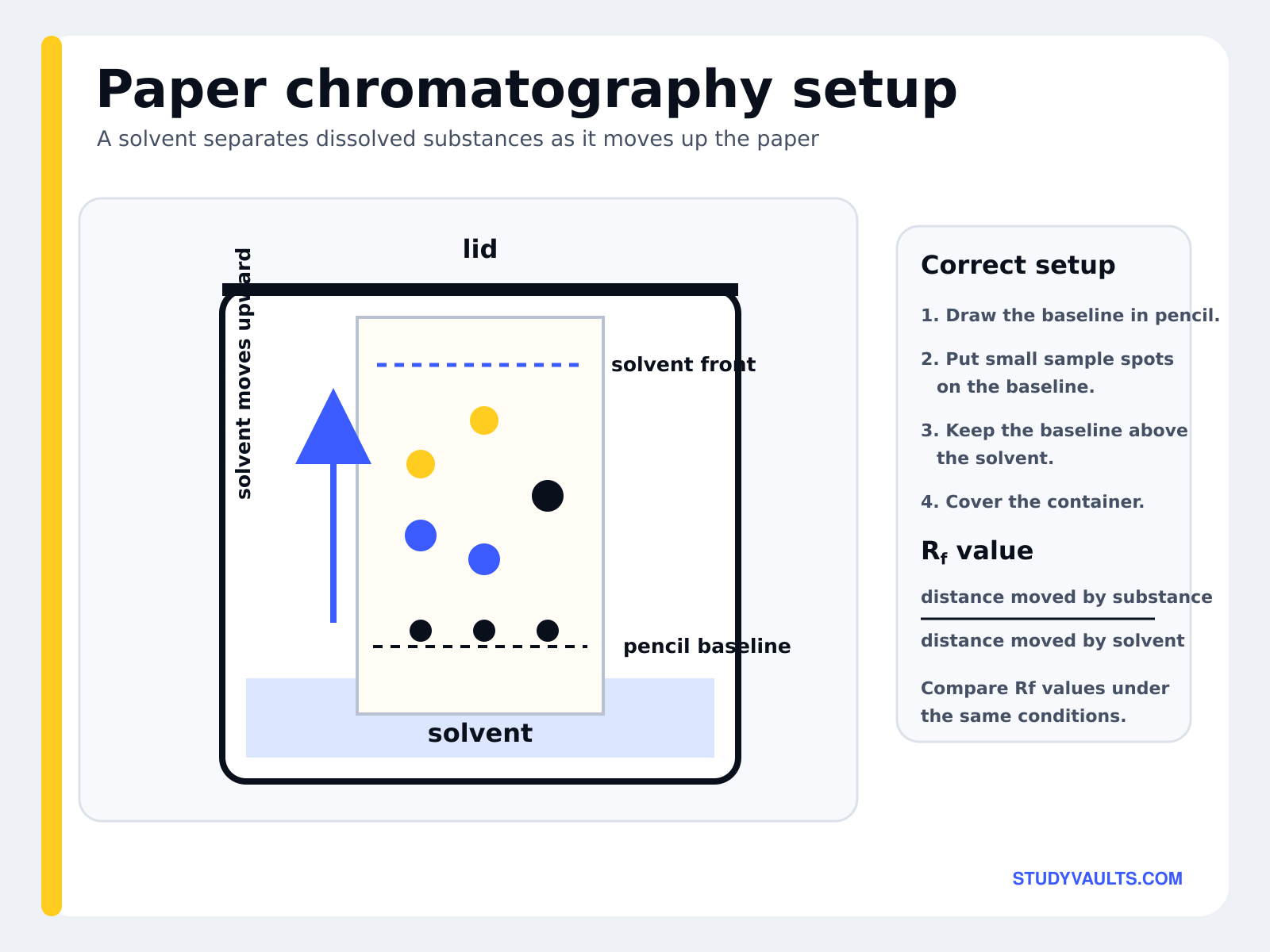
Chromatography is used to separate soluble inks and smaller molecules (e.g. amino acids).
Rf value equation:
Rf = Distance travelled by substance / Distance travelled by solvent
Rf value < 1
- If chromatography is used to separate colourless substances, a locating agent is required to identify where the substance has travelled to
Separation and purification
Methods:
- Filtration
- Crystallisation
- Simple distillation
- Fractional distillation
Distillation is a separation technique that takes advantage of the different boiling points of substances.
If the wanted substance is insoluble
- Filter
- Wash the residue
- Dry the residue in an oven
If the wanted substance is soluble
- Filter
- Crystallise the filtrate
Separation of 2 liquids
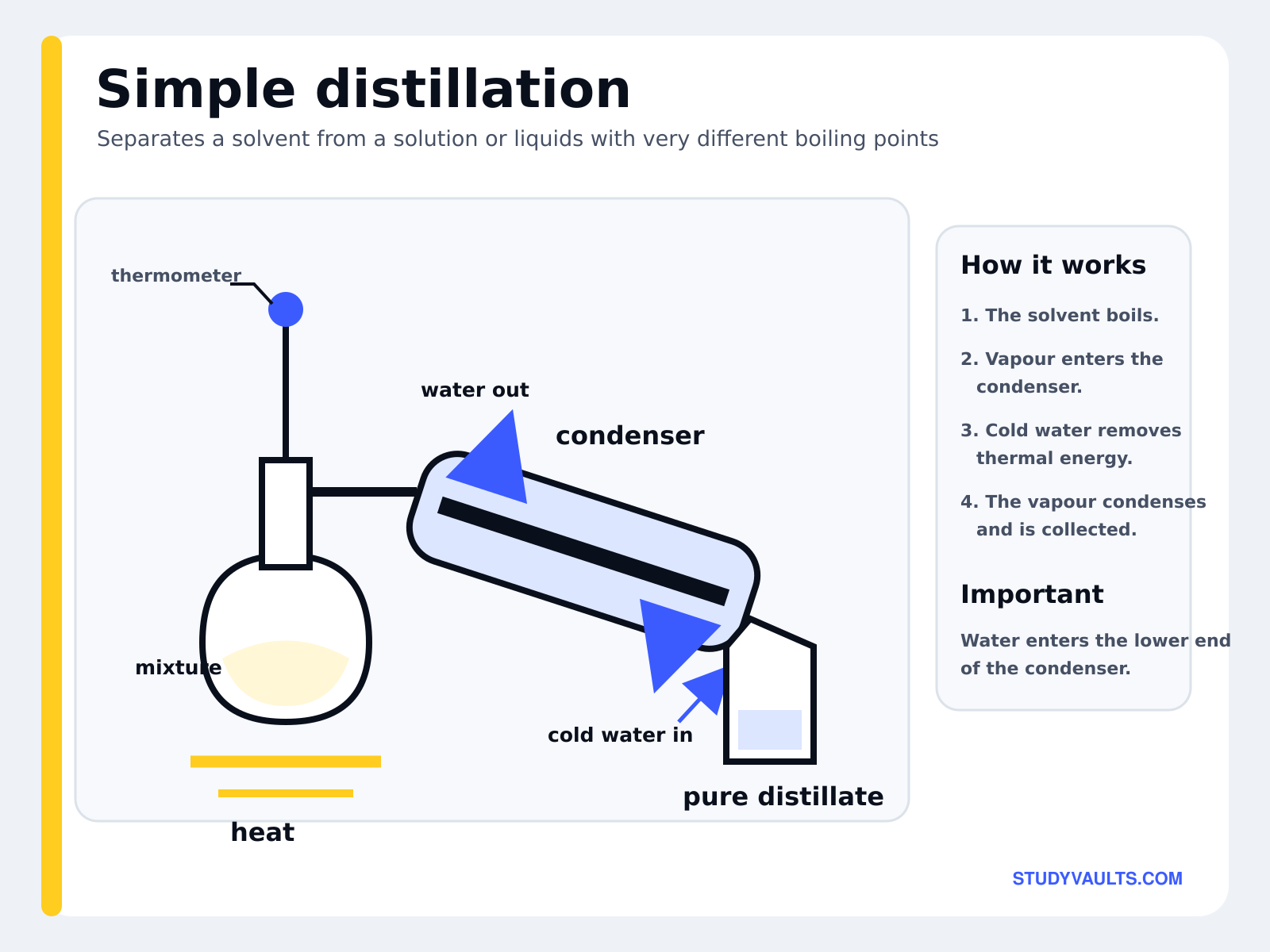
- Simple distillation
Separation of liquids with similar boiling points
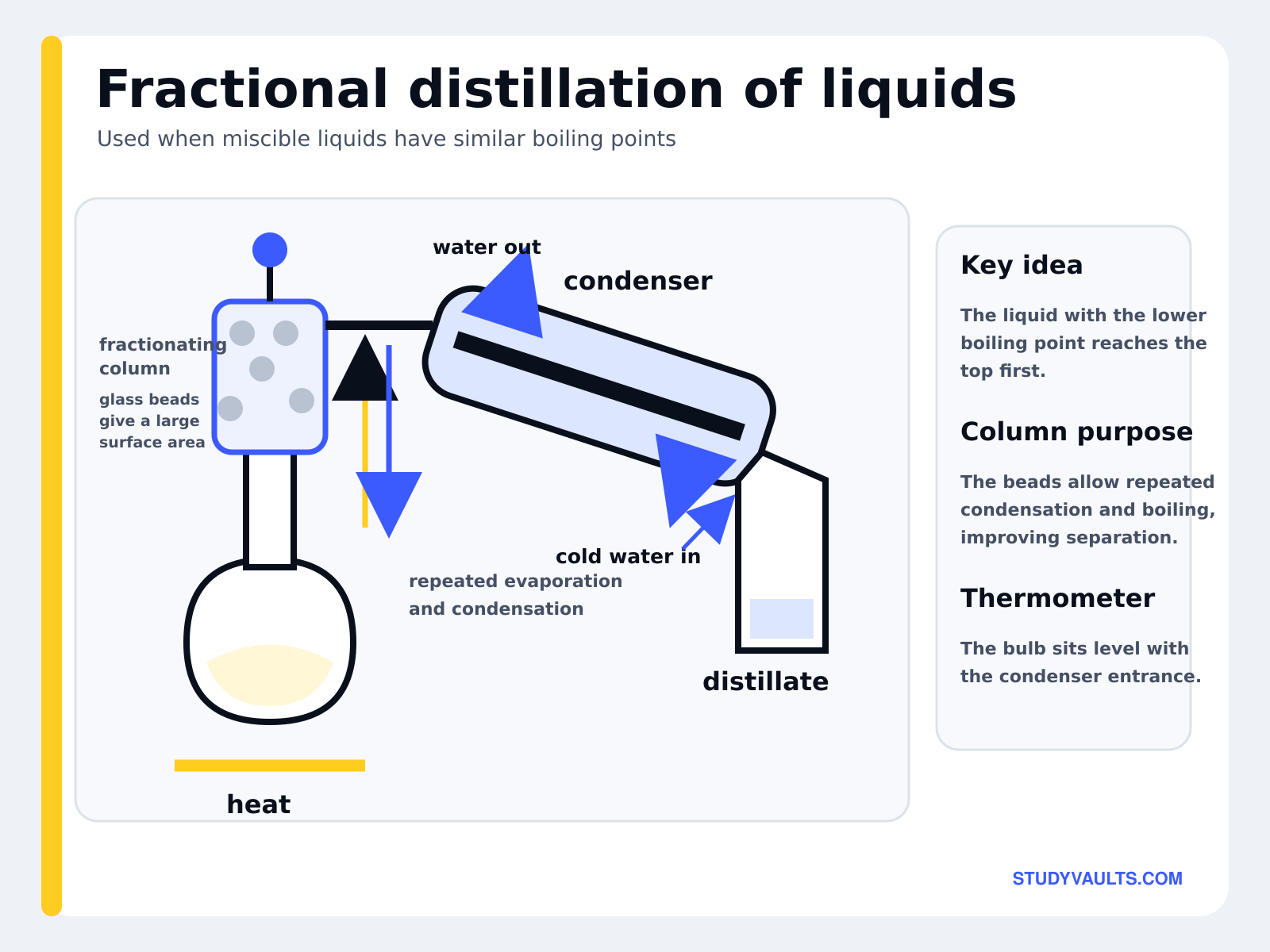
- Fractional distillation
- Uses a fractionating column to separate the liquids
Identification of ions and gases
Anion tests
| Anion | Test | Result |
|---|---|---|
| Carbonate | React with dilute acid then test for carbon dioxide using limewater | Bubbling and limewater turns cloudy/milky |
| Chloride | Acidify with dilute nitric acid and add aqueous silver nitrate | White precipitate forms |
| Bromide | Acidify with dilute nitric acid and add aqueous silver nitrate | Cream precipitate forms |
| Iodide | Acidify with dilute nitric acid and add aqueous silver nitrate | Yellow precipitate forms |
| Nitrate | Add aqueous sodium hydroxide and then aluminium foil. Warm the mixture. | Bubbling, gas produced that turns damp red litmus paper blue (ammonia) |
| Sulfate | Acidify with dilute nitric acid and add aqueous barium nitrate | White precipitate formed |
| Sulfite | Add acidified aqueous potassium manganate(VII) | The potassium manganate(VII) changes from purple to colourless |
Cation tests
| Cation | Aqueous sodium hydroxide | Aqueous ammonia |
|---|---|---|
| Aluminium | White precipitate formed, soluble in excess forming a colourless solution | White precipitate formed, insoluble in excess |
| Ammonium | On warming, a gas is produced that turns damp red litmus paper blue (ammonia) | No reaction |
| Calcium | White precipitate formed, insoluble in excess | No precipitate / very little white precipitate |
| Chromium(III) | Green precipitate formed, soluble in excess | Green precipitate, insoluble in excess |
| Copper(II) | Light blue precipitate formed, insoluble in excess | Light blue precipitate, soluble in excess forming a dark blue solution |
| Iron(II) | Green precipitate formed, insoluble in excess | Green precipitate formed, insoluble in excess |
| Iron(III) | Red-brown precipitate formed, insoluble in excess | Red-brown precipitate formed, insoluble in excess |
| Zinc | White precipitate formed, soluble in excess forming a colourless solution | White precipitate formed, soluble in excess forming a colourless solution |
Test for gases
| Gas | Test | Result |
|---|---|---|
| Ammonia | Damp red litmus paper | Turns blue |
| Carbon dioxide | Limewater | Turns milky |
| Chlorine | Damp litmus paper | Bleaches |
| Hydrogen | Lighted splint | Goes off with a squeaky pop |
| Oxygen | Glowing splint | Relights |
| Sulphur dioxide | Bubble through acidified potassium manganate(VII) | Changes from purple to colourless |
Flame test to identify cations
Using a nichrome wire loop, dip it into some HCl and hold it to the flame, this cleans the loop. Dip the loop into the cation sample and hold it to a blue flame. Observe the colour changes.
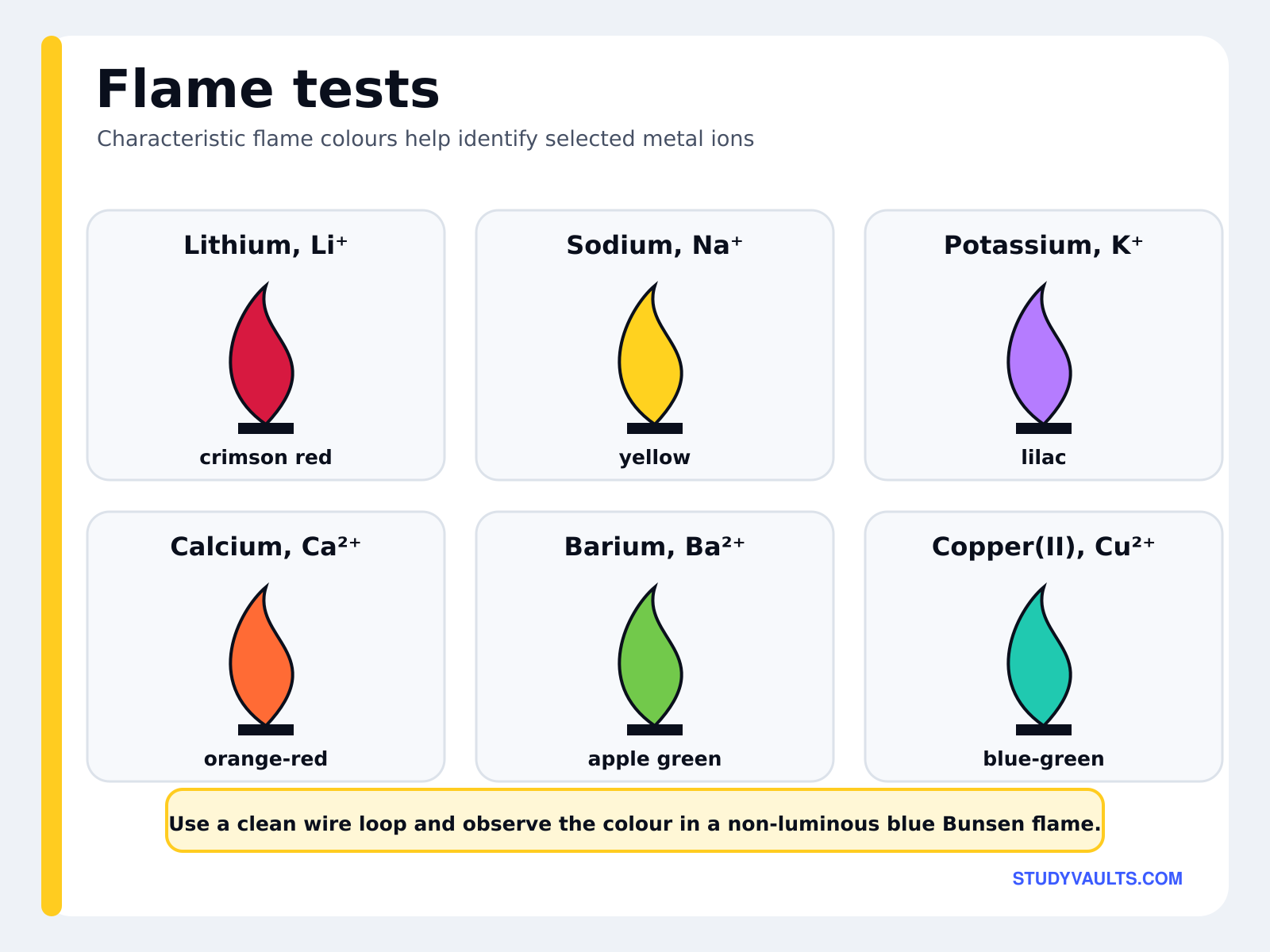
| Cation | Flame colour |
|---|---|
| Lithium | Red flame |
| Sodium | Yellow flame |
| Potassium | Lilac flame |
| Calcium | Orange-red flame |
| Barium | Yellow-green flame |
| Copper | Blue-green flame |