Formulae, functional groups and terminology
Key definitions
- Saturated compound — a compound where all carbon-carbon bonds are single.
- Unsaturated compound — a compound where at least one carbon-carbon bond is not single (alkenes).
- Functional group — an atom or group of atoms that determine the chemical properties of a homologous series.
- Homologous series — a family of similar compounds with the same chemical properties due to the same functional group.
- Condensed formula — the formula that shows the way a molecule's atoms are arranged.
- Displayed formula — the drawn out structure of the molecule and its arranged atoms.
Members of the same homologous series
Members of the same homologous series have:
- Same chemical properties
- Trend in physical properties
- Same functional group
- Same general formula
- Differ from one member to another by one -CH2- unit
Homologous series studied:
- Alkanes
- Alkenes
- Alcohols
- Carboxylic acids
General formulae and functional groups
| Homologous series | General formula | Functional group |
|---|---|---|
| Alkane | CnH2n+2 | C-C |
| Alkene | CnH2n | C double bond C |
| Alcohol | CnH2n+1OH | OH |
| Carboxylic acid | CnH2n+1COOH | COOH |
E.g.
- An alkane with 2 carbon's formula is C2H6 (ethane).
- An alcohol with 4 carbon's formula is C4H9OH (butanol).
Naming organic compounds
| Number of carbons | Prefix |
|---|---|
| 1 | meth- |
| 2 | eth- |
| 3 | prop- |
| 4 | but- |
| Homologous series | Suffix |
|---|---|
| Alkane | -ane |
| Alkene | -ene |
| Alcohol | -ol |
| Carboxylic acid | -oic acid |
E.g.
- An alkene with 3 carbons = propene
- A carboxylic acid with 2 carbons = ethanoic acid
Notes on numbering in displayed formulas:
- Alkenes — the number represents the location of the double carbon bond.
- Alcohols — the number represents the location of the -OH bond.
Structural isomers — compounds with the same molecular formula but different structural formula.
Fuels
- Hydrocarbons — compounds that contain hydrogen and carbon ONLY.
- Petroleum — a mixture of hydrocarbons.
- Fossil fuels — coal, natural gas and petroleum.
- Methane is mainly made out of natural gas.
Petroleum can be separated into different products with different uses. This is done using fractional distillation. The different length of hydrocarbons can be separated via boiling points.
Fractions from top (shortest chains) to bottom of column
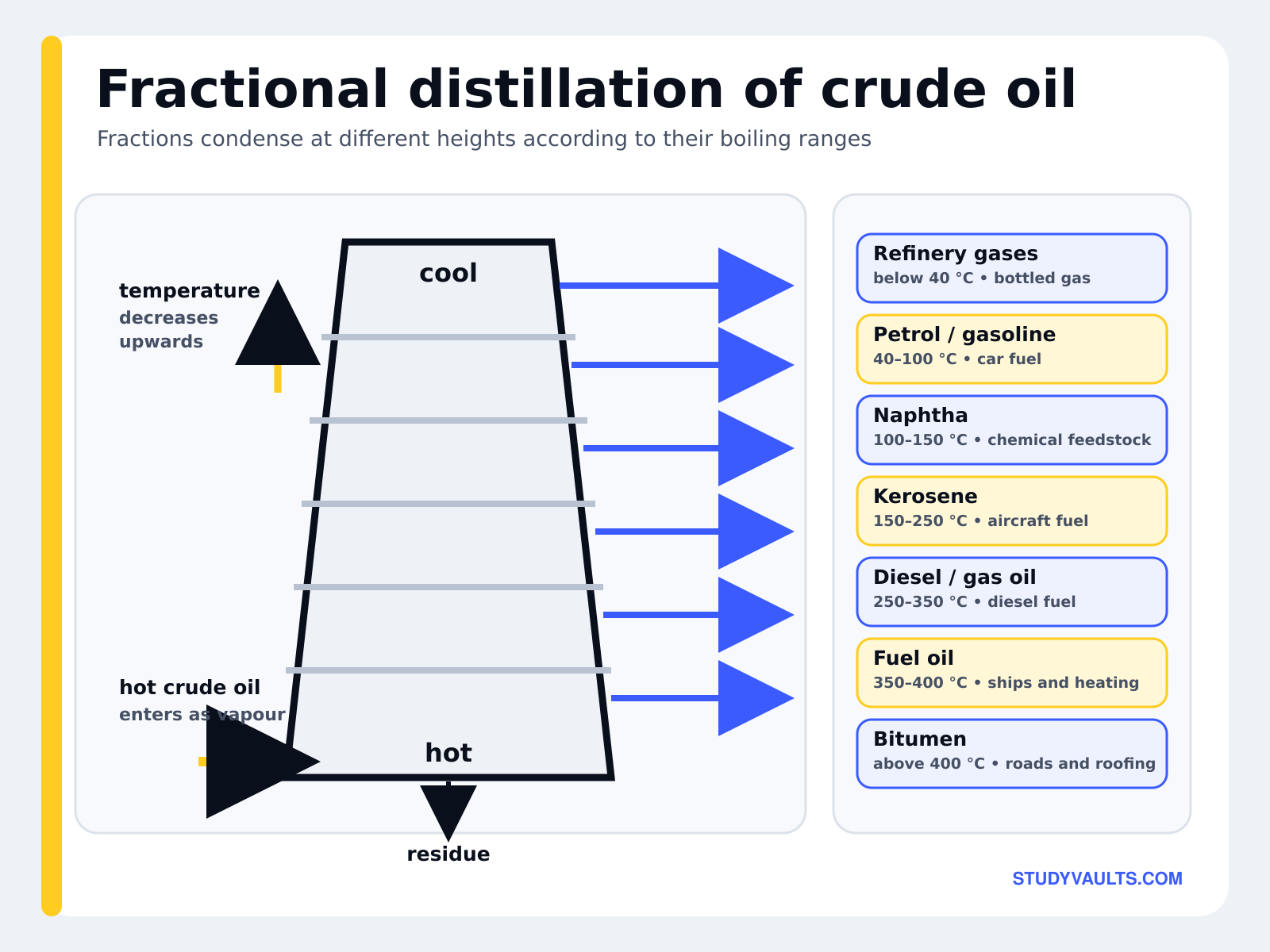
| Fraction | Use |
|---|---|
| Refinery gas (shortest) | Heating and cooking |
| Petrol | Car fuel |
| Naphtha | Chemical feedstock |
| Kerosene | Jet fuel |
| Diesel | Diesel engine fuels |
| Fuel oil | Fuel in ships and home heating |
| Lubricating oil | Waxes, lubricants and polishes |
| Bitumen | Making roads (asphalt) |
The higher up the fractionating column the:
- Shorter the chain length
- Higher the volatility (because of shorter chains)
- Lower boiling point
- Lower the viscosity
Shorter hydrocarbons are more valued because they burn much easier (volatile) and are thus more clean and efficient to use.
Alkanes
General formula: CnH2n+2
- They are saturated hydrocarbons (single C-C bonds).
Reactions of alkanes
Generally unreactive except:
- Combustion, AND/OR
- Substitution by chlorine (photochemical reaction, UV light needed to provide activation energy).
Substitution — where an atom is replaced by another atom.
Substitution by chlorine in methane.
Alkenes
General formula: CnH2n
- They are unsaturated hydrocarbons.
How are they formed?
- Cracking — taking a long chain alkane and heating it to form the products of:
- An alkene and hydrogen, OR
- An alkene and an alkane
Reactions of alkenes
- Test for unsaturated hydrocarbons (alkenes): add bromine water (turns orange brown to colourless).
- Addition reaction: adding on new atoms to the molecule. The double bond is broken to free up bonds for the addition, and an element is added.
- The addition of hydrogen turns an alkene back to an alkane (this requires a NICKEL catalyst).
- The addition of oxygen and hydrogen (steam) turns an alkene to an alcohol (this requires a PHOSPHORIC ACID catalyst).
Examples: using ethene.
Alcohols
General formula: CnH2n+1OH
How are they formed?
- Addition reaction of alkenes with steam (catalytic addition; a large scale process).
- Fermentation of aqueous glucose.
Fermentation vs catalytic addition of steam to ethene
| Feature | Fermentation | Catalytic addition of steam to ethene |
|---|---|---|
| Conditions | 25-35 degrees celsius; yeast; anaerobic respiration (no oxygen) | 300 degrees celsius; 60 atm (6000 kPa); phosphoric acid catalyst |
| Process type | Batch process | Continuous process |
| Reactants | Renewable | Not renewable (requires ethene, sourced from petroleum) |
| Energy | Does not require a lot of energy | Expensive |
| Speed | Slow process | — |
| Product purity | Alcohol produced is not pure and must be separated | Alcohol produced is pure |
Reactions of alcohols
- Combustion
Uses of ethanol
- As a solvent
- As a biofuel
Carboxylic acids
General formula: CnH2n+1COOH
How are they formed?
- Oxidising an alcohol with an oxidising agent (e.g. Potassium manganate(VII)).
- Bacterial oxidation of an alcohol in the production of vinegar.
Reactions of carboxylic acids
- Reacts like a normal acid (weak acid; pH 4-6):
Metal + acid -> salt + hydrogen
Metal Oxide + acid -> salt + water (neutralisation)
Metal carbonates + acid -> salt + water + carbon dioxide
Metal hydroxide + acid -> salt + water (neutralisation)
- Reacts with alcohol using sulfuric acid to form an ester.
- Esters are sweet smelling liquids often used in flavourings and perfumes.
Naming an ester
__yl __ate
(name of alcohol)yl (name of carboxylic acid)ate
E.g.
- Methanol + Propanoic acid -> Methyl propanoate
- Propanol + Ethanoic acid -> Propyl ethanoate
Polymers
Polymers are large molecules formed by the joining of many monomers.
E.g. the monomer propene turns into the polymer polypropene.
There are 2 methods of forming polymers:
- Addition polymerisation — only for alkenes. Monomer -> repeating unit -> polymer.
- Condensation polymerisation — Monomer -> repeating unit -> polymer.
Condensation polymerisation products
There are 2 products of this polymerisation:
- Polyesters — made with diols and dicarboxylic acids.
- Polyamides — made with diamines and dicarboxylic acids.
Polyamide:
- Have amide linkages.
- A synthetic polyamide includes Nylon.
- A natural polyamide includes Proteins, made of the monomer amino acids.
Polyesters:
- Have ester linkages.
- A synthetic polyester includes PET (terylene).
Difference between condensation and addition polymerisation
- Addition polymerisation involves one monomer repeated, and only the polymer forms (one product).
- Condensation involves multiple monomers repeated, a small molecule is removed as a byproduct (usually water, so more than one product).
Plastics
- Made from polymers.
Implications for their disposal:
- Accumulation in landfills — takes a long time to biodegrade, smelly.
- Combustion of plastics — releases toxic gases.
- Water pollution — kills aquatic life and releases toxins.