Solids, liquids and gases
| Solids | Liquids | Gases |
|---|---|---|
| Fixed shape | Takes shape of container | No fixed shape |
| Fixed volume | Fixed volume | No fixed volume |
| Cannot flow | Can flow | Can flow |
| Cannot compress | Hard to compress | Can compress |
| Arranged so particles are tightly packed in lattice | Arranged so particles are touching | Free, spread out particles |
| Particles vibrate in place | Particles slide over each other | Move around quickly and randomly |
Changes of state
- Melting — Solid -> Liquid
- Boiling — Liquid -> Gas
- Evaporating — Liquid -> Gas
- Condensing — Gas -> Liquid
- Freezing — Liquid -> Solid
Evaporation vs boiling
| Evaporation | Boiling |
|---|---|
| Surface level | Happens throughout liquid |
| Does not happen at a fixed temperature | Happens at a fixed temperature (boiling point) |
| Bubbles not produced | Bubbles produced |
| Remaining liquid is cooled | Remaining liquid boils at one temp |
Kinetic particle theory
When a substance is changing it can either:
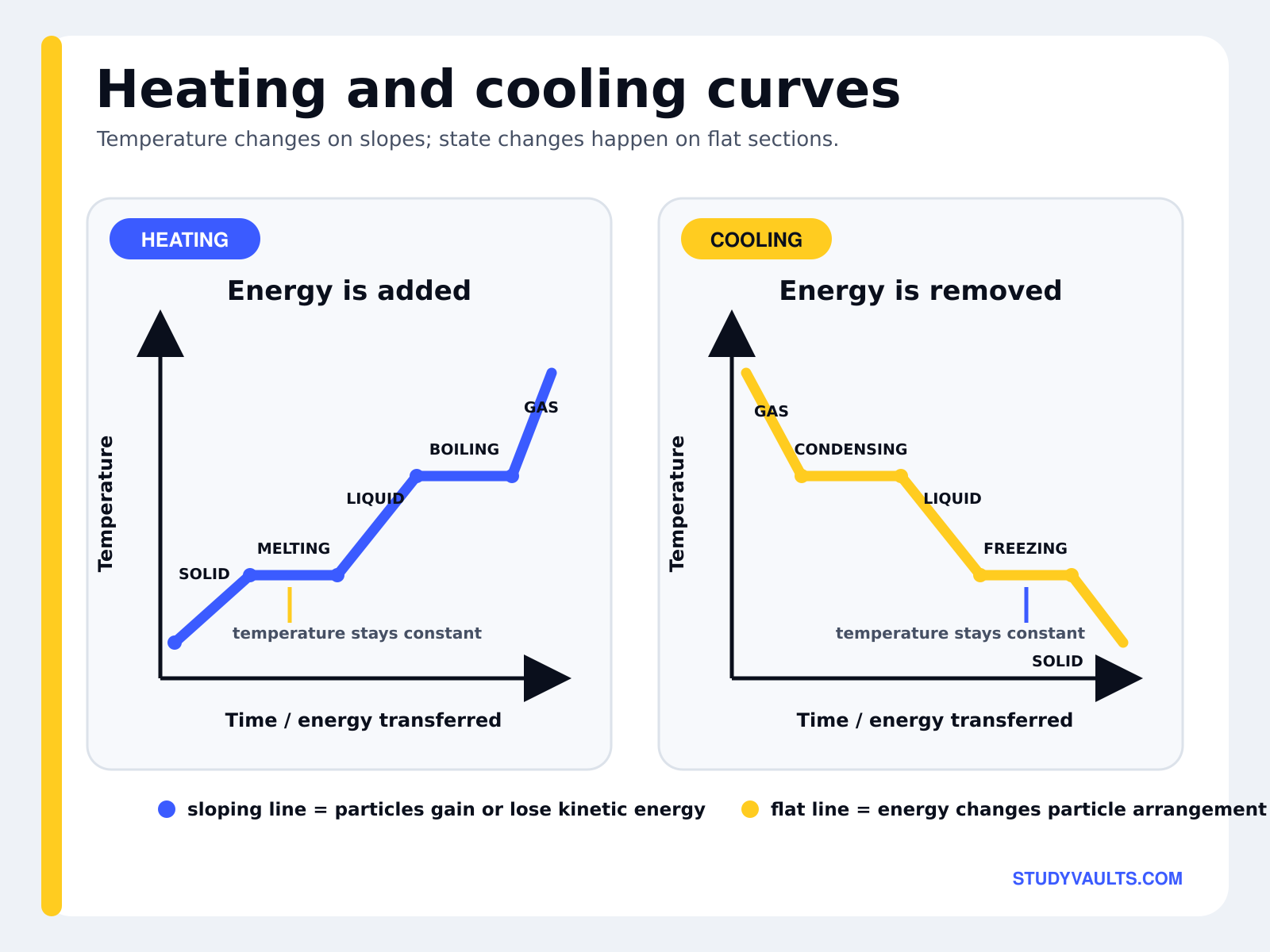
- Gain kinetic energy from heat, which causes the particles to vibrate more vigorously. They then gain enough energy to break free of their bonds. E.g. Liquid -> Gas
- Lose energy to their surroundings. The particles move closer to each other, moving less vigorously. E.g. Gas -> Liquid
Factors affecting changing states
- Temperature — Increases kinetic energy of particles, particles move more rapidly.
- Pressure — Pushes particles closer to each other. Can change the state of matter if decreased or increased sufficiently (e.g. if a gas is under very high pressures, the particles can be pushed together so densely that a liquid is formed.)
Cooling curve
Heating curve
Diffusion
The net movement of particles from an area of high concentration to an area of low concentration down a concentration gradient as a result of random particle movement.
Factors affecting the rate of diffusion
- Relative molecular mass — The heavier the molecular mass, the slower the diffusion.
- Temperature — The higher the temperature, the faster the diffusion, as particles have more energy and move quicker.