Arrangement of elements
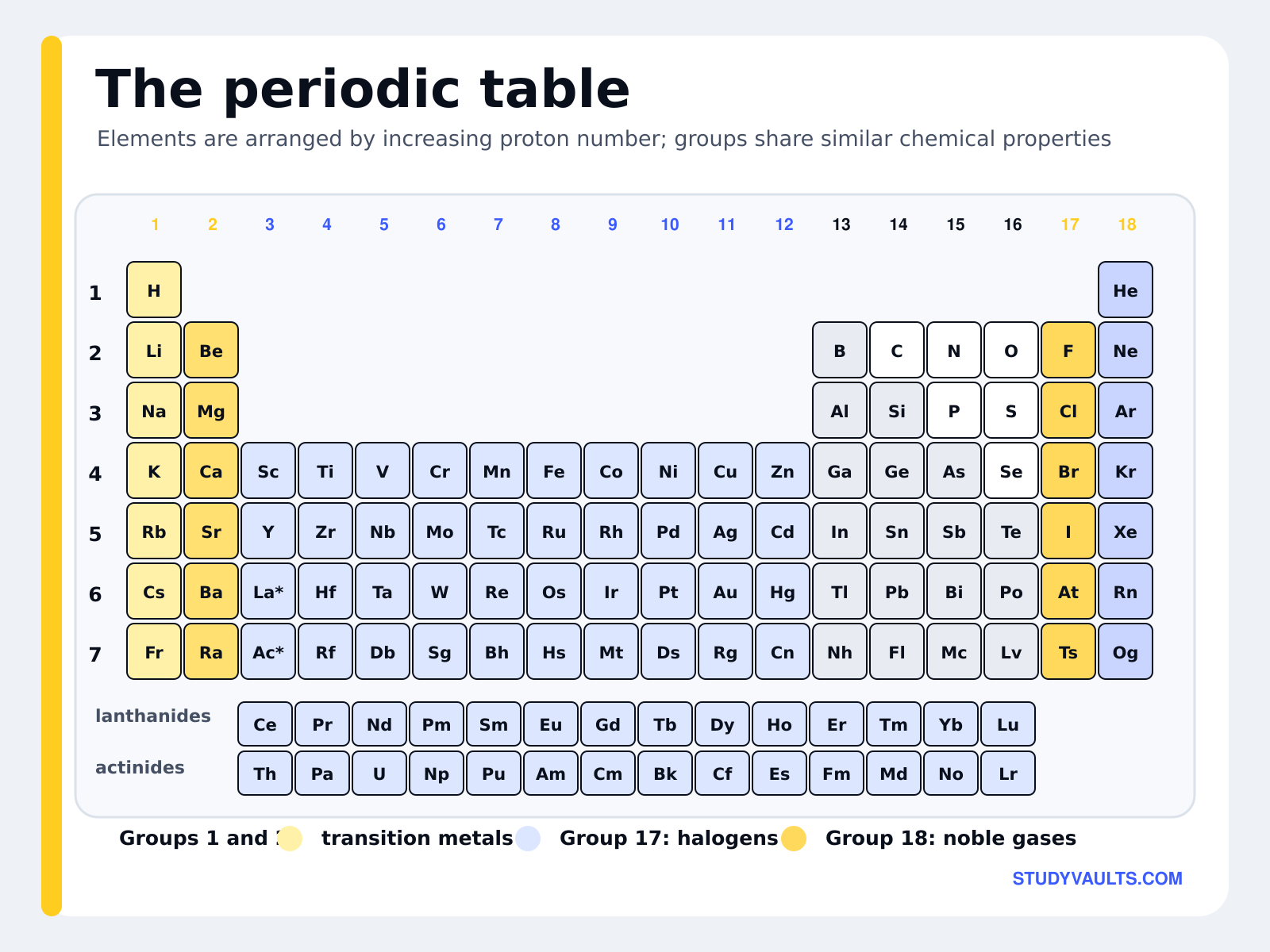
The elements in the periodic table are arranged in order of increasing proton number.
- Metals are found to the left of the periodic table.
- Non-metals are found to the right of the periodic table.
- Members of the same group have the same electron valency.
- Elements of the same group have the same chemical properties (due to same electron valency).
- The group number of an element also determines its ionic charge, e.g. Group 2 has charge +2.
- The period of a group represents the number of shells an element occupies.
Group I properties
- They are soft metals that can be cut with a knife.
- They are known as alkali metals.
- They react with water to form an alkali solution.
As you go down the group:
- Melting point decreases
- Density increases
- Reactivity increases
Group VII properties
- They exist as diatomic molecules, e.g. Br2, Cl2.
- They are known as halogens.
- More reactive halogens can displace less reactive halogens in a reaction.
As you go down the group:
- Density increases
- Reactivity decreases
Appearance of halogens
The colour gets darker down the group.
| Halogen | Appearance |
|---|---|
| Chlorine | Pale yellow-green gas |
| Bromine | Red-brown liquid |
| Iodine | Grey-black solid |
Displacement chart of halogens
More reactive halogens can displace less reactive halogens in a reaction.
| Halogen added | Potassium chloride | Potassium bromide | Potassium iodide |
|---|---|---|---|
| Chlorine | x | Potassium chloride and Bromine produced | Potassium chloride and Iodine produced |
| Bromine | No reaction | x | Potassium bromide and Iodine produced |
| Iodine | No reaction | No reaction | x |
Transition elements
Found around the middle of the periodic table.
Properties:
- High density
- High melting and boiling point
- Form coloured compounds
- They act as catalysts
- Their ions have variable oxidation states, e.g. Iron(II) and Iron(III)
Noble gases (Group VIII)
- Noble gases have full electron shells so they are inert (they do not react) and stable.
- They exist as monatomic gases, e.g. Ar, He.