Demand
Meaning of demand
- Demand - the quantity that a consumer is willing and able to buy at a given price at a given time.
- Individual demand - the demand of one consumer for a product.
- Market demand - the total demand of all consumers in a market. It is found by adding individual quantities demanded at each price.
From individual to market demand
| Price ($) | Buyer A | Buyer B | Market demand |
|---|---|---|---|
| 10 | 5 | 4 | 9 |
| 20 | 3 | 2 | 5 |
| 30 | 1 | 1 | 2 |
Example.
The demand curve
Demand curve - Line showing the relationship between the price and quantity demanded for a good, all other factors unchanged (ceteris paribus).
- Extension of demand - a rise in quantity demanded caused by a fall in the product's price. It is a movement down the demand curve.
- Contraction of demand - a fall in quantity demanded caused by a rise in the product's price. It is a movement up the demand curve.
A demand curve normally slopes downwards: as price falls, quantity demanded rises. A lower price makes the product affordable to more consumers and encourages existing consumers to buy more.
Demand shifts
- Increase in demand - buyers want more at every price, so the whole demand curve shifts right.
- Decrease in demand - buyers want less at every price, so the whole demand curve shifts left.
- Substitute - a product that can be used instead of another product, such as tea instead of coffee.
- Complement - a product used together with another product, such as games consoles and video games.
- Normal good - a product for which demand rises when consumer income rises, and falls when consumer income falls.
| Cause | Demand increases (shift right) when... | Demand decreases (shift left) when... |
|---|---|---|
| Income | income rises for normal products | income falls for normal products |
| A substitute's price | The substitute good becomes more expensive; if the goods are similar, a consumer will demand the cheaper alternative. | the substitute good becomes cheaper |
| A complement's price | the complement becomes cheaper | the complement becomes more expensive |
| Tastes / advertising | the product becomes more fashionable or well promoted | it becomes less fashionable or receives bad publicity |
| Population | the number of potential buyers rises | the number of potential buyers falls |
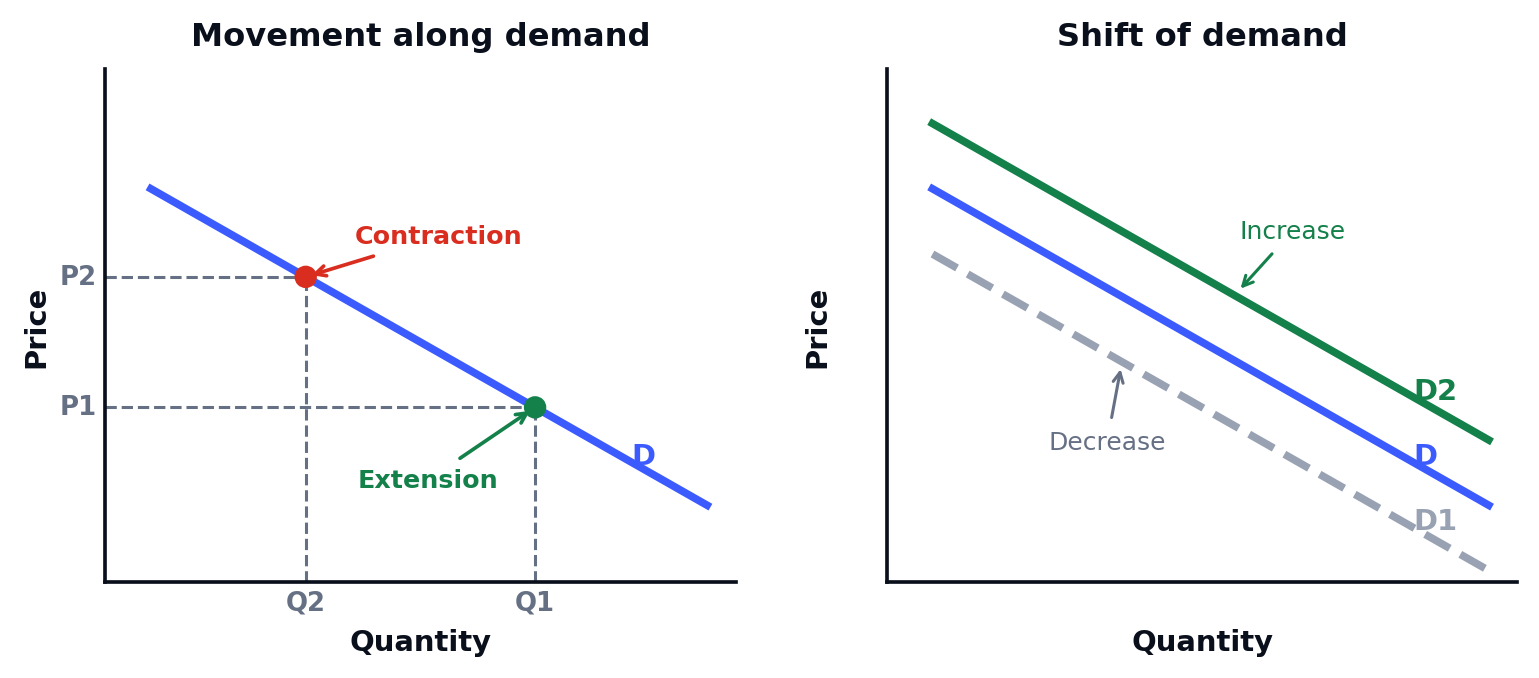
Figure 2.1: A price change causes movement along D; another influence causes D itself to shift.
Exam distinction: Own price changes quantity demanded and causes movement along D. Any other cause changes demand and shifts D.