Firms
Types of firms by economic sector
- Firm - an organisation that combines factors of production to produce goods or services.
- Primary sector - firms that extract or harvest natural resources, such as farming, fishing, forestry and mining.
- Secondary sector - firms that manufacture or construct products by transforming raw materials.
- Tertiary sector - firms that provide services, such as transport, retail, banking, healthcare and education.
The sectors are connected. A fishing firm supplies a food-processing factory, which supplies a supermarket. Economies often experience a changing sector balance as income, technology and trade patterns develop.
Types of firms by ownership
- Private-sector firm - a firm owned and controlled by private individuals or organisations.
- Public-sector firm - a firm or organisation owned and controlled by the government.
| Private sector | Public sector |
|---|---|
| Aims to earn profit, survive or grow | Prioritises access, social welfare, strategic control or service quality |
| Owners provide capital and bear financial risk | Government and ultimately taxpayers finance ownership and losses |
| Competition and consumer demand strongly influence decisions | Political decisions and public-service obligations may influence decisions |
| Can respond quickly but may avoid unprofitable g/s | Can maintain essential services but may face weaker pressure to reduce cost |
Small and large firms
- Size of a firm - the scale of a business, which may be measured using employment, output, sales revenue, capital employed or market share.
- Market share - a firm's sales as a percentage of total sales in its market.
No single size measure is perfect. A highly automated factory may employ few workers but produce huge output, while a labour-intensive service may employ many people but own little machinery.
| Small firms: possible advantages | Small firms: possible disadvantages |
|---|---|
| Close personal contact with customers and workers | Limited finance and weaker bargaining power with suppliers |
| Fast decisions and flexibility | May have higher average costs and little advertising |
| Can serve specialised or local markets | Greater risk from one owner, customer or product |
| Owners keep control and may be highly motivated | Fewer specialist managers and limited promotion opportunities |
| Large firms: possible advantages | Large firms: possible disadvantages |
|---|---|
| Can gain economies of scale and access more finance | Complex communication and slower decisions |
| Can employ specialist managers and fund research | Workers and customers may receive less personal attention |
| Can spread risk across products and markets | Market power may reduce competitive pressure |
| May offer stable jobs and training opportunities | Expansion can create diseconomies of scale |
Evaluation: The better size depends on the product and market. A local tailor may benefit from personal service, while aircraft production requires huge finance, specialist labour and large-scale equipment.
Mergers
- Merger - the joining of two or more firms to form one business. Growth through a merger is external growth.
- Horizontal merger - a merger between firms at the same stage of production in the same industry.
- Vertical merger - a merger between firms at different stages of the same production process.
- Backward vertical merger - a firm joins with a supplier at an earlier production stage.
- Forward vertical merger - a firm joins with a distributor or retailer at a later production stage.
- Conglomerate merger - a merger between firms producing unrelated products.
| Type | Simple example | Possible motive | Possible drawback |
|---|---|---|---|
| Horizontal | Two supermarket chains | Greater market share, lower duplicated costs and less competition | Less consumer choice and possible monopoly power |
| Backward vertical | A café chain and a coffee farm | More reliable supply and control over input quality or cost | Managing an unfamiliar production stage |
| Forward vertical | A manufacturer and a retailer | Secure distribution and keep the retailer's profit margin | May lose access to competing distribution channels |
| Conglomerate | A food producer and a software firm | Spread risk across unrelated markets | Managers may lack expertise and lose focus |
Mergers can produce economies of scale, new technology, wider markets and greater bargaining power. However, integration costs, culture clashes, duplicated jobs, diseconomies of scale and weaker competition may prevent the expected gains.
Economies and diseconomies of scale
- Economies of scale - reductions in average total cost caused by an increase in the scale of production.
- Diseconomies of scale - increases in average total cost caused by a firm becoming too large or complex.
- Internal economies of scale - cost advantages gained because the individual firm itself expands.
| Internal economy | How expansion can reduce average cost |
|---|---|
| Purchasing | Bulk buying may obtain discounts and lower delivery costs per unit. |
| Technical | Large, efficient machinery and specialised production methods spread high fixed costs over more output. |
| Managerial | Specialist managers improve decisions in finance, marketing, production and human resources. |
| Financial | Large firms may borrow at lower interest rates because lenders view them as less risky. |
| Marketing | One advertising campaign or distribution network can support a larger volume of sales. |
| Risk-bearing | Selling several products or in several markets reduces dependence on one source of revenue. |
- External economies of scale - reductions in a firm's average cost caused by growth of the whole industry rather than growth of the firm alone.
Industry growth may attract specialist suppliers, trained workers, improved transport, research facilities and supporting services. Every firm in the area may then gain lower costs or higher productivity.
Diseconomies
| Internal diseconomy | Why average cost may rise |
|---|---|
| Communication problems | Messages travel through more layers and may become slow or inaccurate. More mistakes incurs costs to output and efficiency. |
| Coordination and control | Managers find it harder to monitor many sites, workers and product lines. |
| Low motivation | Workers may feel unacknowledged and managers may not understand conditions. |
| Slow decisions | Extra rules and management layers reduce flexibility. |
External diseconomies arise when industry growth raises costs for all firms—for example, congestion, higher land prices, higher wages caused by competition for skilled labour, or pressure on local suppliers and infrastructure.
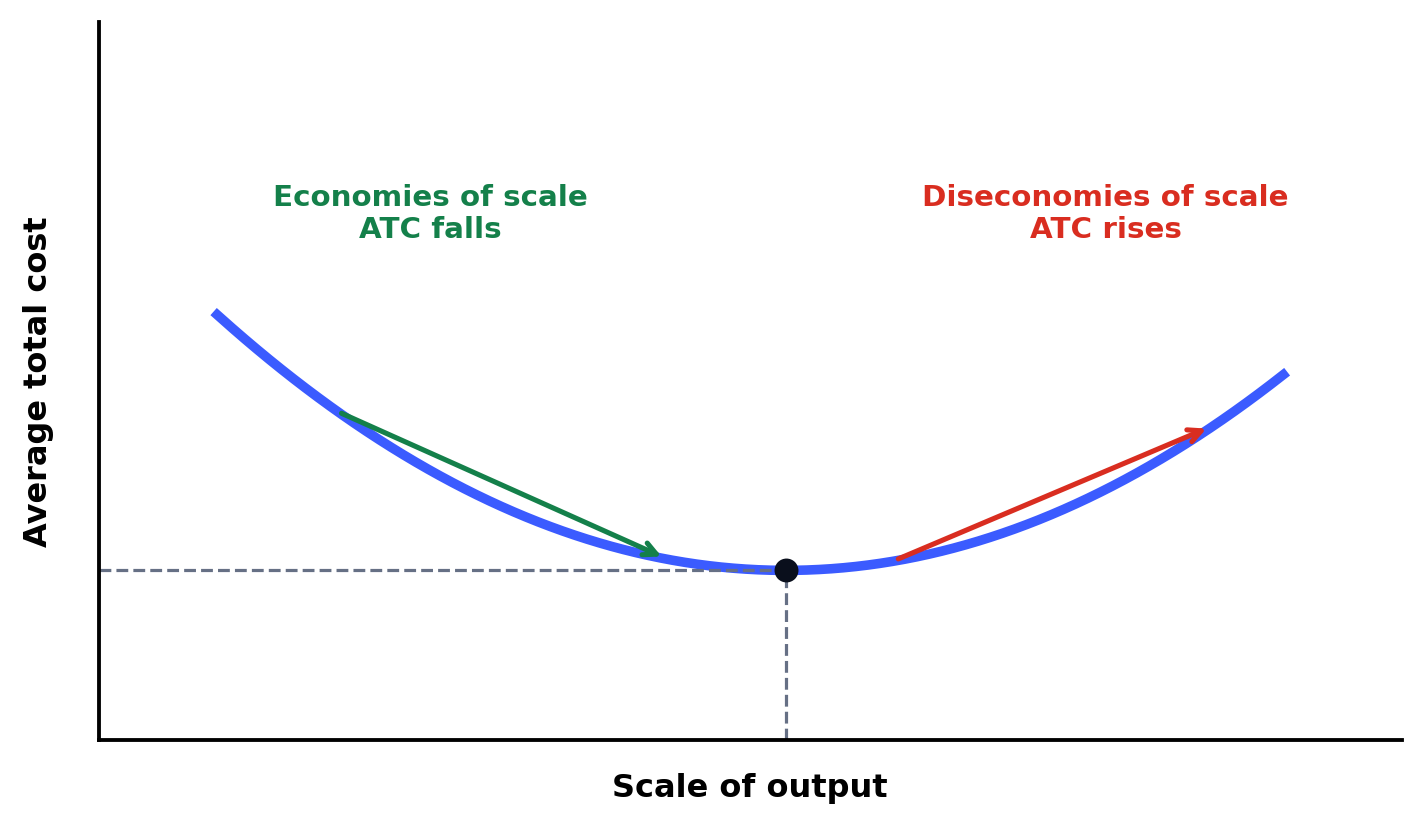
Figure 3.3: Economies of scale reduce ATC; diseconomies of scale raise ATC.