Price determination
The price mechanism
- Price mechanism - the way changes in market prices guide the decisions of buyers and sellers and therefore allocate resources.
Prices carry information and create incentives. Rising prices can signal relatively high demand or low supply, encouraging firms to direct more resources towards that market. Falling prices can signal relatively low demand or high supply, encouraging resources to move elsewhere.
| Basic question | How market prices help answer it |
|---|---|
| What to produce? | Products that buyers are willing and able to purchase can earn revenue and profit, so firms are encouraged to supply them. |
| How to produce? | Firms compare input prices and choose a production method that keeps costs competitive (the cheapest method). |
| Who receives output? | Goods usually go to consumers who are willing and able to pay the market price, rationing goods/services to those who can afford it. |
Equilibrium and disequilibrium
- Market equilibrium - the position where quantity demanded equals quantity supplied. There is no pressure for the price to change.
- Equilibrium price - the price at which quantity demanded equals quantity supplied.
- Equilibrium quantity - the quantity bought and sold at the equilibrium price.
- Disequilibrium - a market position where quantity demanded and quantity supplied are unequal.
- Shortage - excess demand: quantity demanded is greater than quantity supplied at the current price.
- Surplus - excess supply: quantity supplied is greater than quantity demanded at the current price.
| Price ($) | Quantity demanded | Quantity supplied | Market position |
|---|---|---|---|
| 10 | 100 | 20 | Shortage of 80 |
| 20 | 80 | 40 | Shortage of 40 |
| 30 | 60 | 60 | Equilibrium |
| 40 | 40 | 80 | Surplus of 40 |
| 50 | 20 | 100 | Surplus of 80 |
Below equilibrium, a shortage gives sellers an incentive to raise price. As price rises, demand contracts and supply extends until equality is restored. Above equilibrium, a surplus gives sellers an incentive to cut price. Demand extends and supply contracts until equality is restored.
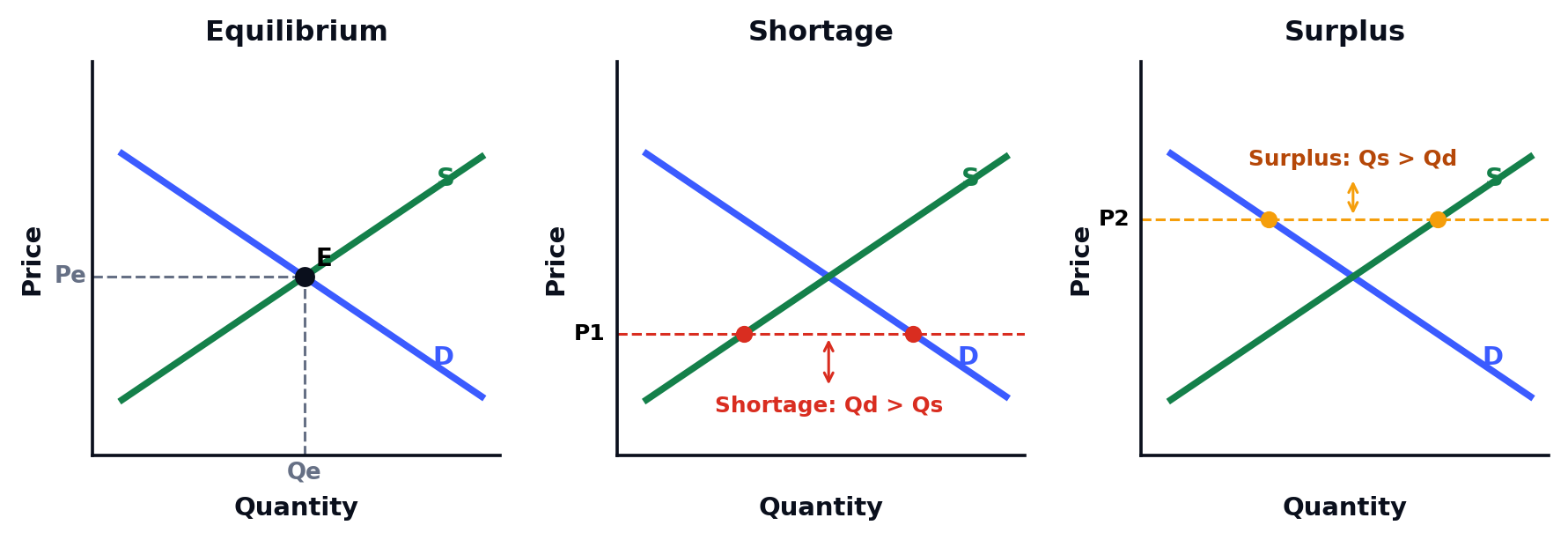
Figure 2.3: Equilibrium occurs at D = S; a price below it creates a shortage and a price above it creates a surplus.
Diagram method: Label Price and Quantity, draw and label D and S, mark their intersection E, then project dashed lines to Pe and Qe.