Price elasticity of demand (PED)
Meaning and calculation
- Price elasticity of demand - a measure of how responsive quantity demanded is to a change in price.
Formula: PED = percentage change in quantity demanded / percentage change in price
A calculated PED may carry a minus sign. Ignore this and focus on the magnitude, i.e. -1.5 PED can be seen as 1.5.
Worked example
Price rises from $10 to $12, while quantity demanded falls from 100 to 70 units.
- Price change: ($2 / $10) x 100 = 20%.
- Quantity change: (30 / 100) x 100 = 30%.
- PED: 30% / 20% = 1.5. Demand is elastic because 1.5 > 1.
Interpreting PED values
| PED magnitude | Classification | Meaning |
|---|---|---|
| 0 | Perfectly inelastic | Quantity demanded does not change when price changes. |
| More than 0 but less than 1 | Inelastic | Quantity demanded changes by a smaller percentage than price. |
| 1 | Unitary | Quantity demanded changes by the same percentage as price. |
| More than 1 | Elastic | Quantity demanded changes by a larger percentage than price. |
| Infinite | Perfectly elastic | Any price rise causes quantity demanded to fall to zero. |
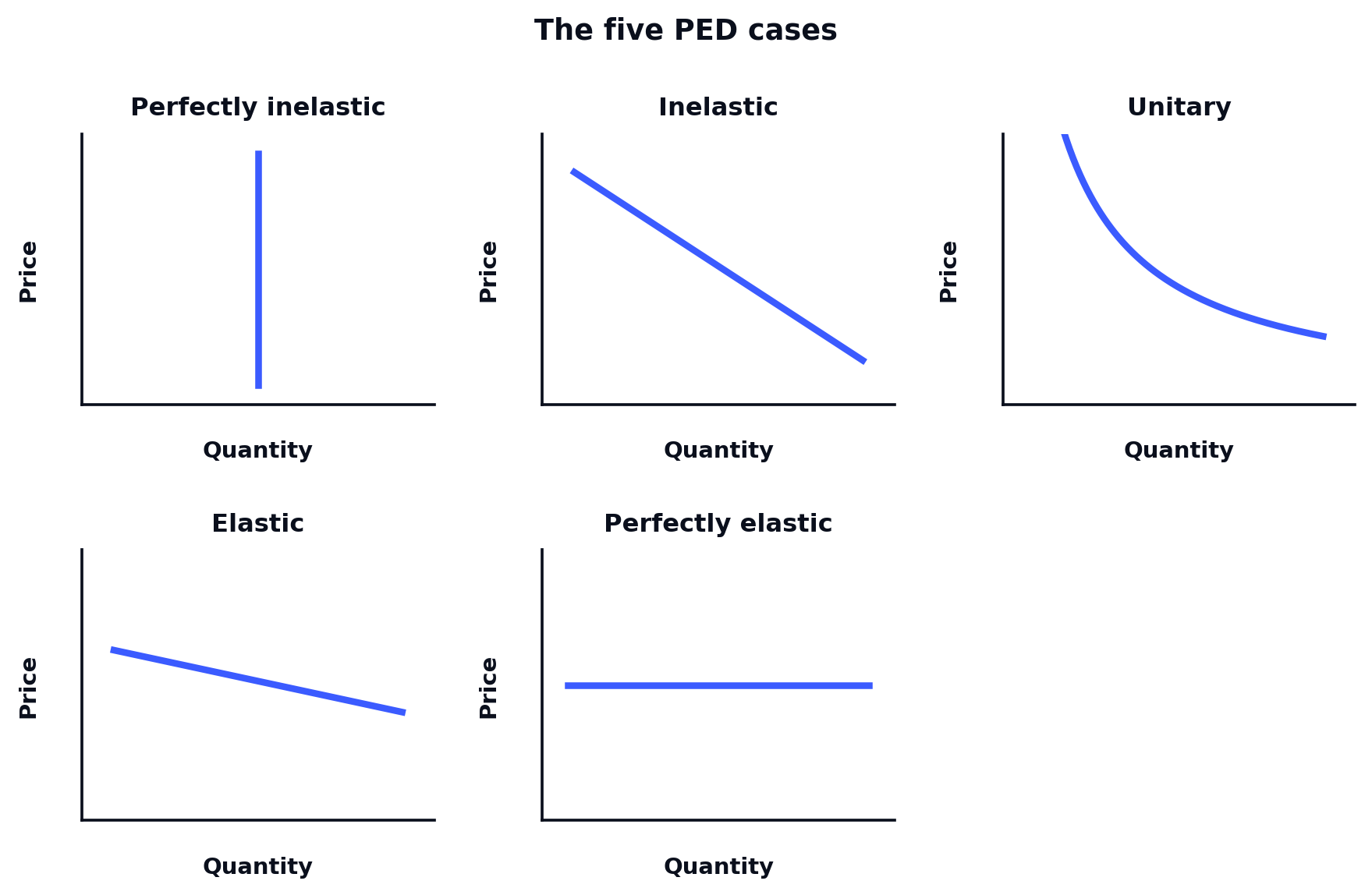
Figure 2.5: The five PED cases. Steeper and flatter curves are only safe comparisons when the axes use the same scales.
Important: A curve's appearance alone does not give an exact PED value. Use percentage changes when figures are provided.
What determines PED?
| Influence | Demand tends to be more elastic when... | Reason |
|---|---|---|
| Substitutes | many close substitutes are available | buyers can switch easily after a price rise |
| Necessity or luxury | the product is a luxury | buyers can postpone or avoid the purchase |
| Share of income | the product takes a large share of income | a price change has a noticeable effect on income budgets |
| Time | consumers have more time to adjust | they can find alternatives or change habits |
| Habit / addiction | consumption is not strongly habitual | buyers are more willing to reduce purchases |
| Market definition | the product is narrowly defined | a particular brand has more substitutes than the whole product category |
PED, expenditure and revenue
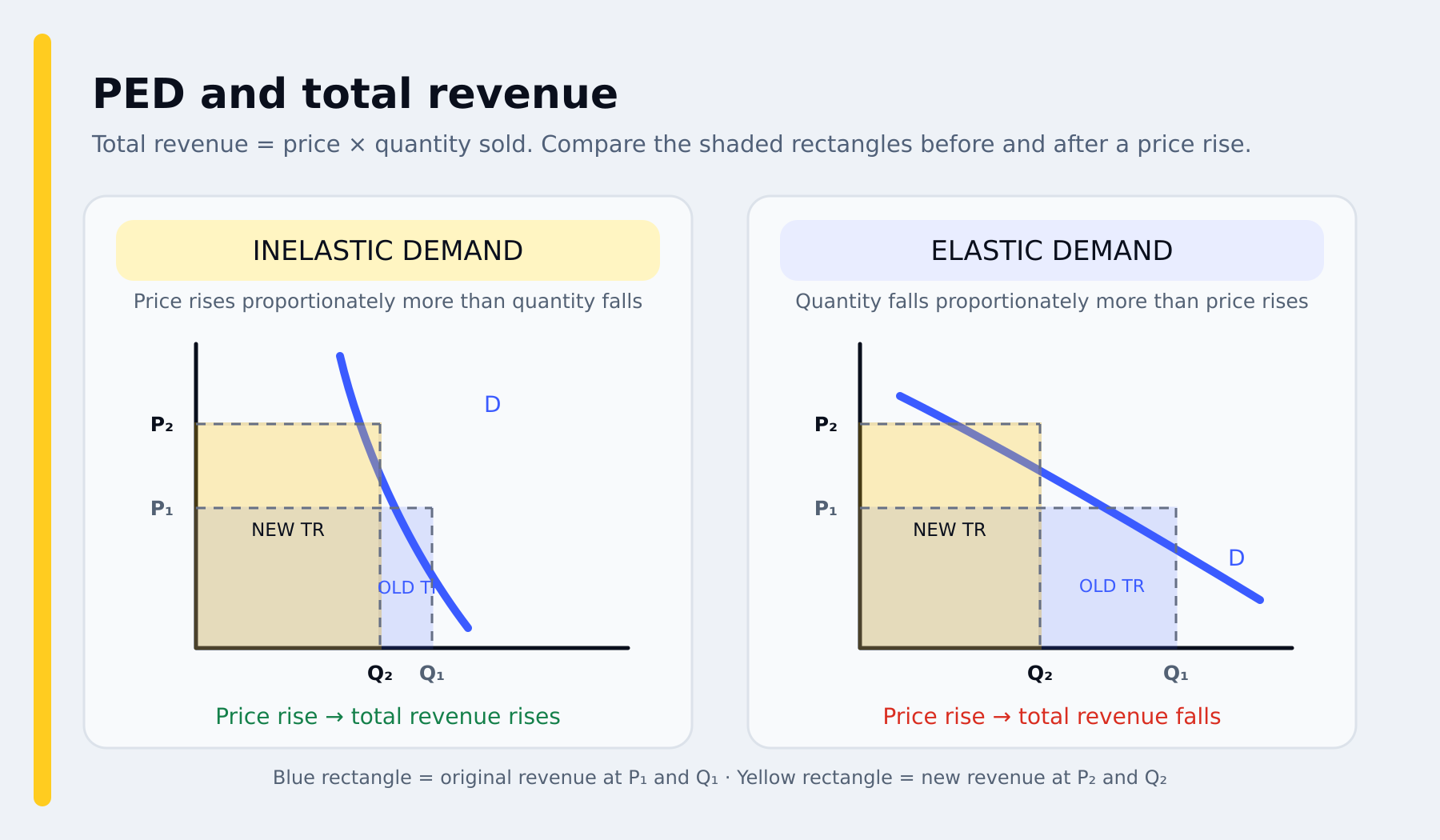
- Consumer expenditure - the amount consumers spend on a product: price multiplied by quantity bought.
- Firm's total revenue - the money a firm receives from sales: price multiplied by quantity sold. For the whole market, consumer expenditure equals firms' total revenue.
Formula: Total expenditure / total revenue = price x quantity
| PED | If price rises... | If price falls... | Why |
|---|---|---|---|
| Inelastic (< 1) | revenue rises | revenue falls | quantity changes by a smaller percentage than price |
| Unitary (= 1) | revenue is unchanged | revenue is unchanged | the percentage changes exactly offset |
| Elastic (> 1) | revenue falls | revenue rises | quantity changes by a larger percentage than price |
Why PED matters
| Group | Significance of PED |
|---|---|
| Consumers | When demand is elastic, consumers can respond strongly to a price rise by switching or buying less. When it is inelastic, avoiding the higher price is harder. |
| Workers | If demand for a firm's product is elastic, a price rise may cause a large fall in sales and production, putting jobs or hours at greater risk. |
| Firms | PED helps predict how a price change may affect sales revenue and supports pricing decisions. |
| Government | A tax on a product with inelastic demand may raise substantial revenue because quantity demanded falls proportionately less. It may, however, reduce consumption only slightly. |