The mixed economic system
- Mixed economic system - an economy in which both the private sector and government own resources and influence how resources are allocated.
- Public sector - the part of the economy owned and controlled by the government.
Most economies are mixed. Markets make many day-to-day decisions, while governments tax, spend, regulate, provide services and sometimes own firms.
Arguments for a mixed economy
Markets can preserve consumer choice, competition, incentives and rapid responses to changing demand.
The government can provide public and merit goods, reduce harmful external costs and control monopoly power.
Taxes, benefits and public services can reduce extreme inequality.
Strategic services can remain available even when private provision would be unprofitable.
Arguments against a mixed economy
Intervention may be expensive to administer and require higher taxation.
Governments may lack accurate information about the best price, output or policy size.
Poorly designed rules can weaken incentives, reduce competition or create shortages and surpluses.
Public-sector organisations may face weaker pressure to reduce costs or innovate.
Evaluation: The outcome depends on the balance: markets may fail, but government intervention can also create costs or unintended effects.
Price controls
- Maximum price - a legal price ceiling above which a product cannot be sold. To affect the market, it must be set below the equilibrium price.
- Minimum price - a legal price floor below which a product cannot be sold. To affect the market, it must be set above the equilibrium price.
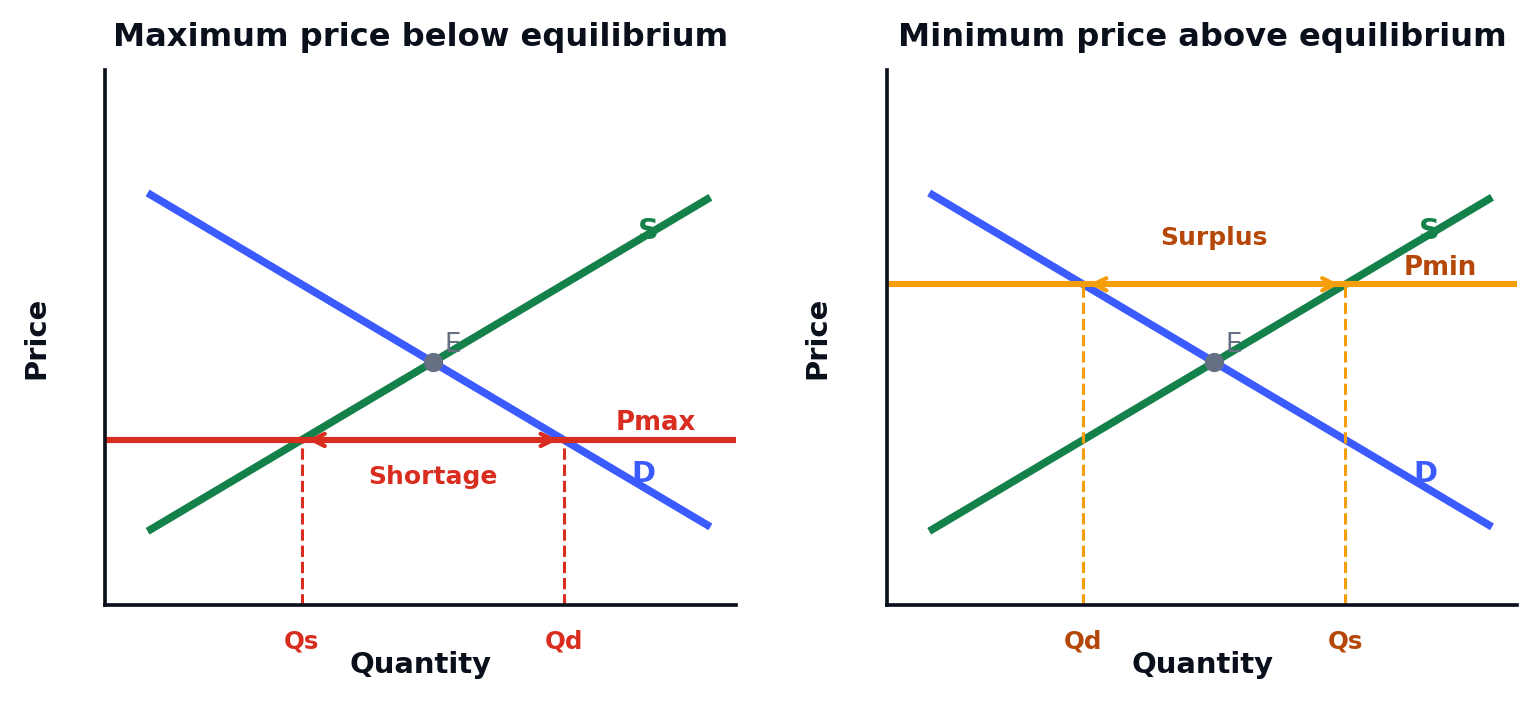
Figure 2.7: A maximum price below equilibrium causes a shortage; a minimum price above equilibrium causes a surplus.
| Policy | Possible advantages | Possible disadvantages |
|---|---|---|
| Maximum price | Makes an essential product more affordable for consumers who can obtain it; may limit monopoly pricing. May increase international competitiveness of a g/s in foreign markets. | Creates a shortage; encourages queues, rationing or illegal resale; may reduce quality and future supply. |
| Minimum price | Can raise producer income or workers' pay and discourage consumption when applied to harmful goods. | Creates a surplus; consumers pay more; the government may have to buy excess output; firms may become inefficient. |
No-effect control: A maximum price above equilibrium or a minimum price below equilibrium does not change the market outcome.
Indirect taxes and subsidies
- Indirect tax - a government levy on spending or production. It raises firms' costs, so supply decreases and shifts left; it becomes less profitable for producers to supply the g/s.
- Subsidy - a government payment to producers. It lowers firms' costs, so supply increases and shifts right; it becomes more profitable for producers.
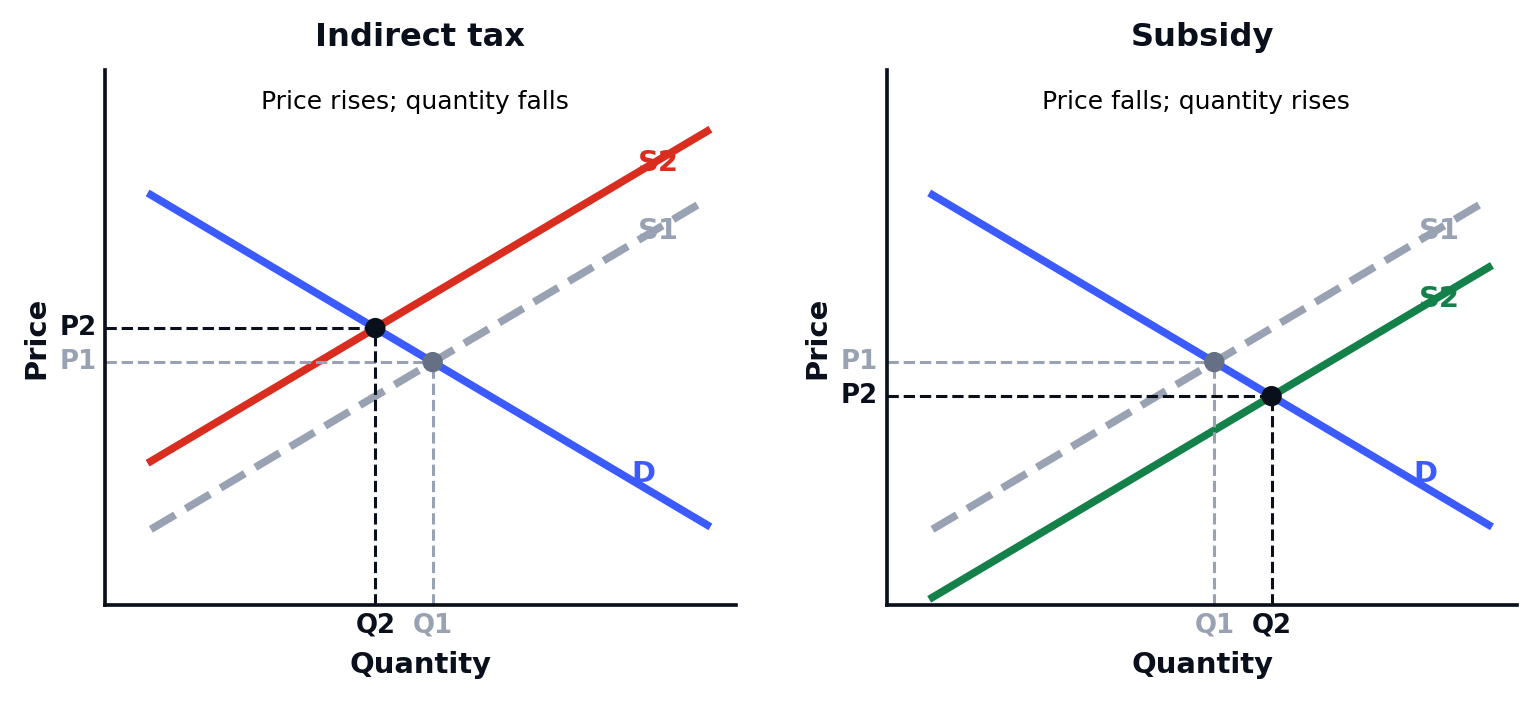
Figure 2.8: An indirect tax shifts supply left; a subsidy shifts supply right.
| Policy | Possible advantages | Possible disadvantages |
|---|---|---|
| Indirect tax | Can reduce consumption of demerit goods or goods with external costs; raises government revenue. | Raises consumer prices; can take a larger share of low incomes; output and jobs may fall; effect is small when demand is inelastic. |
| Subsidy | Can increase consumption of merit goods or goods with external benefits; lowers price and supports output and jobs. | Has an opportunity cost to the government; firms may become dependent or inefficient; estimating the correct subsidy is difficult. |
Elasticity and policy impact
PED and PES affect how much price and quantity change after a tax or subsidy. For example, when demand is inelastic, an indirect tax may reduce quantity only slightly, so it is more effective at raising revenue than changing behaviour.
Other forms of government intervention
- Regulation - laws and rules controlling economic behaviour, such as safety standards, age limits or pollution limits.
- Privatisation - the transfer of an organisation or asset from public-sector ownership to private-sector ownership.
- Nationalisation - the transfer of an organisation or industry from private-sector ownership to public-sector ownership.
- Direct provision - government production or funding of a good or service, such as state schooling, healthcare or street lighting.
- Quota - a legal limit on the quantity produced, sold, imported or extracted over a period of time.
| Intervention | Possible advantages | Possible disadvantages |
|---|---|---|
| Regulation | Can directly ban or limit harmful activity; standards protect consumers and workers. | Monitoring and enforcement cost money; firms face higher costs; rules may be avoided or set incorrectly. |
| Privatisation | Profit and competition may improve efficiency, investment and customer choice; sale raises government funds. | A private monopoly may raise prices or cut unprofitable services; profit may take priority over access. |
| Nationalisation | The government can protect strategic services, access and long-term goals; profits can support public finances. | Political interference and weak competitive pressure may reduce efficiency; taxpayers bear losses and investment costs. |
| Direct provision | Ensures public goods are supplied and can increase access to merit goods regardless of income. | Requires taxation and has an opportunity cost; output may not match preferences; provision can be inefficient. |
| Quota | Directly limits harmful output or protects a scarce natural resource from over-extraction. | Can raise prices, create illegal markets, be costly to enforce and protect inefficient producers. |
Choosing and evaluating an intervention
A strong answer links the policy to the exact cause of the problem, then weighs benefits against costs. The same policy can work well in one market and poorly in another.
| Evaluation question | Why it matters |
|---|---|
| How large is the problem? | A small intervention may be insufficient, while an excessive one may create a new distortion. |
| How elastic are demand and supply? | Responsiveness affects the size of price, quantity, revenue and employment changes. |
| Can the policy be enforced? | Rules and quotas have little effect if monitoring is weak or evasion is easy. |
| What is the opportunity cost? | Government spending or lost tax revenue means another use of funds is forgone. |
| Who gains and who loses? | Consumers, workers, firms, taxpayers and third parties may be affected differently. |
| What happens over time? | Firms and consumers may adapt, so short-run and long-run outcomes can differ. |
A very common evaluation is referring to the effects on market failure. I.e. Will indirect taxation worsen the allocation of resources? Would this worsen market failure? However, while it is good, avoid using it as your main evaluation for every point
A* evaluation frame: Policy goal -> how the policy changes incentives or costs -> intended benefit -> likely drawback -> condition that decides the final outcome.