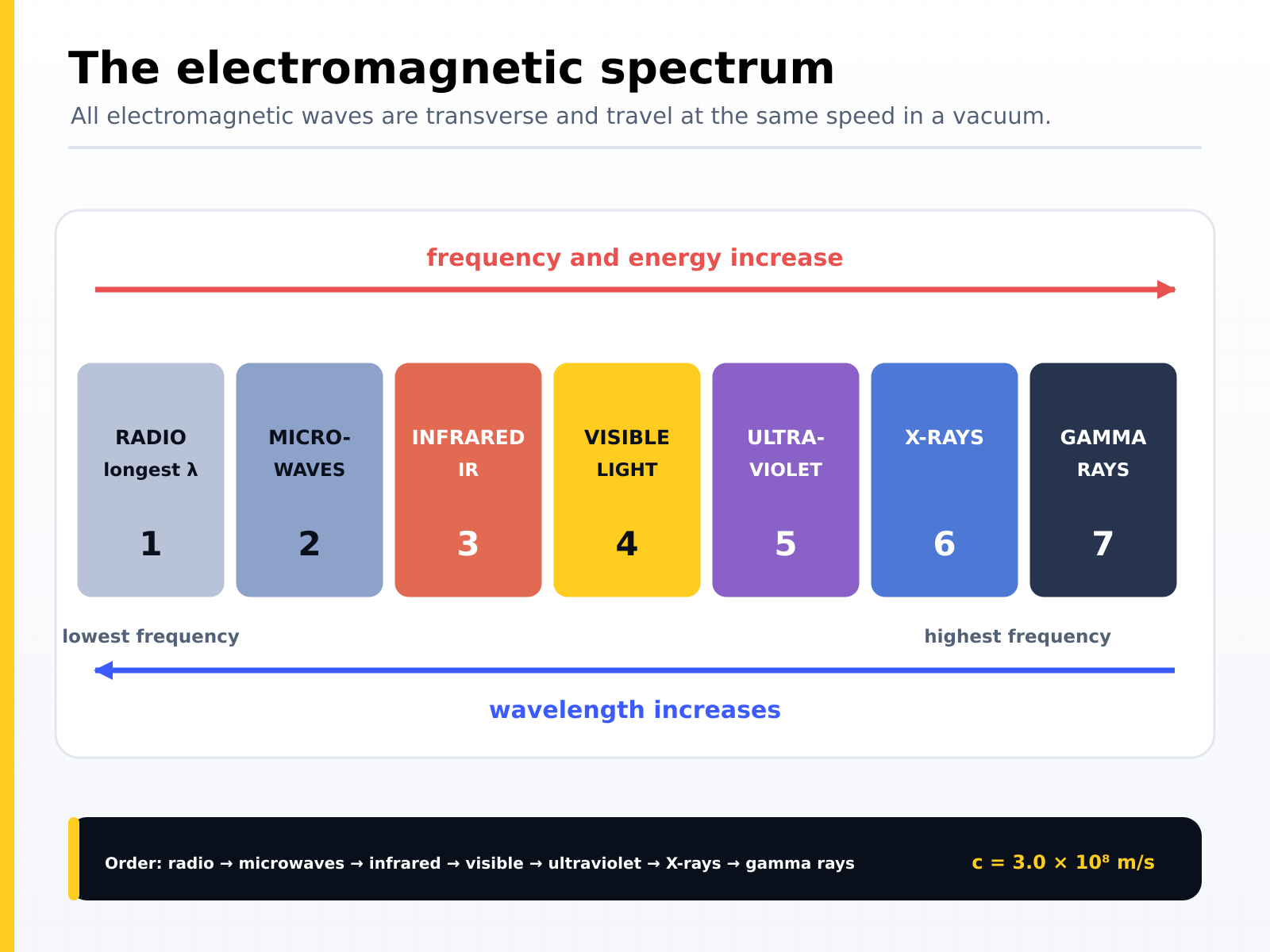
There are 7 types of electromagnetic waves which form the electromagnetic spectrum (EMS).
Radio waves have long wavelengths, low frequency & low energy. Gamma rays have short wavelengths, high frequency & high energy.
All electromagnetic waves travel at the same high speed in a vacuum. The speed of electromagnetic waves in a vacuum is 3.0 × 10⁸m/s and is approximately the same in air.
Uses:
- Radio waves — radio and television transmissions, astronomy, radio frequency identification (RFID).
- Microwaves — satellite television, mobile phones (cell phones), microwave ovens.
- Infrared — electric grills, short range communications (such as remote controllers for televisions), intruder alarms, thermal imaging, optical fibres.
- Visible light — vision, photography, illumination.
- Ultraviolet — security marking, detecting fake bank notes, sterilising water.
- X-rays — medical scanning, security scanners.
- Gamma rays — sterilising food and medical equipment, detection of cancer and its treatment.
Harmful effects from excessive exposure:
- Microwaves — internal heating of body cells.
- Infrared — skin burns.
- Ultraviolet — damage to surface cells and eyes, leading to skin cancer and eye conditions.
- X-rays & gamma rays — mutation or damage to cells in the body.
The higher the frequency, the higher the energy of the radiation. Radiation with higher energy is:
- Highly ionising.
- Harmful to cells and tissues causing cancer.
Communication with artificial satellites
Communication with artificial satellites is mainly by microwaves:
- Some satellite phones use low orbit artificial satellites
- Some satellite phones and direct broadcast satellite television use geostationary satellites
Many important systems of communications rely on electromagnetic radiation including:
- Mobile phones (cell phones) and wireless internet use microwaves because microwaves can penetrate some walls and only require a short aerial for transmission and reception.
- Bluetooth uses low energy radio waves or microwaves because they can pass through walls, but the signal gets weakened.
- Optical fibres (visible light or infrared) are used for cable television and high-speed broadband because glass is transparent to visible light and some infrared; visible light and short wavelength infrared can carry high rates of data.
Sound signals
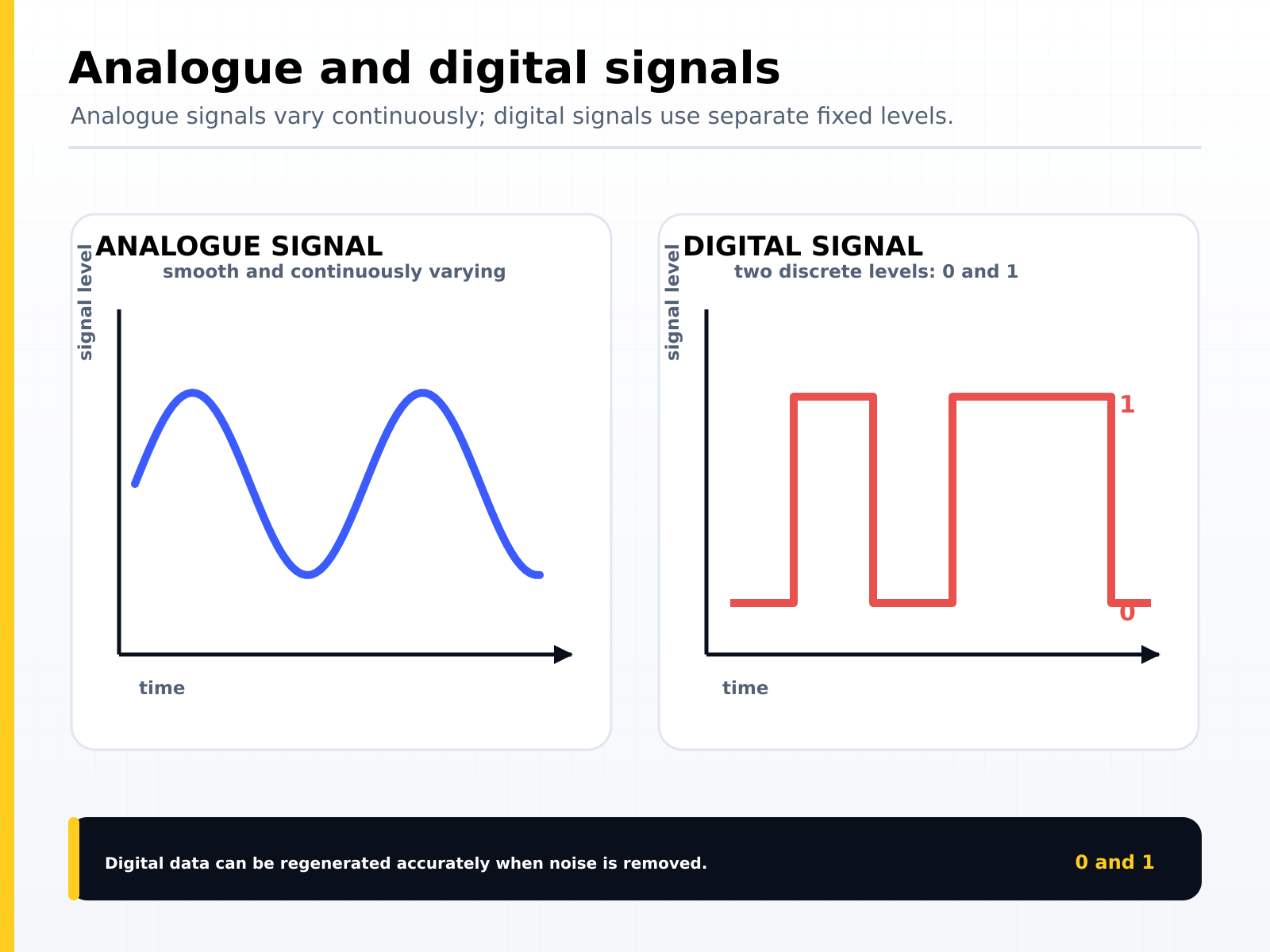
Sound can be transmitted as a digital or analogue signal:
| Digital signal | Analogue signal |
|---|---|
| Discrete and represent data in binary format | Continuous waveforms |
Benefits of digital signalling:
- Increased rate of transmission of data.
- Increased range due to accurate signal regeneration.