Energy
Types of energy:
- Heat
- Light
- Sound
- Kinetic
- Electric
- Chemical
- Gravitational potential
- Elastic
- Nuclear
- Electrostatic
- Internal (thermal)
Energy is transferred between stores during events and processes.
Examples:
Ball lifted to a height above the ground: Kinetic energy -> gravitational potential energy
Ball falls: Gravitational potential energy -> kinetic energy
Bird flies through air: Chemical energy -> kinetic energy + thermal energy
The Law of Conservation of Energy - Energy can be changed (transformed) from one type to another, but it can never be made or destroyed.
Gravitational potential energy:
Ep = m × g × h (gravitational potential energy = mass × gravitational field strength × height)
Kinetic energy:
Ek = ½ × m × v² (kinetic energy = ½ × mass × speed²)
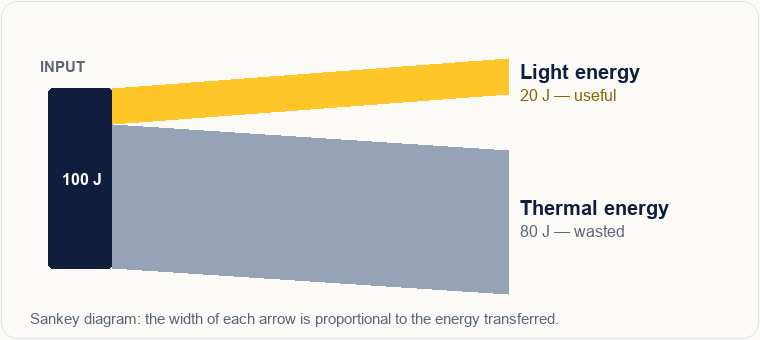
Sankey diagram:
A Sankey diagram shows energy transfers — the width of each arrow is proportional to the amount of energy transferred. For example, a filament lamp:
Work
Mechanical or electrical work done is equal to the energy transferred.
Energy resources
Energy and electrical power can be generated from:
- Chemical energy stored in fossil fuels
- Chemical energy stored in biofuels
- Water, from energy stored in waves, tides, and water behind hydroelectric dams.
- Geothermal resources
- Nuclear fuel
- Light from the Sun to generate electrical power (solar cells)
- Infrared and other electromagnetic waves from the Sun to heat water (solar panels) and be the source of wind energy
- Tidal energy — Energy stored in tidal currents
- Wind energy — Energy stored from wind movement
- Wave energy — Energy stored in waves movement
- Geothermal energy — Energy stored from the heat of the Earth’s core
- Solar energy — Energy stored in sunlight
- Biofuels — a fuel derived immediately from living matter
- Renewable energy — Sources of energy that can be replenish
- Non-renewable energy — Sources of energy that cannot be replenish
Fossil fuels
| Advantages | Disadvantages |
|---|---|
| Abundant | Non renewable |
| Reliable | Causes pollution & greenhouse gases |
Biofuels
| Advantages | Disadvantages |
|---|---|
| Renewable | Causes pollution & greenhouse gases |
| Abundant | |
| Reliable |
Tidal energy
| Advantages | Disadvantages |
|---|---|
| Renewable | May damage habitats |
| No pollution | |
| Reliable |
Hydroelectric energy
| Advantages | Disadvantages |
|---|---|
| Renewable | Large area needed |
| No pollution | Destroys wildlife habitats |
| Abundant | Could cause flooding |
| Reliable |
Geothermal energy
| Advantages | Disadvantages |
|---|---|
| Renewable | Release of greenhouse gas underground |
| Abundant | Surface instability |
| Reliable | |
| No harmful pollution |
Nuclear fuels
| Advantages | Disadvantages |
|---|---|
| No pollution | Non renewable |
| Reliable | Radioactive waste produced |
| Risk of explosion |
Solar energy
| Advantages | Disadvantages |
|---|---|
| Renewable | Not reliable |
| No pollution | |
| Abundant |
Wind energy
| Advantages | Disadvantages |
|---|---|
| Renewable | Not reliable |
| No pollution | Noisy |
| Abundant |
Efficiency of energy transfer – how much energy is transferred to do something useful.
Radiation from the Sun is the main source of energy for all our energy resources except geothermal, nuclear and tidal.
Energy is released by nuclear fusion in the Sun.
Research is being carried out to investigate how energy released by nuclear fusion can be used to produce electrical energy on a large scale.
Power
Power – Work done per unit time. OR energy transferred per unit time.