Effects of forces
Effects of forces:
- Changes size of object
- Changes shape
- Changes the speed of motion
- Changes direction of motion
Load–extension practical:
- Take a spring and suspend it from a clamp & stand.
- Attach a ruler to the clamp.
- Add a pointer for more accurate readings to prevent parallax error.
- Measure initial position of pointer.
- Add 100g masses.
- Continue until limit of proportionality and measure the position of pointer each time.
- Repeat to get accurate results.
Resultant forces acting along the same straight line:
An object either remains at rest or continues in a straight line at constant speed unless acted on by a resultant force.
- Friction – The force between two surfaces that may impede motion and produce heat.
Friction (drag) acts on an object moving through a liquid.
Friction (drag) acts on an object moving through a gas (e.g. air resistance).
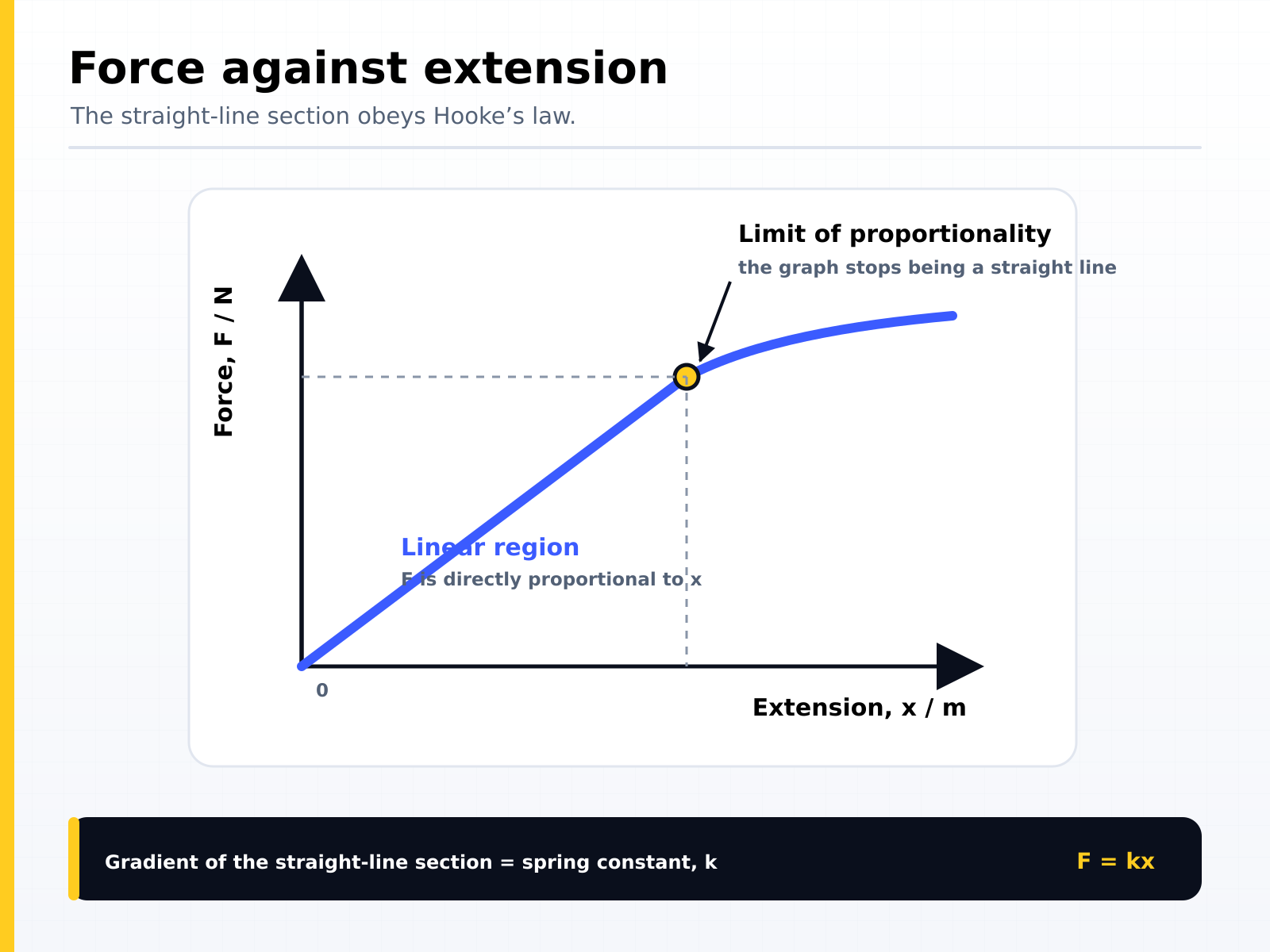
- Spring constant – Force per unit extension
k=F/x
- Limit of proportionality – The maximum force that can be applied to a spring so that it can still return to its original length/shape when the force is removed.
When the limit of proportionality is exceeded, the spring will no longer bounce back to its original shape after the force is removed.
F=ma
Motion in a circular path due to a force perpendicular to the motion:
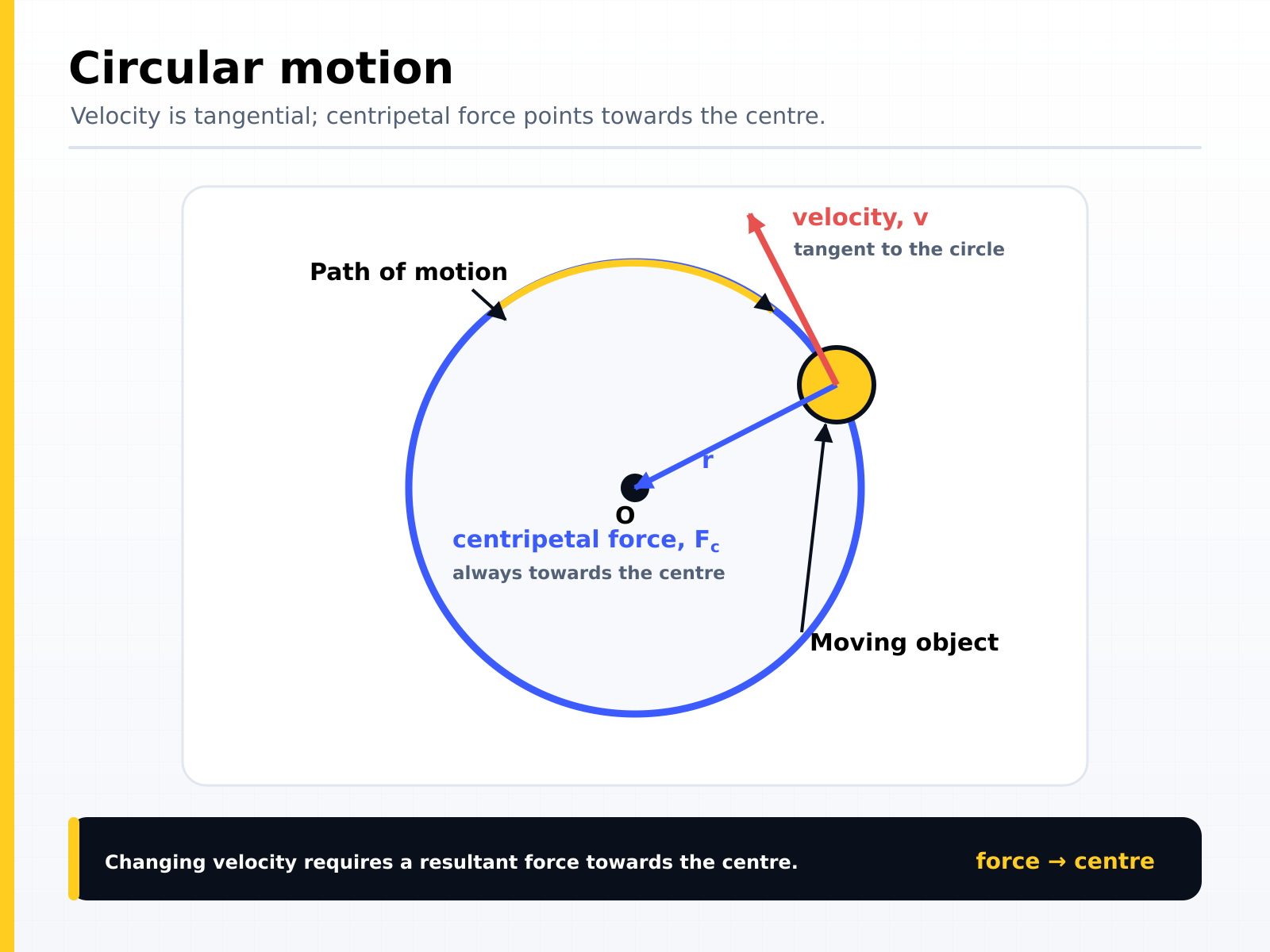
- Speed increases if force increases, with mass and radius constant.
- Radius decreases if force increases, with mass and speed constant.
- An increased mass requires an increased force to keep speed and radius constant.
Turning effect of forces
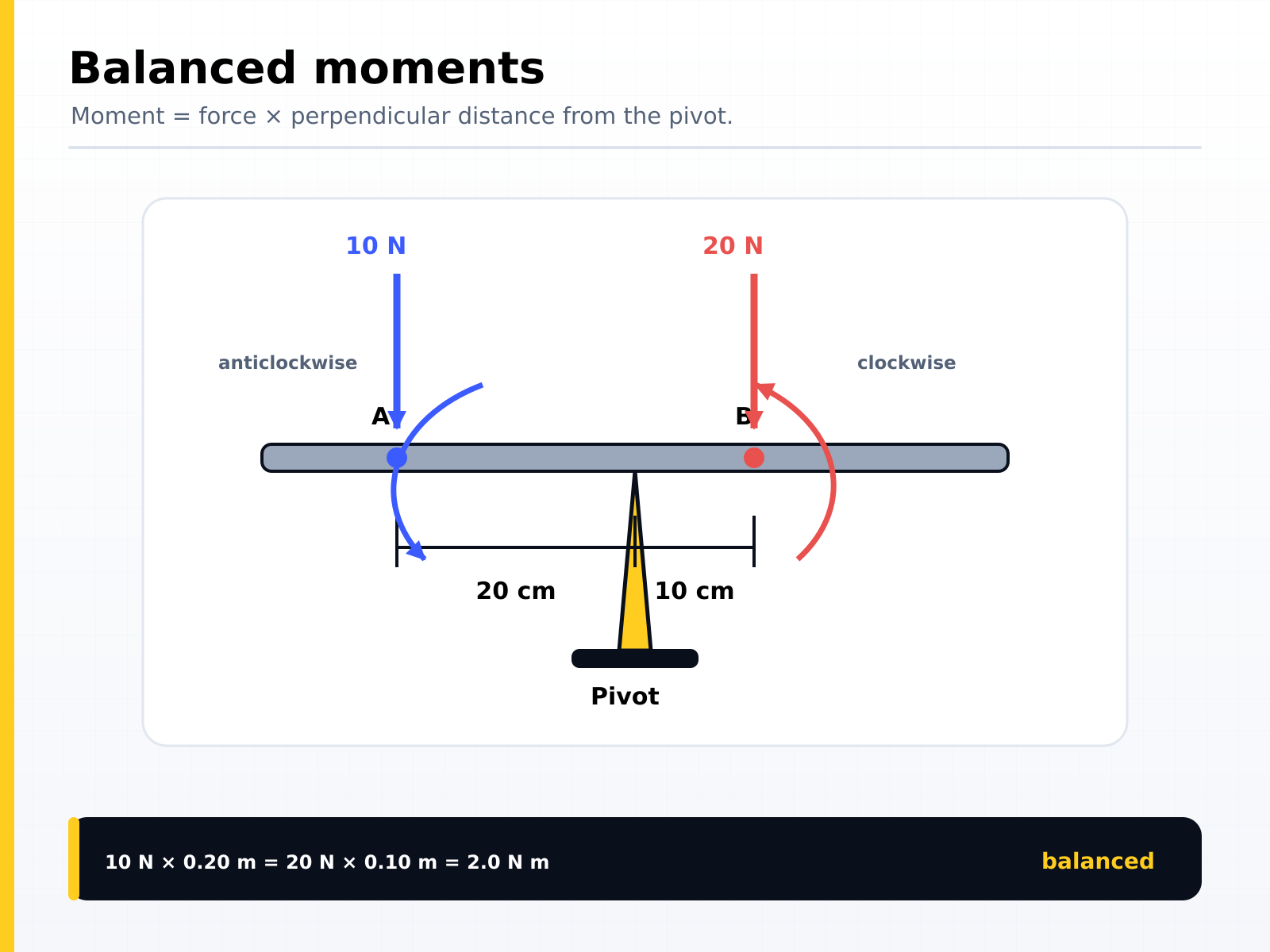
- Moment of a force – A measure of a turning effect of a force around a pivot.
Moment = force × perpendicular distance from the pivot
Everyday applications: A door opening around a fixed hinge, seesaws, scissors.
For equilibrium there must be: no resultant force, no resultant moment.
Opposing moments are balanced when: sum of the clockwise = sum of the anti-clockwise.
Opposing forces are balanced when: sum of upward forces = sum of downward forces.
Demonstrating equilibrium:
- Take an object (e.g. a beam) and replace the supports with newton metres.
- The forces acting on the beam can be found by measuring using newton meters or measuring the masses (then calculating the weights) of the beam.
- The distance of each force from the end of the ruler can then be measured.
- The moment of each force about the end of the ruler to be calculated.
- The sum of clockwise moments = the sum of anticlockwise moments.
Centre of gravity
- Centre of gravity – The point an object's weight will act through.
Determine centre of gravity:
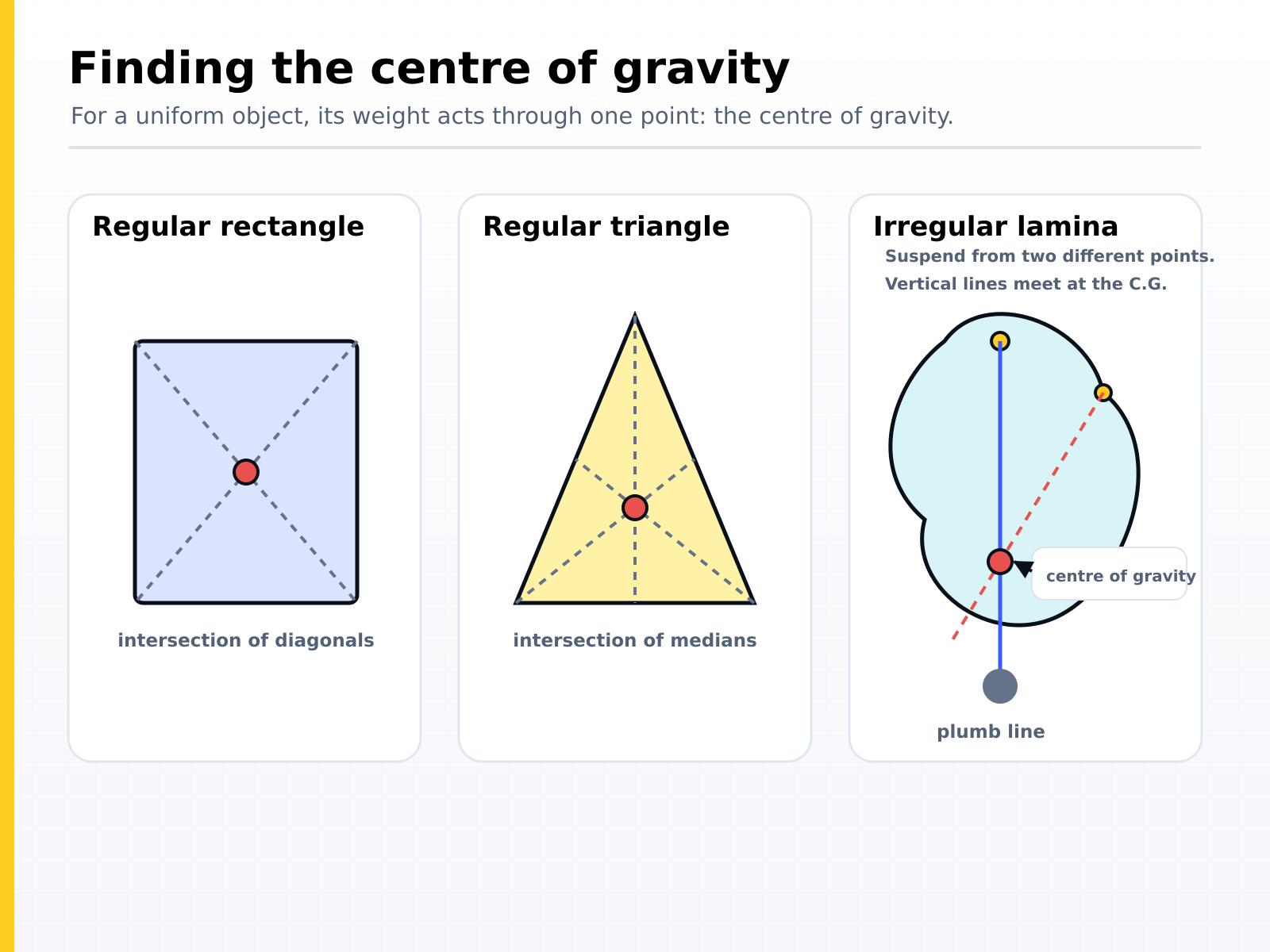
- Hang the irregular shape with a pin and a thread of plumb line.
- Draw a line based on the thread.
- The point where the lines intersect is the centre of gravity.
For an object to be stable it should have a low centre of gravity and a wide base