The Kinetic Particle Model of Matter
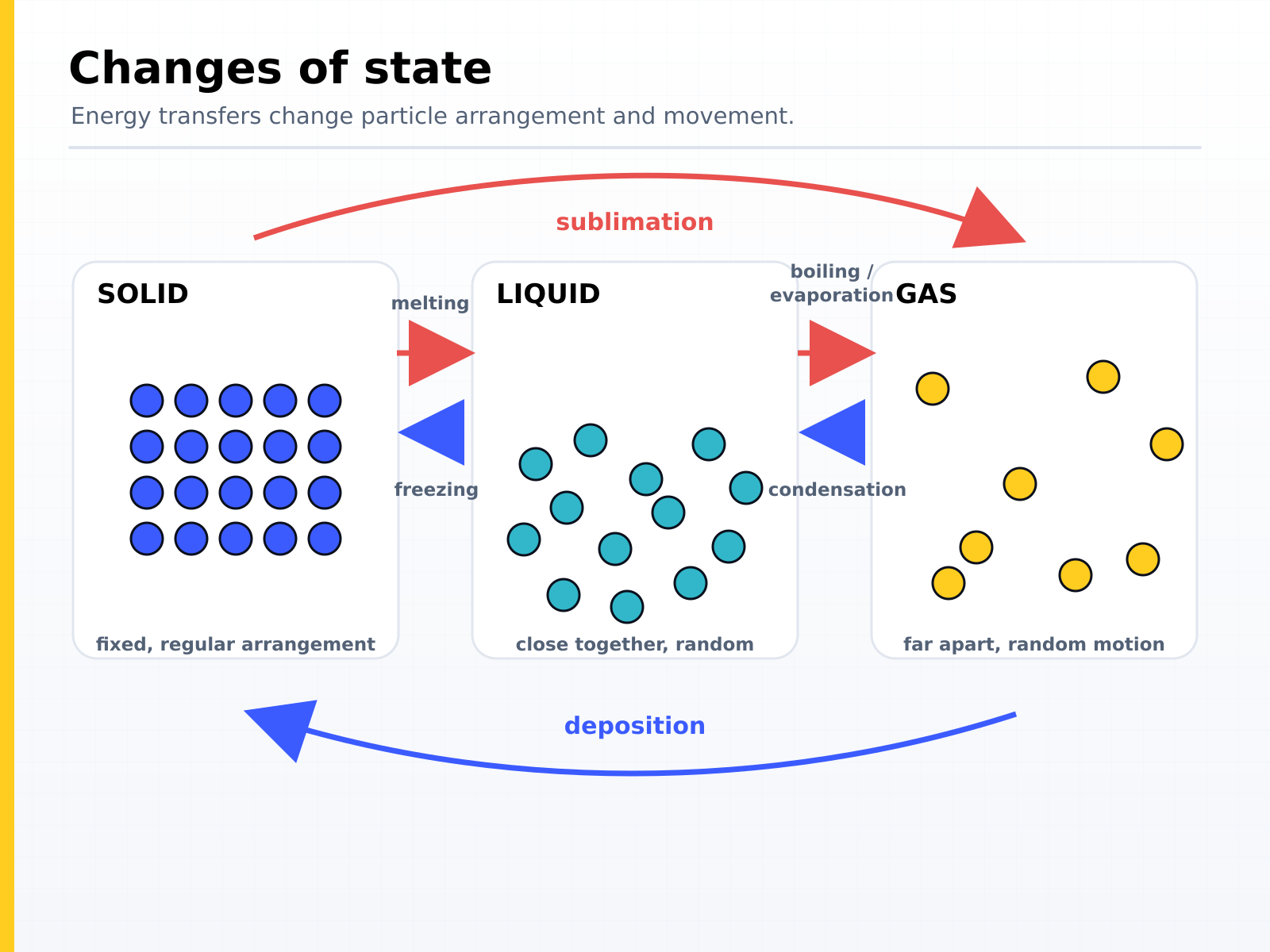
| Solid | Liquid | Gas | |
|---|---|---|---|
| Forces between molecules | Balanced forces which hold molecules in fixed positions. | Forces as strong as those in solid. Molecules not held in fixed position, move among one another. | Negligible. Only at moments of collision, the intermolecular forces act. |
| Distance between molecules | Close together in a regular pattern. | Not arranged in a regular pattern, slightly further apart than in solid. | Far apart. Mainly empty space between molecules. |
| Motion of molecules | Vibrate about fixed positions. Alternately attracting & repelling one another. | Vibrate to & fro. Alternately attracting & repelling one another. | Move randomly with high speed, colliding with one another and with the walls of the containers. |
| Compression | Cannot be compressed. | Cannot be compressed. | Can be easily compressed. |
As temperature increases: Surrounding air particles move faster and hit the particles more frequently and harder. Thermal energy is transferred to the molecules and the molecules gain kinetic energy causing molecules to move faster & more collisions.
The lowest possible temperature (−273°C), known as absolute zero, is where the particles have least kinetic energy.
Pressure of a Gas
Pressure of gas is caused by collision of molecules with walls of the container.
The magnitude of pressure is related to how hard/often the molecules strike the wall.
Pressure increases when: volume decreases OR temperature increase
Brownian Motion
- Brownian Motion — Random collisions between the microscopic particles in a suspension and the particles of the gas or liquid. It is due to the instantaneous imbalance in the combined forces exerted by collisions of the particle with the much smaller liquid molecules surrounding it. This is evidence for the kinetic particle model of matter.
E.g. smoke particles moving in the air due to the bombardment of smaller microscopic air particles
Equations
T (in K) = θ (in °C) + 273
pV = constant for a fixed mass of gas at constant temperature.