Elements, compounds and mixtures
| Elements | Compounds | Mixtures |
|---|---|---|
| Atoms of an element are identical to each other | Atoms of different elements bond together in a chemical reaction to form compounds | Particles that are mixed without any chemical bonds |
| They cannot be changed chemically into another element | Can be changed chemically to a different compound | Mixture retains properties of its particles |
| Cannot be broken down into simpler forms | Can be broken down into simpler forms | Can be separated using techniques such as filtration and evaporation |
Atomic structure and the Periodic Table
Structure of an atom
| Particle | Relative charge | Relative mass |
|---|---|---|
| Proton | +1 | 1 |
| Neutron | 0 | 1 |
| Electron | -1 | 1/1840 (negligible) |
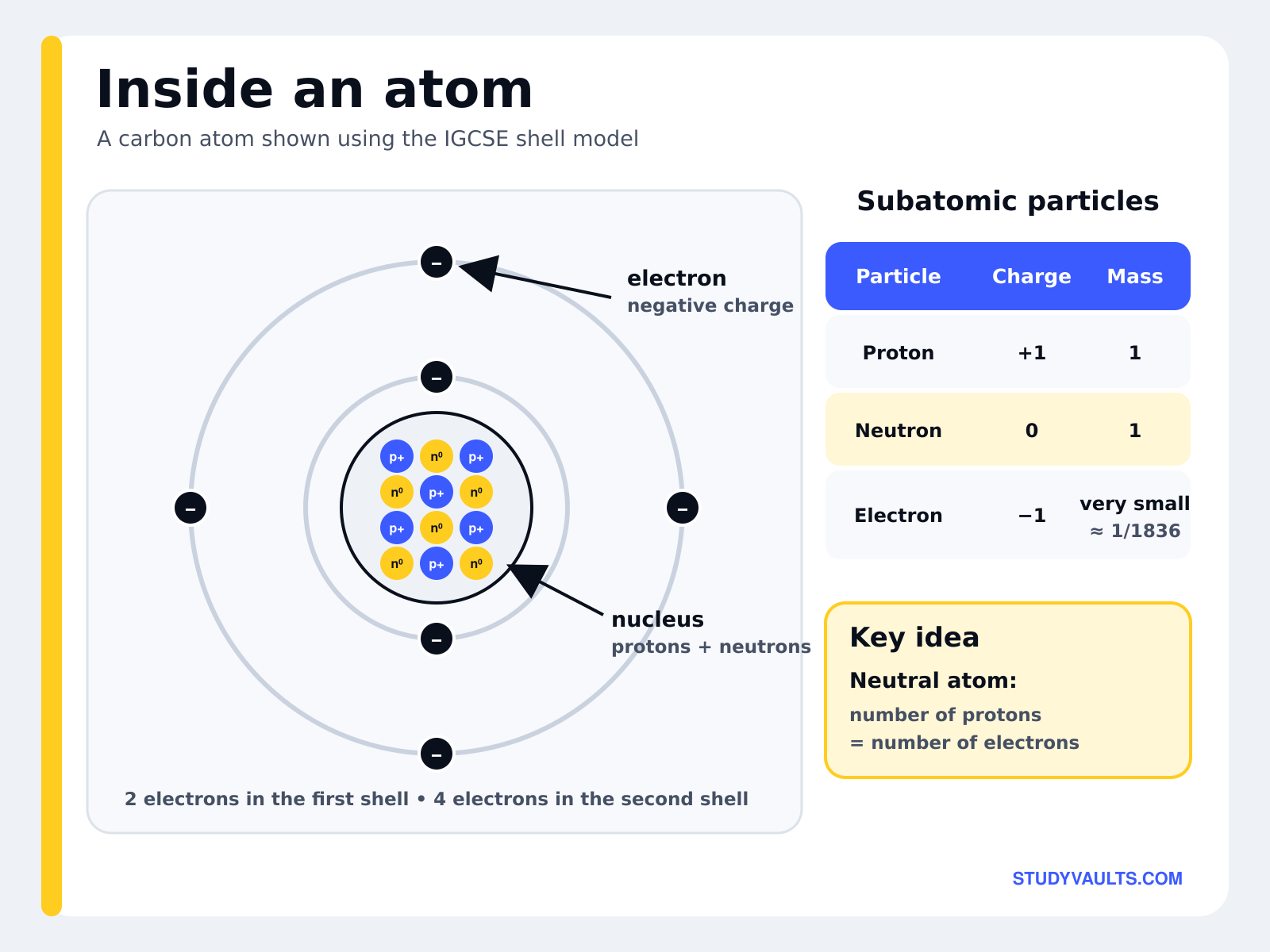
Key definitions
Atomic number — the number of protons in an atom of an element.
Nucleon number — the total number of protons and neutrons in an atom of an element.
Electronic configuration — the way electrons in an atom of an element are distributed in its shells.
- First shell can hold up to 2 electrons.
- 2nd and 3rd shells can hold up to 8 electrons.
E.g.:
- Potassium (19 electrons) = 2, 8, 8, 1
- Carbon (6 electrons) = 2, 4
Periods and groups
- The number of electron shells occupied represents an element's period. E.g. Potassium is in period 4 and Carbon is in period 2.
- The number of outer shell electrons (electron valency) is equivalent to an element's group number. E.g. Potassium is in group 1 and Carbon in group 4.
- Note that group VIII elements have full outer shells.
Isotopes
Isotopes are atoms of the same element with the same number of protons but different number of neutrons.
- Isotopes of an element have the same electronic configuration, and thus still have the same chemical properties.
Relative atomic mass (the average mass of isotopes of an element in comparison to 1/12th of a mass of an atom of carbon-12):
(abundance x mass number) + (abundance x mass number) / 100
Ions and ionic bonds
- Ion — an atom or group of atoms that have an electric charge (+ or -).
- Cations — positively charged ions.
- Anions — negatively charged ions.
- An atom loses or gains electrons to obtain a full outer shell, which will stabilise the atom.
E.g.:
- Potassium has an ion of 1+, it loses an electron to achieve a full outer shell: 2, 8, 8, 1 -> 2, 8, 8
- Oxygen has an ion of 2-, it gains 2 electrons to achieve a full outer shell: 2, 6 -> 2, 8
Ionic bonds
The strong electrostatic force between oppositely charged ions.
- Between a metal (positive ion) and a nonmetal (negative ion).
- Ionic bonds are strong: high melting and boiling point (lots of energy is required to break the strong bonds).
- Soluble in water.
- Conducts electricity when molten or aqueous only.
- Brittle (positive and positive charges repel when layers slide over each other when hit).
- E.g. Potassium oxide.
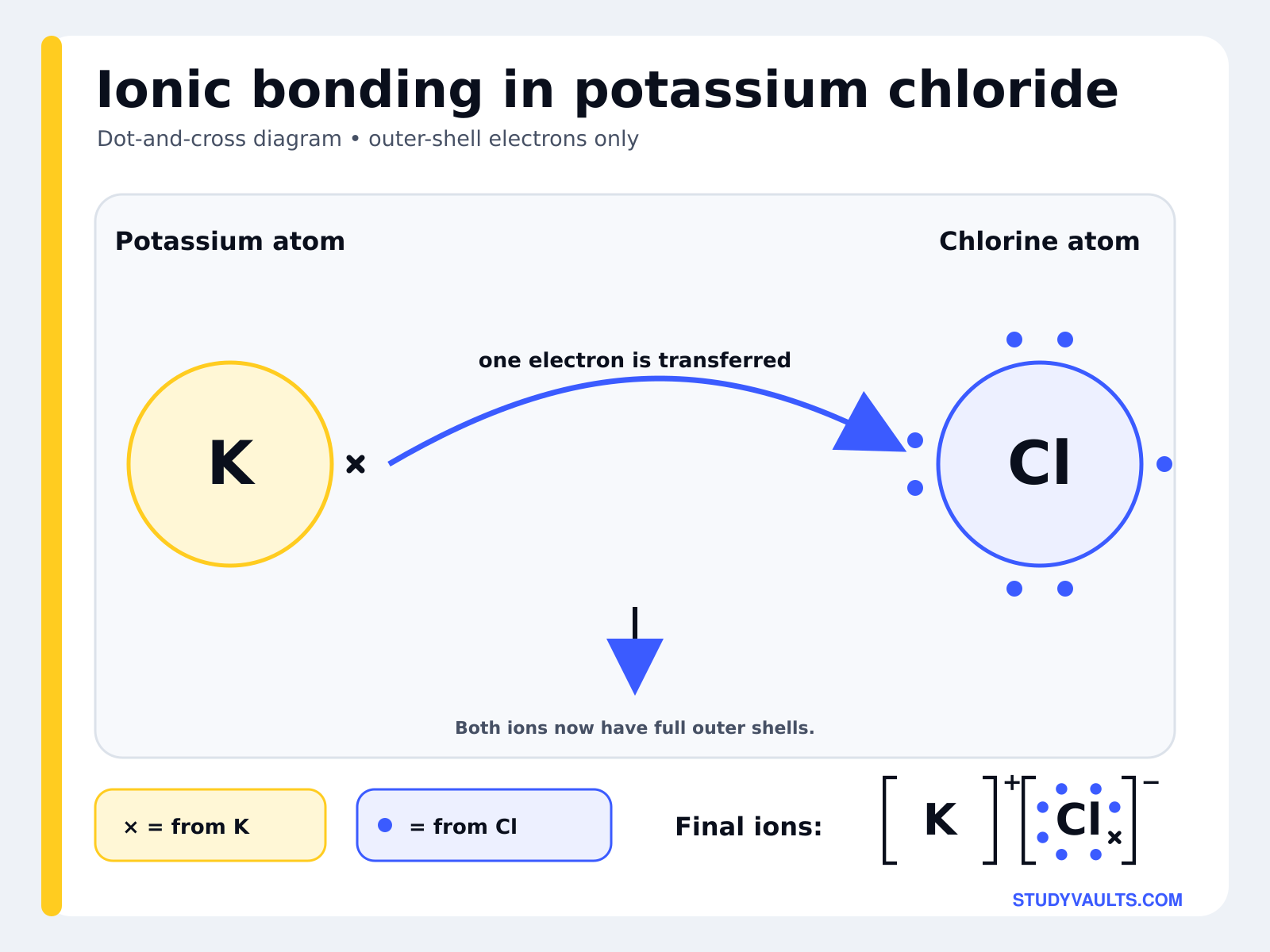
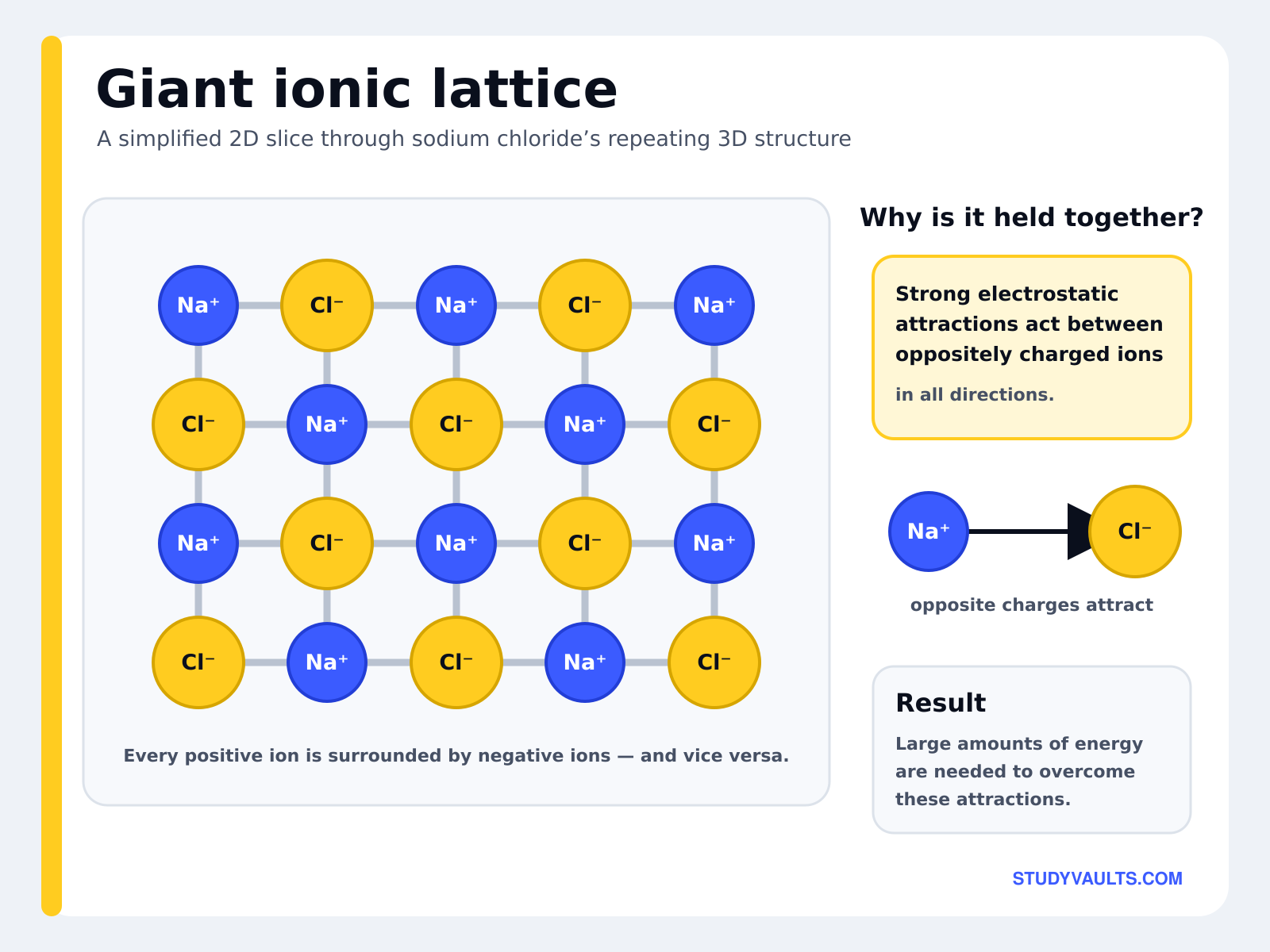
Ionic bonds are represented by a dot and cross diagram.
Simple molecules and covalent bonds
Covalent bonds
The sharing of pairs of electrons between 2 atoms to achieve full electron valency.
- Between nonmetal and nonmetal (2 negative ions).
- Weak intermolecular forces: low melting and boiling point (less energy is required to break the bonds).
- Insoluble in water.
- Does not conduct electricity.
- E.g. Carbon dioxide.
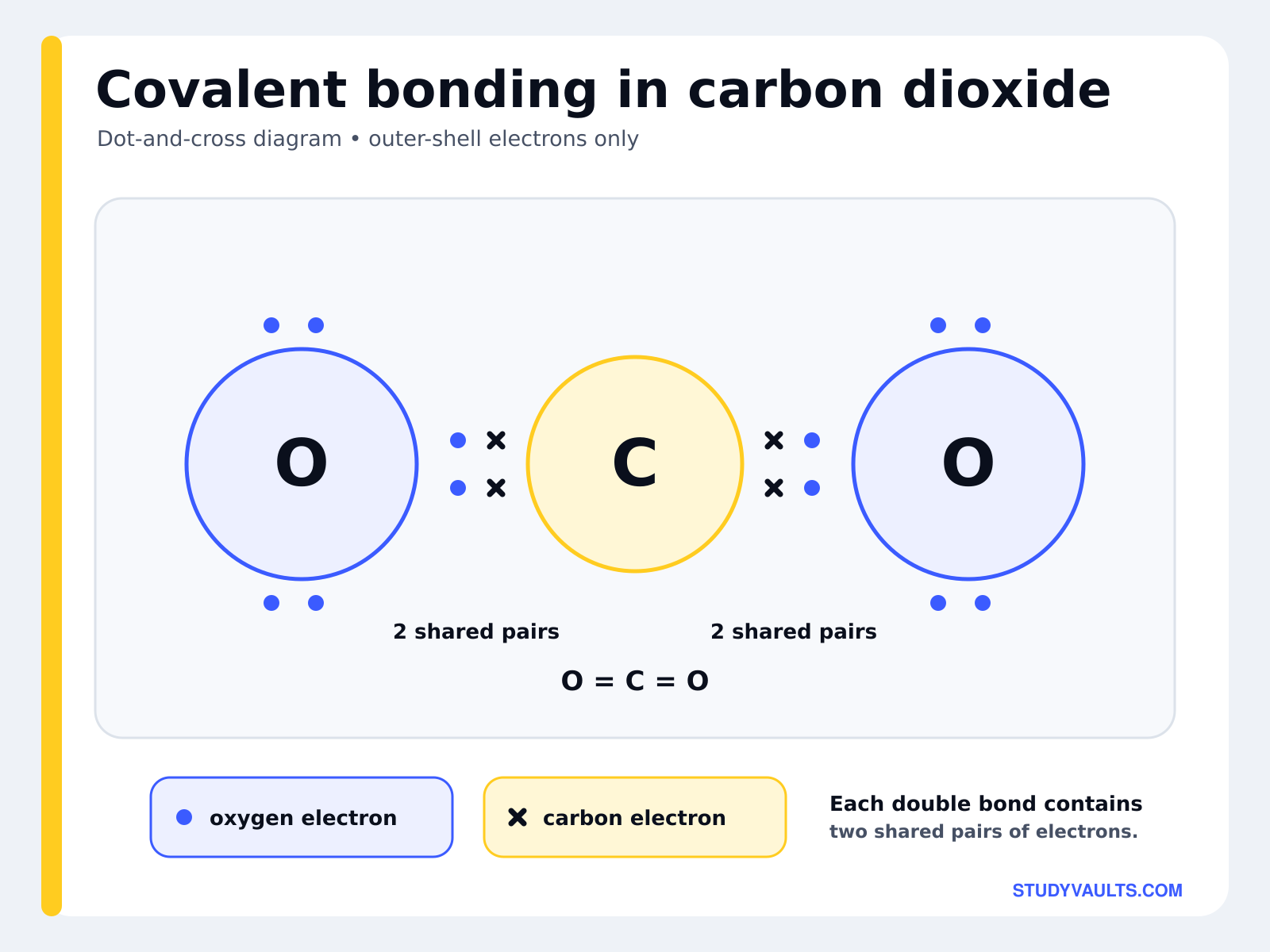
Covalent bonds are represented by a dot and cross diagram in a different form.
Giant covalent structures
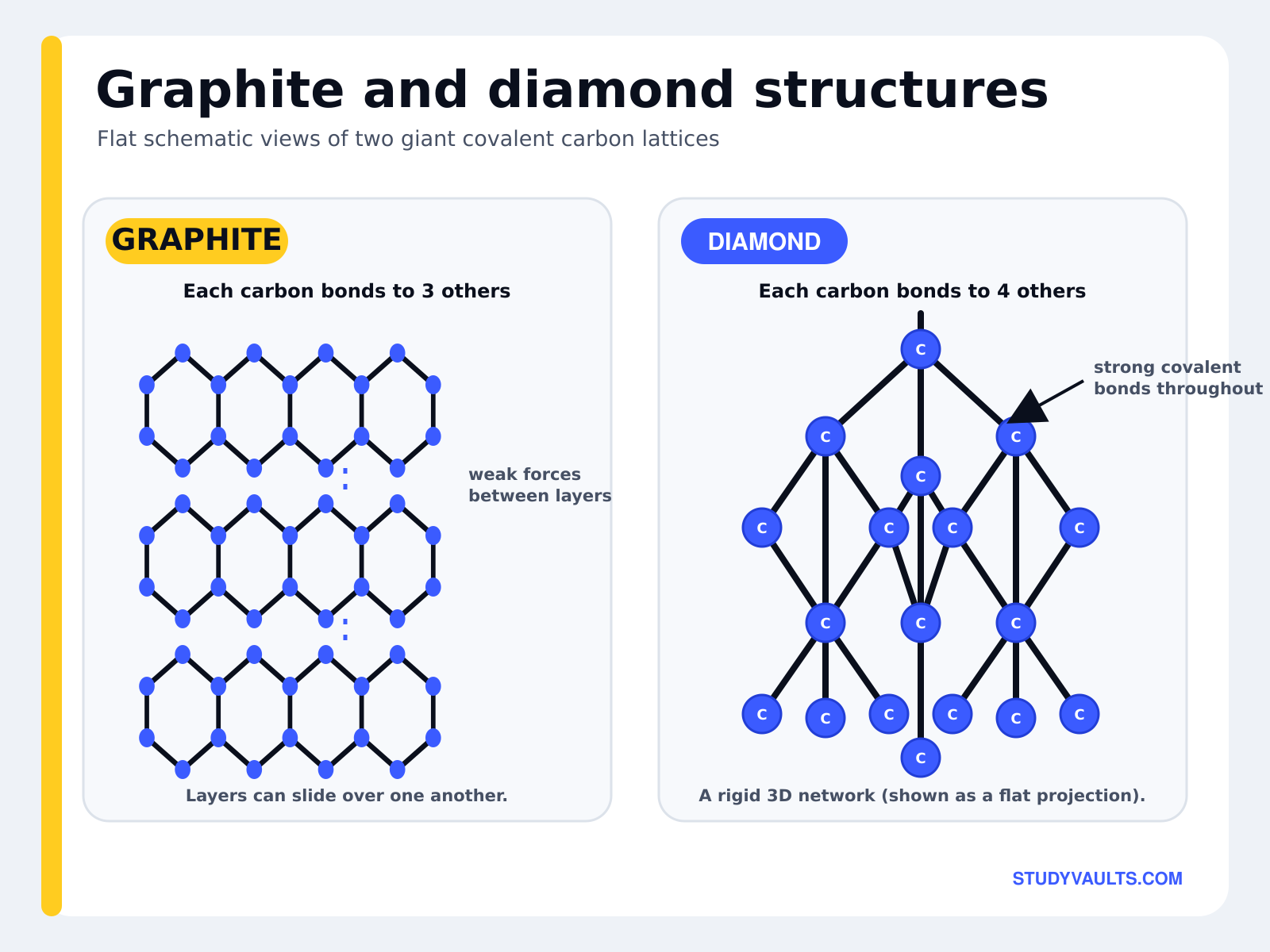
The result of many atoms bonded covalently.
The 2 covered giant covalent structures:
| Graphite | Diamond |
|---|---|
| Used as a lubricant and pencils | Used in cutting tools |
| Hexagonal structure | Tetrahedral structure |
| Once carbon bonded to 3 carbon: 1 delocalised | One carbon is bonded to 4 carbon |
| Layers can be easily rubbed off as they are soft | Hard |
| Insoluble | Insulator |
| Conducts electricity: delocalised electron | Do not conduct electricity |
| Insoluble |
- Graphite and diamond are allotropes: they are both made up of carbon, but have different structures.
- Silicon(IV) oxide, SiO2, is another example of a giant covalent structure. It has similar properties to diamond and also has a tetrahedral structure.
- One oxygen bonded to 2 silicon.
- 1 silicon bonded to 4 oxygen.
Metallic bonding
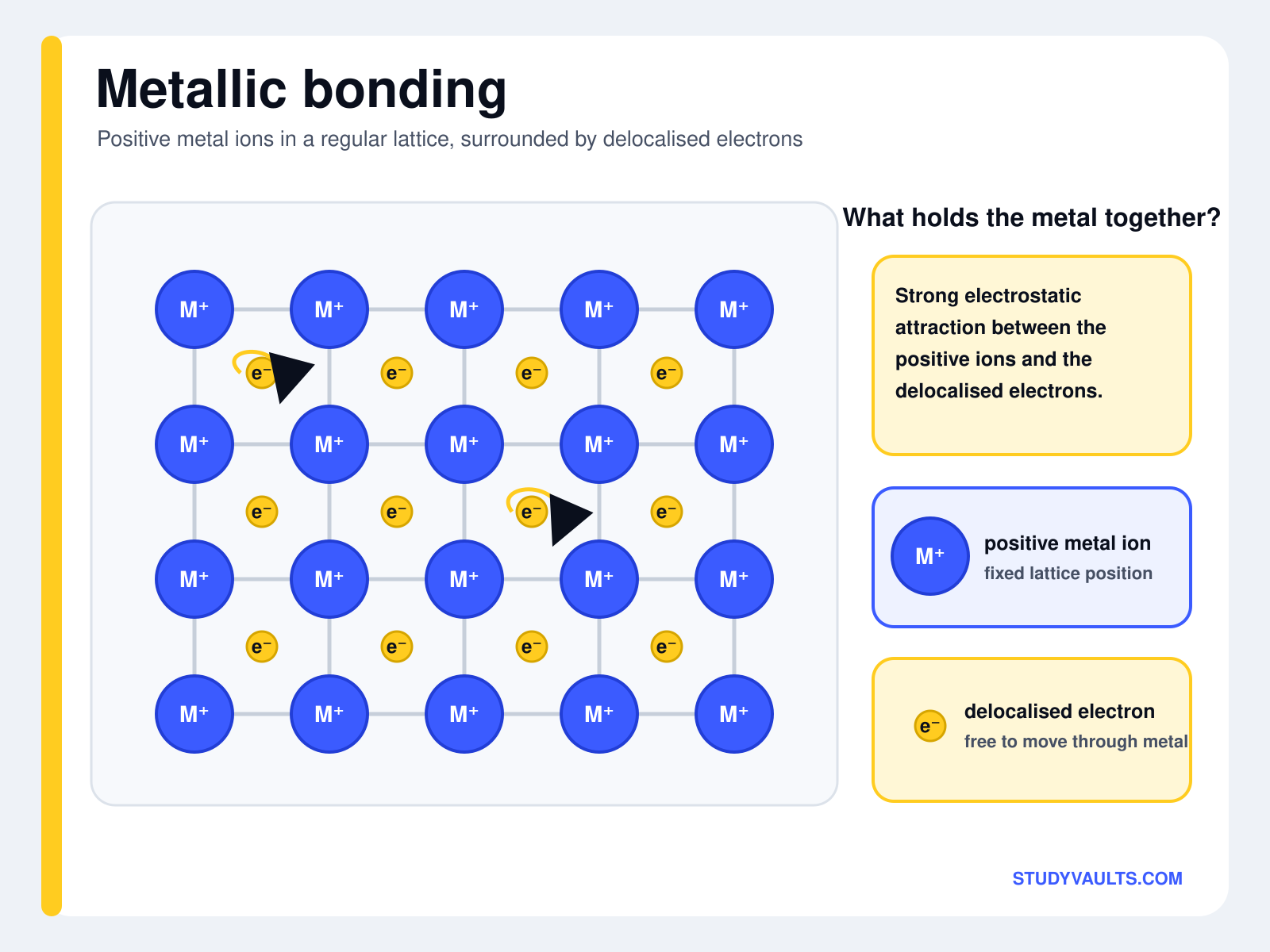
The electrostatic force of attraction between positive ions and a sea of delocalised electrons.
- High melting and boiling point (due to strong electrostatic forces).
- Good conductor of electricity (due to the mobile electrons to carry the current).
- Malleable and ductile (positive ions are arranged in layers, when it is hit, the layers can slide over and form new bonds easily).