Properties of metals
- Metals are conductors of heat and electricity
- They are malleable and ductile
- High melting and boiling points
Metal reactions
Metal + acid -> salt + hydrogen
Metal + cold water -> metal hydroxide + hydrogen
Metal + steam -> metal oxide + hydrogen
Metal + oxygen -> metal oxide
Uses of metals
Aluminium
- Used in aircrafts as it has a low density
- Used in electrical cables due to its low density and conductivity
- Used in food storage as it is corrosion resistant
Copper
- Used in electrical wiring due to copper being ductile and a conductor
Alloys and their properties
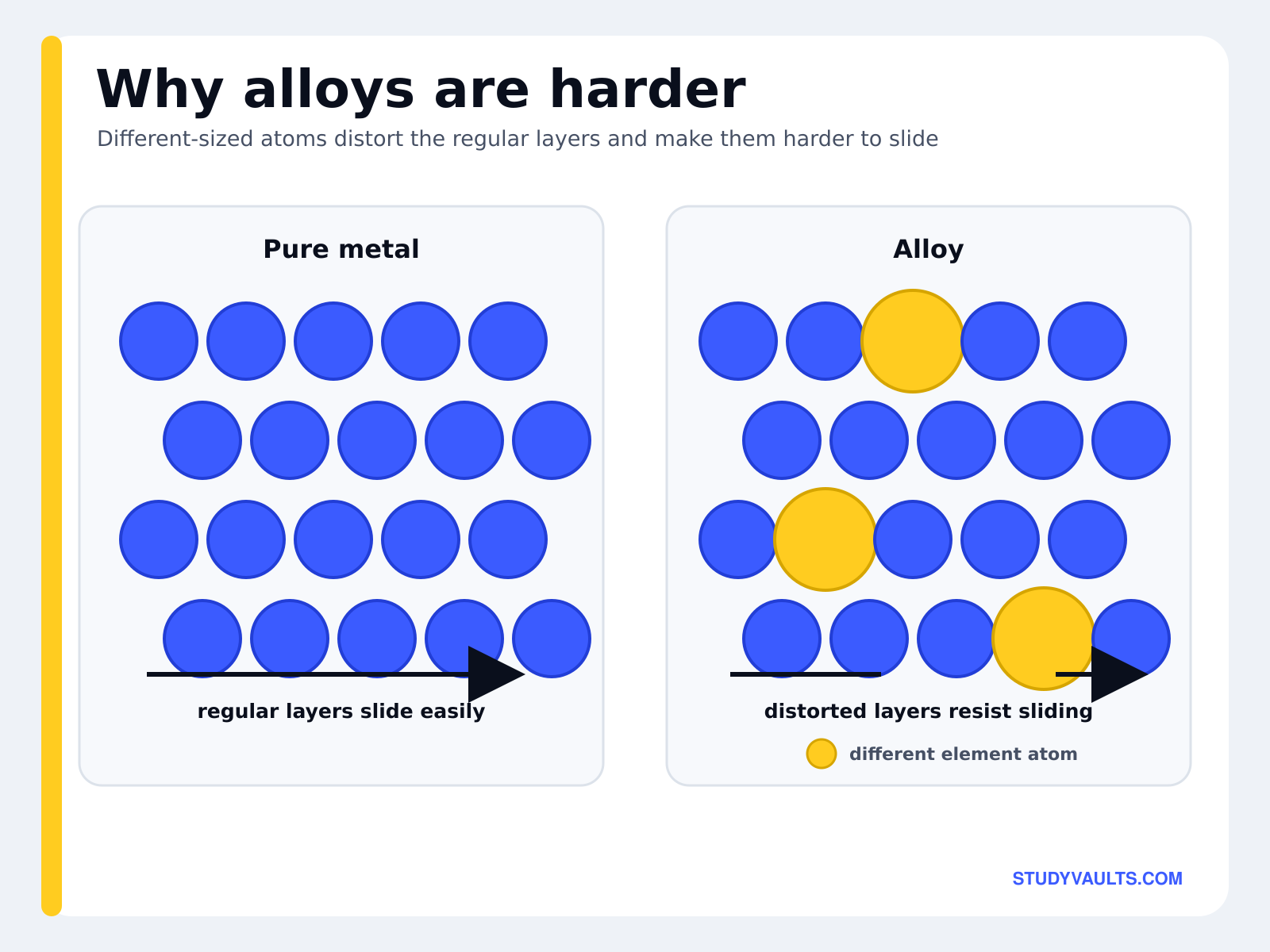
Alloys are mixtures of metals.
E.g.
- Brass — mixture of zinc and copper
- Stainless steel — mixture of iron, carbon, chromium and nickel
- Alloys are often stronger than pure metals due to the differently sized atoms, that stops the layers from sliding over each other.
Stainless steel is used in cutlery due to its rust resistance.
Reactivity series
Most reactive
- Potassium K
- Sodium Na
- Lithium Li
- Calcium Ca
- Magnesium Mg
- Aluminium Al: seems less reactive due to the oxide layer it has
- Carbon C
- Zinc Zn
- Iron Fe
- Hydrogen H
- Copper Cu
- Silver Ag
- Gold Au
Least reactive
More reactive metals can displace less reactive metals in a reaction.
Reactivity series reactions
| Metals | Steam | Water | Acid |
|---|---|---|---|
| Potassium K, Sodium Na, Lithium Li, Calcium Ca | Reacts with steam vigorously to form oxide (explosive) | Reacts with cold water vigorously to form hydroxide | Reacts explosively to form hydrogen gas |
| Magnesium Mg | Reacts with steam vigorously to form metal oxide | Reacts slowly to form hydroxide | Reacts to form hydrogen |
| Zinc Zn, Iron Fe | Reacts slowly to form metal oxide | Reacts slowly to form hydroxide | Reacts slowly to form hydrogen |
| Copper Cu, Silver Ag, Gold Au | Does not react | Does not react | Does not react |
Corrosion of metals
Sacrificial protection — the reaction of a more reactive metal in place of another metal to protect it from corrosion.
E.g. Galvanising iron using zinc
- Zinc is more reactive than iron. Reacts instead of iron. Zinc oxidises (loses electrons).
When iron is in the presence of water and oxygen, RUST is formed (hydrated iron(III) oxide).
Rust prevention: painting, greasing, coating with plastic, galvanising (coating with zinc i.e. via electroplating).
Extraction of metals
2 processes studied:
- Extraction of Iron (blast furnace)
- Extraction of Aluminium oxide (electrolysis)
Extraction of Iron (blast furnace)
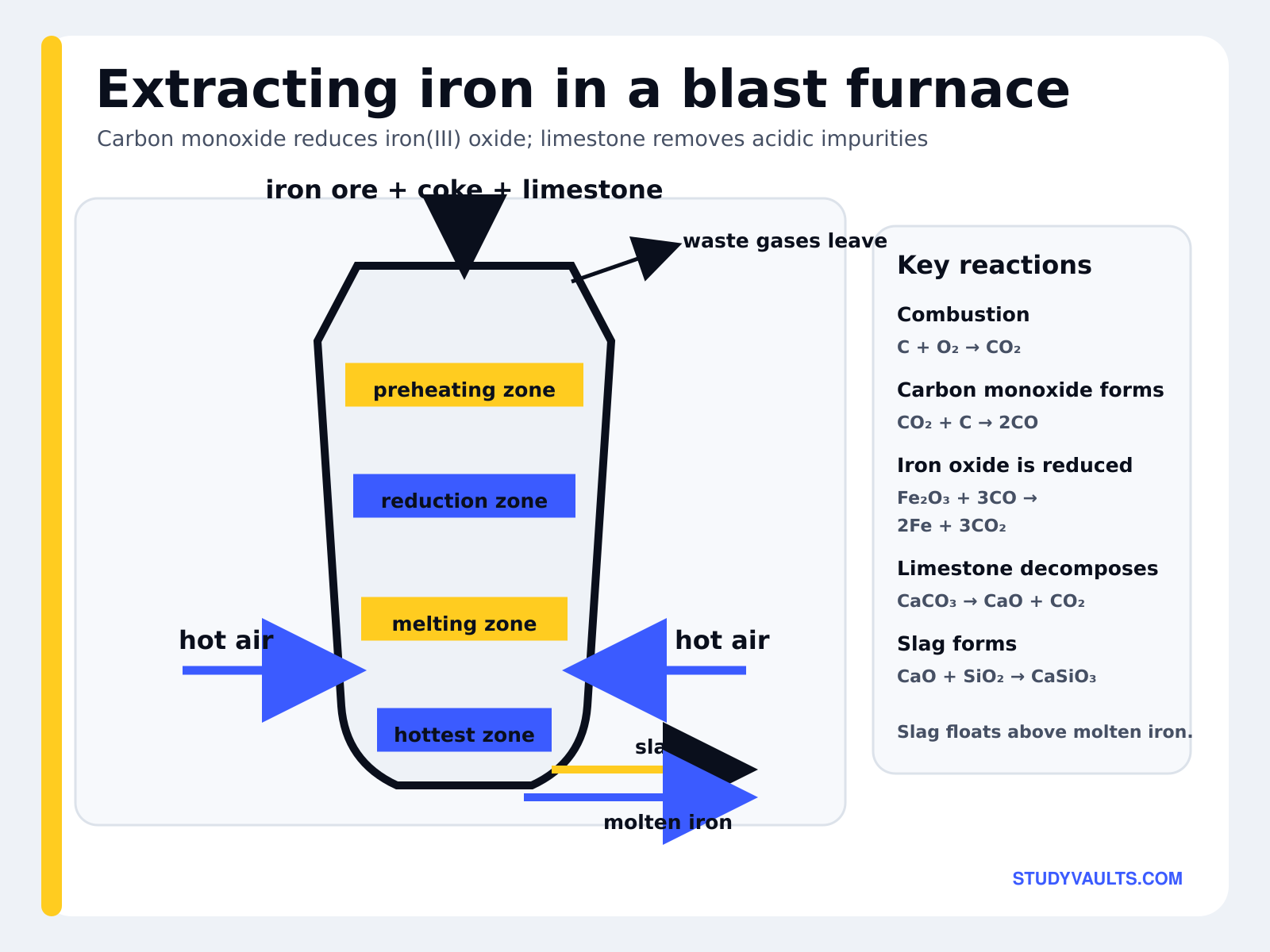
- Substances added: (iron ore) Hematite, coke, limestone, air
- C + O2 -> CO2 (produces heat)
- CO2 + C -> CO (reduction)
- 3CO + Fe2O3 -> 3CO2 and 2Fe (redox)
- CaCO3 -> CaO + CO2 (thermal decomposition)
- CaO + SiO2 -> CaSiO3 (neutralisation: removes impurities - produces slag)
Extraction of Aluminium oxide (electrolysis)
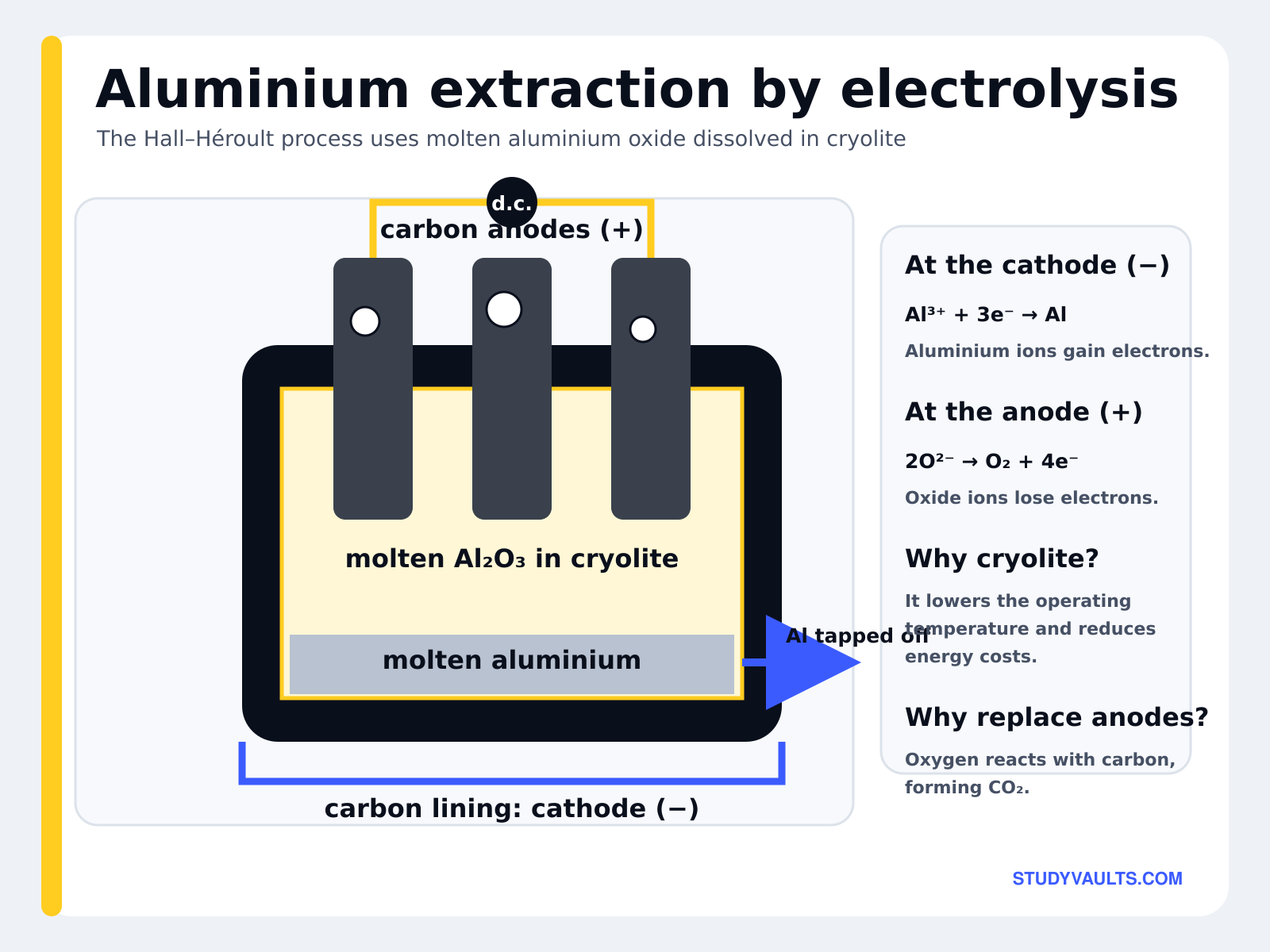
- Substances added: (aluminium ore) Bauxite purified to Al2O3 and Cryolite
- Al3+ + 3e- -> Al (cathode)
- 2O2- -> O2 + 4e- (anode)
- Anode needs to be replaced continuously as carbon reacts with the O2 produced to produce CO2
Cryolite usage:
- Used as solvent
- Lowers working temp
- Increases conductivity of electrolysis