Price elasticity of supply (PES)
Meaning and calculation
- Price elasticity of supply - a measure of how responsive quantity supplied is to a change in price.
Formula: PES = percentage change in quantity supplied / percentage change in price
Price and quantity supplied normally move in the same direction, so PES is usually positive.
Worked example
Price rises from $10 to $12, and quantity supplied rises from 50 to 60 units.
- Price change: ($2 / $10) x 100 = 20%.
- Quantity change: (10 / 50) x 100 = 20%.
- PES: 20% / 20% = 1. Supply is unitary elastic.
Interpreting PES values
| PES value | Classification | Meaning |
|---|---|---|
| 0 | Perfectly inelastic | Quantity supplied does not change when price changes. |
| More than 0 but less than 1 | Inelastic | Quantity supplied changes by a smaller percentage than price. |
| 1 | Unitary | Quantity supplied changes by the same percentage as price. |
| More than 1 | Elastic | Quantity supplied changes by a larger percentage than price. |
| Infinite | Perfectly elastic | Any amount can be supplied at one price, but none at a lower price. |
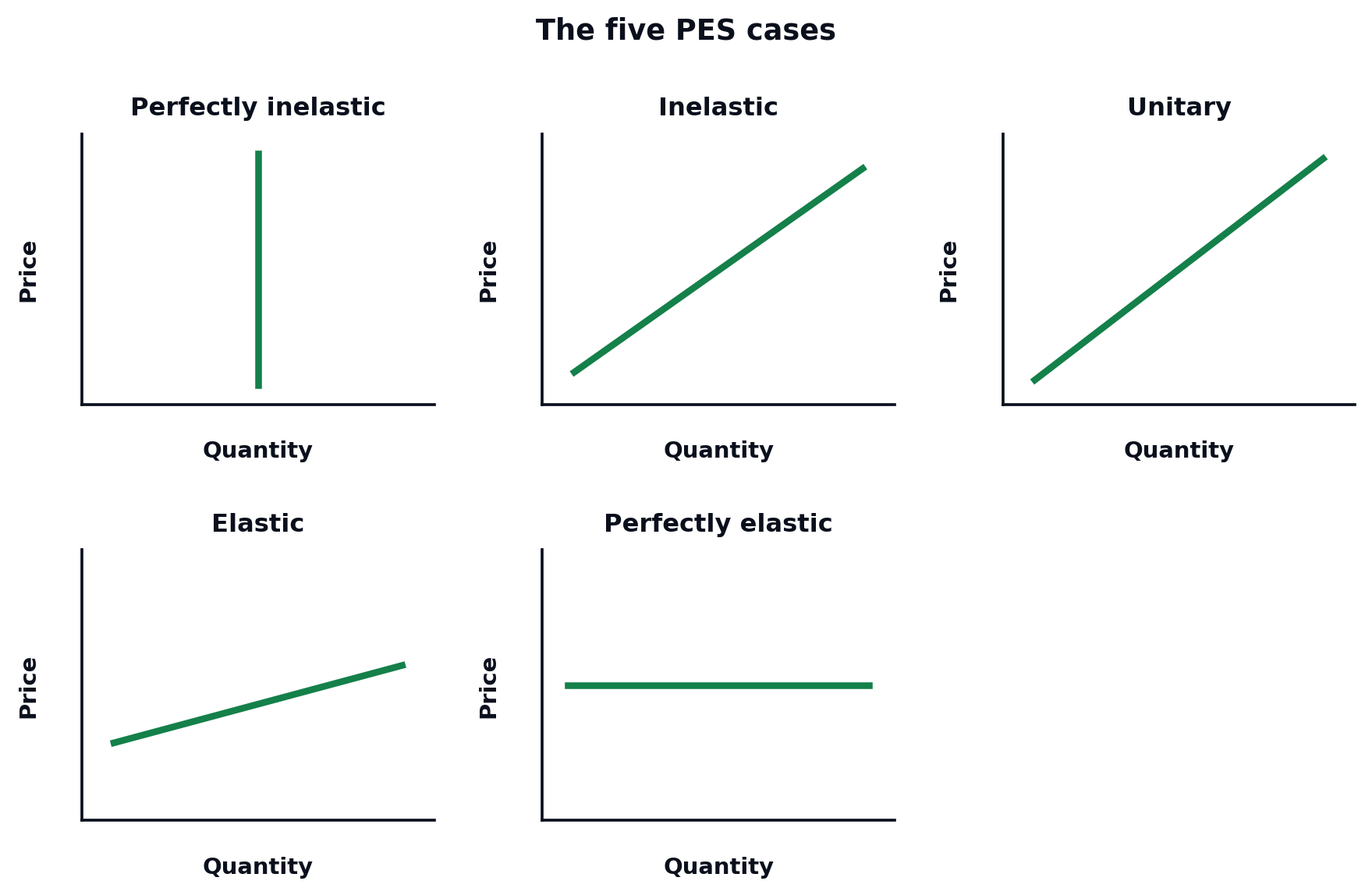
Figure 2.6: The five PES cases. A straight supply curve through the origin has unitary PES.
Determinants of PES
| Influence | Supply tends to be more elastic when... | Reason |
|---|---|---|
| Spare capacity | firms have unused machines or workers | output can rise without building new capacity |
| Stocks | finished goods are held in storage | firms can release stock quickly |
| Production time | the production period is short | extra units can be made quicker |
| Time to adjust | more time has passed | firms can hire, train, invest or new firms can enter |
| Resources | inputs are available and easily moved between uses | production can expand with fewer barriers |
| Storage | the product is durable and cheap to store | supply can be moved between time periods |
Why time matters
- Short run - a period in which at least one factor of production is fixed.
- Long run - a period where all factors of production are variable.
Supply is often inelastic in the short run because firms cannot quickly add factories, skilled workers or farmland; these factors of production are fixed. It becomes more elastic in the long run as firms can expand capacity i.e. buy new factories; FOP are variable.
Why PES matters to firms
A firm with elastic supply can respond strongly to a price rise and gain more sales. A firm with inelastic supply may miss the opportunity because capacity, stock or inputs cannot expand quickly.