Workers
Choosing an occupation
- Occupation - a type of job or profession performed by a worker.
- Wage - payment received by labour for work. It may be paid hourly, weekly, monthly or per unit produced.
- Non-wage factors - features of a job other than its direct pay.
A worker does not just choose the highest advertised wage. The worker compares the benefits and costs of an occupation, as well as whether they possess the required qualifications and can access the job.
| Wage factors | Non-wage factors |
|---|---|
| Basic pay and overtime rates | Working hours, shift pattern and flexibility |
| Bonuses, commission and tips | Job security and promotion prospects |
| Pension and paid leave | Working conditions, safety and stress |
| Expected future earnings | Location, travel time and cost |
| Benefits such as housing or health insurance | Interest in the work, status, colleagues and social usefulness |
A dangerous, unpleasant or insecure job may need to offer higher pay to attract workers. By contrast, a highly enjoyable or prestigious job may attract many applicants even when its wage is lower.
Wage determination in a labour market
- Labour market - a market in which workers supply labour and employers demand labour.
- Demand for labour - the number of workers or hours of work that employers are willing and able to hire at different wage rates over a period of time.
- Derived demand - demand for a resource that exists because the resource helps produce a product consumers want. Labour demand is therefore derived from demand for the final product.
- Supply of labour - the number of workers or hours of work that people are willing and able to offer at different wage rates over a period of time.
- Equilibrium wage - the wage at which the quantity of labour demanded equals the quantity of labour supplied.
Employers are the buyers of labour and workers are the sellers. The demand-for-labour curve slopes down because a higher wage raises the cost of employing each worker, so firms hire fewer workers. The supply-of-labour curve slopes up because a higher wage attracts more people into the occupation or encourages longer working hours.
A change in the wage itself causes movement along the existing curves. Another influence changes employers' or workers' decisions at every wage, so the curve shifts.
Changes in demand for labour
| Demand for labour increases when... | Reason |
|---|---|
| Demand or price for the firm's product rises | Firms can sell more output or receive more revenue, so hiring extra workers becomes worthwhile. |
| Labour productivity rises | Each worker produces more output and may generate more revenue for the firm. |
| The price of machinery rises | Labour becomes relatively cheaper, so some firms substitute workers for machines. |
| Other employment costs fall | Lower payroll taxes, training costs or compulsory benefits reduce the total cost of hiring. |
The reverse changes decrease demand for labour. For example, falling demand for restaurant meals reduces the number of staff restaurants can profitably employ at each wage.
Changes in supply of labour
| Supply of labour increases when... | Reason |
|---|---|
| The working-age population or immigration rises | More potential workers are available. |
| Education and training become more accessible | More people gain the qualifications needed for the occupation. |
| The job's non-wage conditions improve | Flexible hours, safety or promotion prospects attract more workers at every wage. |
| Wages in alternative occupations fall | The occupation becomes relatively more attractive. |
| Retirement occurs later or participation rises | More people remain in or enter the labour force. |
The reverse changes decrease labour supply. A lengthy training requirement, outward migration, poor working conditions or better pay in alternative jobs may reduce the number willing and able to work in an occupation.
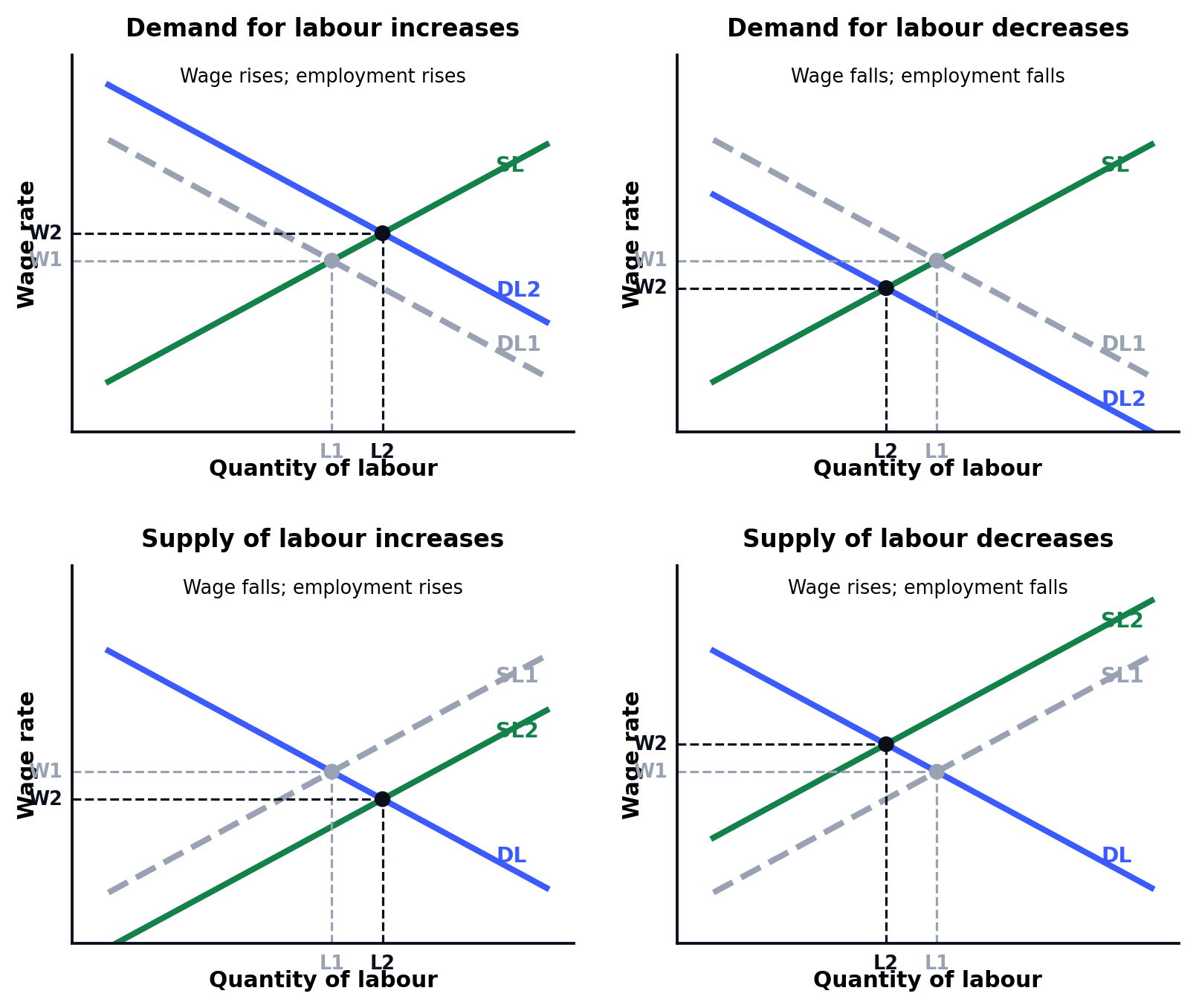
Figure 3.1: Labour-market shifts change both the equilibrium wage and employment.
Diagram chain: Name the cause -> shift DL or SL -> identify the temporary shortage or surplus of labour at the old wage -> explain the wage adjustment -> state the new wage and employment level.
Trade unions and bargaining power
- Trade union - an organisation of workers that represents members' interests, including pay, hours, safety, job security and working conditions.
- Collective bargaining - negotiation between worker representatives and employers over employment terms.
- Bargaining power - the ability of one side in a negotiation to obtain terms closer to what it wants.
A union may raise wages by negotiating collectively, restricting the supply of appropriately qualified members, supporting industrial action or improving workers' information. Whether it succeeds depends on its relative bargaining power.
| Union bargaining power is stronger when... | It is weaker when... |
|---|---|
| A high proportion of workers are members and act together | Membership is low or workers can easily be replaced |
| Members have scarce skills or provide an essential service | Unemployment is high and many substitute workers are available |
| Demand for the firm's product and labour is strong | Demand for the product is weak or production can move elsewhere |
| The employer is profitable and can afford a settlement | The employer faces losses or a serious risk of closure |
| The union has legal protection, funds and public support | Industrial action is restricted or public support is weak |
Higher negotiated wages can raise income, motivation and productivity. However, if the wage rises far above the value of workers' output and the firm cannot raise prices or productivity, employment or profit may fall. The final effect depends on how easily the firm can replace labour, automate or pass higher costs to consumers.
Government policy and the national minimum wage
- National minimum wage (NMW) - a legal minimum hourly wage that employers may pay covered workers.
- Effective minimum wage - a wage floor set above the market equilibrium wage, so it changes the market outcome.
An NMW below the equilibrium wage has no direct effect because employers already pay more. If it is set above equilibrium, the quantity of labour supplied rises while the quantity demanded falls. The horizontal gap between Ls and Ld is excess labour supply, which may appear as unemployment.
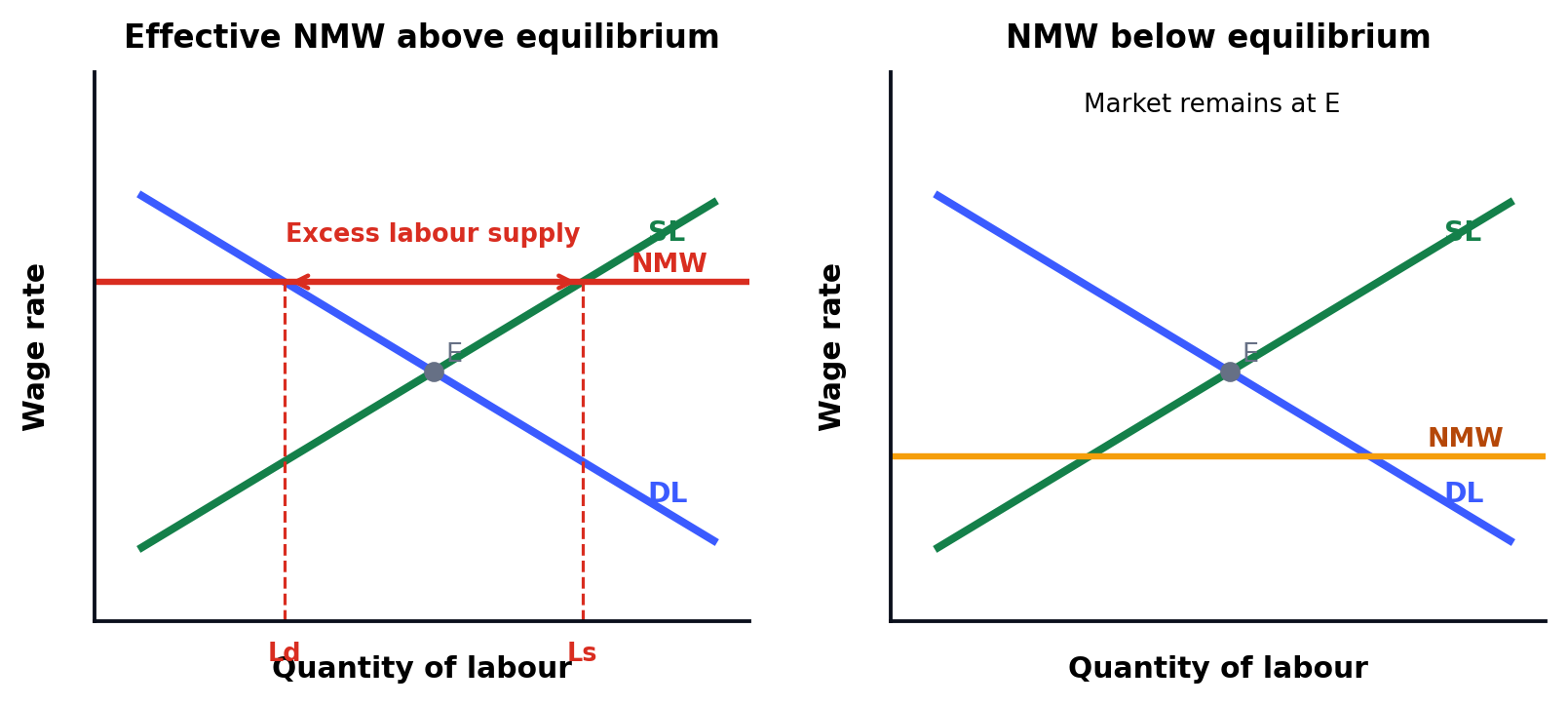
Figure 3.2: An NMW affects the market only when it is above the equilibrium wage.
| Possible advantages | Possible disadvantages |
|---|---|
| Raises the pay and living standards of workers who keep their jobs | May reduce employment or working hours if labour costs rise substantially |
| Reduces very low pay and may narrow income differences | May raise firms' costs, prices or encourage automation |
| Can increase motivation, productivity and worker retention | Some firms may close, relocate or avoid the law through informal employment |
| May increase spending because low-paid workers spend much of their income | Not every low-income household contains an NMW worker, so poverty may remain |
Evaluation: The employment effect is smaller when the NMW increase is modest, labour demand is strong, firms can absorb the cost through lower profit, or better pay raises productivity. Enforcement, regional costs and the starting wage also matter.
Reasons for differences in wages
Wages differ between occupations and between workers in the same occupation because labour demand, labour supply and bargaining conditions are different.
| Reason | How it can influence wages |
|---|---|
| Skills, qualifications and productivity | Highly trained or productive workers may be scarce and generate more revenue, increasing demand relative to supply. |
| Demand for the final product | Strong demand for a firm's output raises derived demand for its workers and can raise wages. |
| Training time and entry requirements | Long, costly training restricts labour supply and can raise wages. |
| Working conditions | Dangerous, unpleasant, unsocial or insecure work may require higher pay to attract labour. |
| Bargaining strength | A strong union or an individually scarce worker may negotiate higher pay. |
| Government policy | An NMW raises the legal floor; public-sector pay decisions and anti-discrimination law can also affect wages. |
| Discrimination | Workers may receive different pay because of gender, ethnicity, disability or another personal characteristic rather than productivity. |
| Economic sector | Primary, secondary and tertiary jobs have different skill needs, productivity, demand and working conditions. |
| Public or private sector | Public pay may follow national scales and policy aims; private pay may respond more directly to profit, competition and individual performance. |
One factor rarely explains a wage by itself. A highly skilled worker may still earn less if demand for the service is weak, while a less-qualified worker may earn more because the job is dangerous, hours are unsocial or labour is unusually scarce.
Mobility of labour
- Occupational mobility - the ability and willingness of workers to move between different occupations.
- Geographical mobility - the ability and willingness of workers to move between different locations for work.
| Mobility | Increases because of... | Is restricted by... |
|---|---|---|
| Occupational | education, retraining, transferable skills, online learning, recognition of qualifications | lack of skills, training cost and time, age, imperfect information, licensing rules |
| Geographical | better transport, remote work, housing support, migration rights, information about vacancies | housing costs, moving expenses, family ties, language, culture, immigration controls |
Greater mobility allows workers to move from declining industries or high-unemployment regions to expanding jobs. This can reduce labour shortages, unemployment and wage gaps and can raise national output.
However, movement can impose retraining and relocation costs. A region that loses many skilled workers may suffer a brain drain—a loss of educated and trained labour—while receiving regions may face pressure on housing and public services.
Division of labour
- Division of labour (worker specialisation) - splitting production into separate tasks so each worker concentrates on a limited part of the process.
Instead of one worker making an entire product, different workers repeatedly perform the stages they do best. This can greatly increase output, but it also makes workers and firms more dependent on one another.
| Advantages | Why they occur | Disadvantages | Why they occur |
|---|---|---|---|
| Higher productivity | Repetition increases speed and skill | Monotony | Repeated tasks may reduce motivation |
| Less time lost | Workers do not continually change tools or tasks | Interdependence | One absent worker or broken stage can halt output |
| Specialised machinery | Narrow tasks can be mechanised | Loss of flexibility | Workers may not learn the whole production process |
| Lower unit costs | Higher output spreads costs | Job insecurity | Simple specialised tasks may be easier to automate |
| Consistent quality | Training and checking focus on a small task | Reduced craftsmanship | Workers have less control over the finished product |
Balanced judgement: Division of labour is most beneficial when the market is large enough for mass production and firms prevent boredom through job rotation, teamwork, breaks and training.