The Earth's Axis
- The Earth rotates in a circular orbit around the Sun.
- It rotates on its axis, which is tilted (23.4°)
- One full rotation (revolution) is in 24 hours.
- This rotation creates the daily motion of the Sun rising/setting, and is responsible for the periodic cycle of day and night.
The Earth orbits the Sun once in approximately 365 days. The orbiting of the Earth around the Sun and the Earth's tilt creates the seasons.
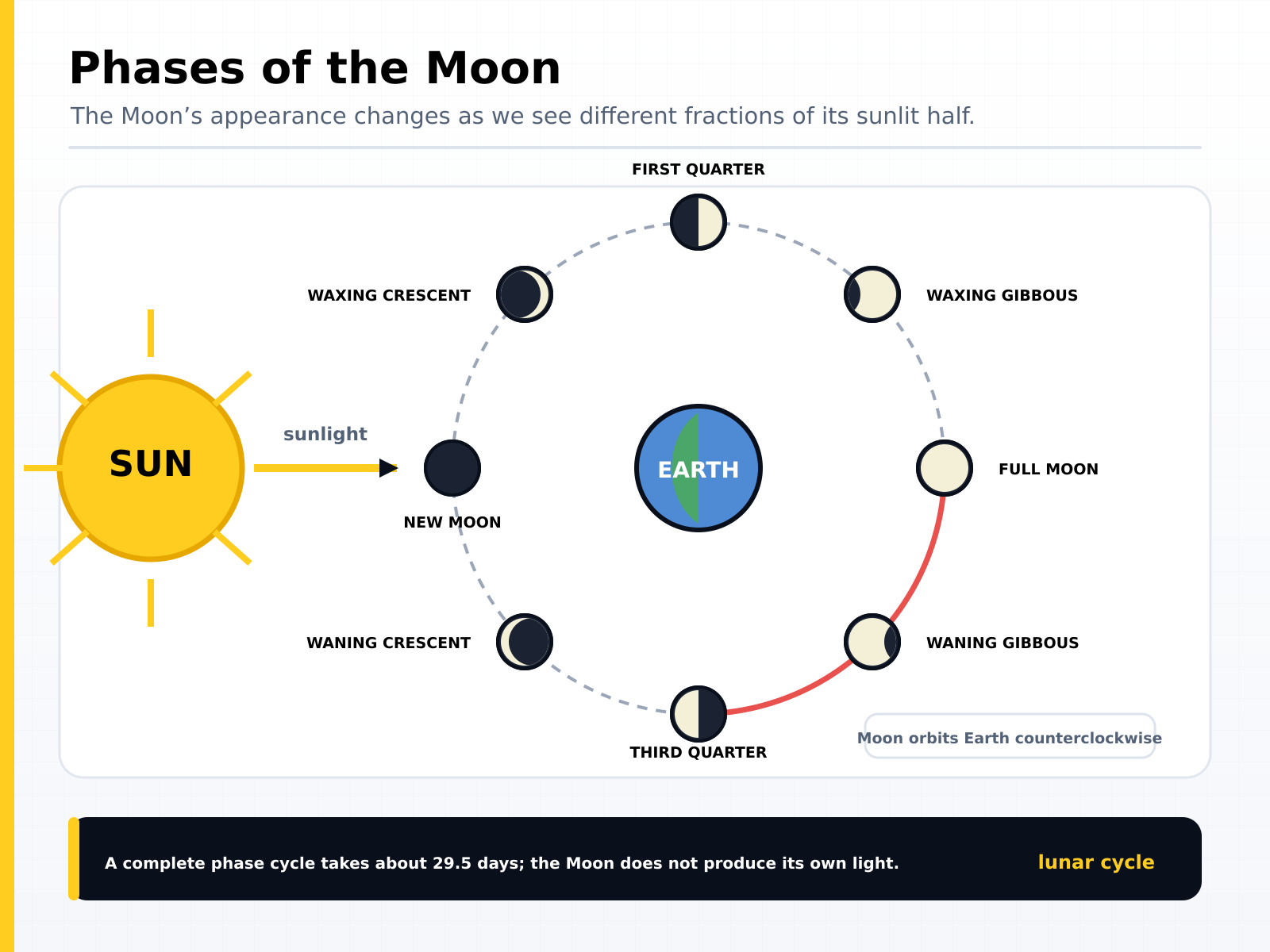
It takes approximately one month for the Moon to orbit the Earth. Moon's cycle of phases:
v = 2πr ÷ t
Orbital speed = 2π x average radius of the orbit ÷ orbital period
Solar System contains:
- One star, the Sun
- Eight planets
- Minor planets that orbit the Sun (dwarf planets & asteroids in the asteroid belt)
- Moons, that orbit the planets
- Smaller Solar System bodies (comets and natural satellites)
Accretion model for Solar System formation:
- The Sun formed when gravitational attraction pulled together clouds of hydrogen dust and gas (called nebulae).
- Planets formed from the remnants of the disc cloud of leftover matter from the nebula.
- These interstellar clouds of gas and dust included many elements that were created during the final stages of a star's lifecycle (a previous supernova).
- Gravity collapsed the matter from the nebula in on itself causing it to spin around the Sun.
- The gravitational attraction between all the small particles caused them to join together and grow in an accretion process.
- A rotating accretion disc is formed when the planets emerge.
Why are the four planets nearest the Sun rocky and small?
- The larger, more heavier elements (such as the metals) are pulled closer to the sun as a result of gravitational force
- As these elements move closer to each other, under great pressure do they form planets
Why are the four planets farthest from the Sun gaseous and large?
- The lighter elements (gases) are left further away from the sun following the creation of these rocky planets
- These large masses of gas form larger, but less dense, gas giants.
Gravitational field strength
- The greater the mass of the planet, the greater its gravitational field strength.
- On the surface of the planet, gravitational field strength is roughly the same.
- Gravitational field strength decreases as the distance from the planet increases.
Orbiting
- The Sun contains most of the mass of the Solar System (99%).
- A smaller body will orbit a larger body.
- Planets will orbit the sun.
- The force that keeps an object in orbit around the Sun is the gravitational attraction of the Sun
Planets, minor planets and comets have elliptical orbits.
The Sun is not at the centre of the elliptical orbit, except when the orbit is approximately circular.
As the distance from the Sun increases: the Sun's gravitational field strength decreases & the orbital speed of the planet decreases.
Orbits & Conservation of Energy
- An object in an elliptical orbit around the Sun travels at a different speed, depending on its distance from the Sun.
- These orbits are not circular, but still stable.
- The radius must change if the comet's orbital speed changes.
- As the comet approaches the Sun: radius of the orbit decreases, orbital speed increases
- Energy must still be conserved, but GPE & KE of the comet changes.
- As the comet approaches the Sun: loses GPE & gains KE -> comet speeds up -> slingshot effect -> the body will be flung back into space again -> passed around the Sun