Detection of radioactivity
Background radiation – Radiation that is present all around us, in natural and artificial sources.
Natural sources:
- Cosmic rays - radiation that reaches the Earth from space
- Rocks and soil - some rocks are radioactive and give off radioactive radon gas
- Food & drink
- Radon gas
Ionising nuclear radiation can be measured using a detector connected to a counter.
The three types of nuclear emission
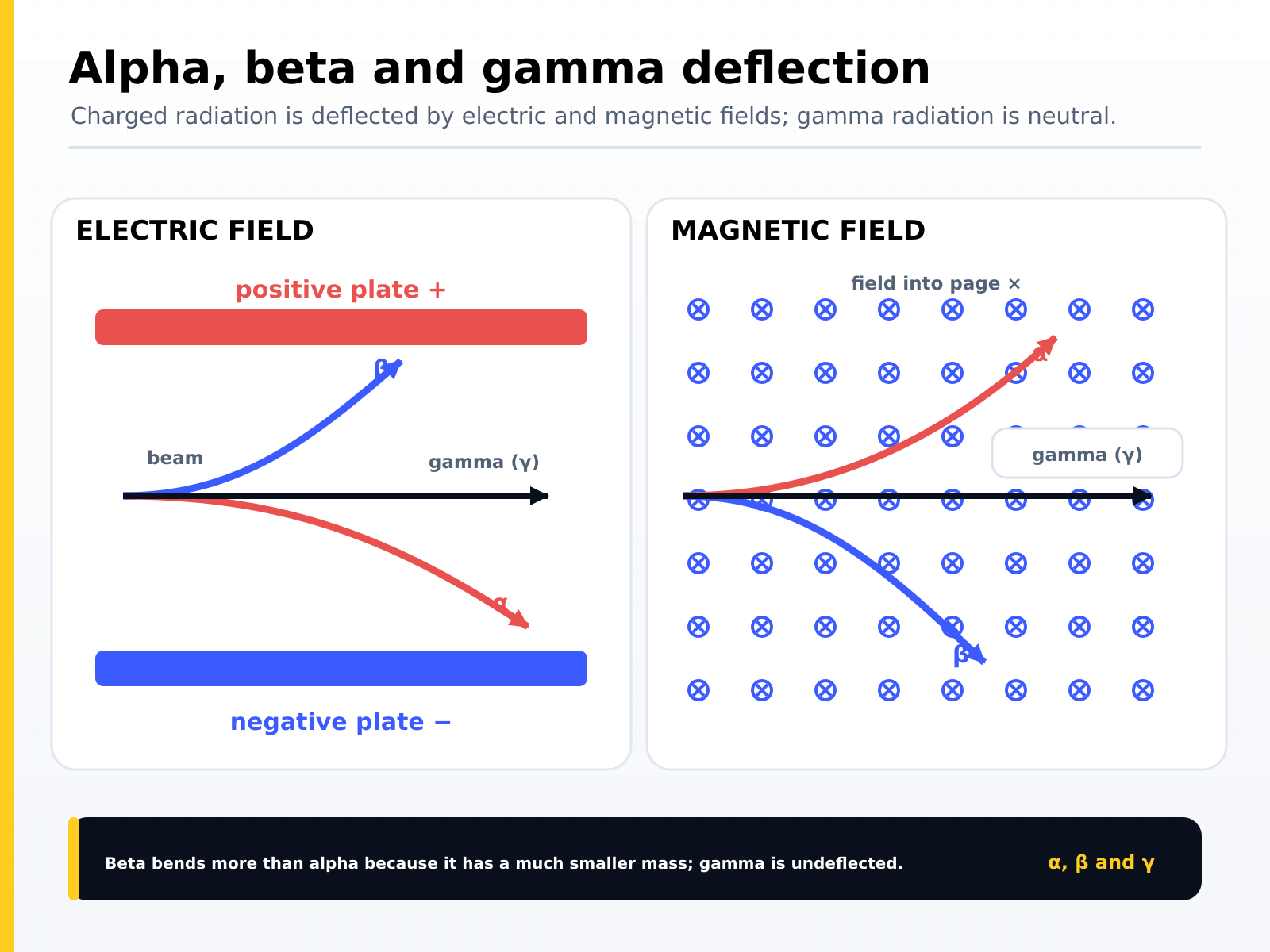
Nuclear emissions are spontaneous and random in direction. Types of nuclear emissions:
| Alpha (α) | Beta (β) | Gamma (γ) | |
|---|---|---|---|
| Their nature | 2 protons & 2 neutrons | Electrons | Electromagnetic waves |
| Ionising power | High | Low | Very low |
| Penetration | Skin/paper | 3mm aluminium foil | Lead/concrete |
The greater the charge of the radiation, the more ionising it is. The higher the kinetic energy of the radiation, the more ionising it is.
Deflection
- Magnetic field
- Electric field
Radioactive decay
Radioactive decay – A change in an unstable nucleus that can result in the emission of α-particles or β-particles and/or γ-radiation. These changes are spontaneous and random.
Radioactive decay - Stable nuclei:
- An atom's nucleus can only be stable if it has a certain number of neutrons for the protons it has.
- Elements with excess neutrons in the nucleus or with heavy nucleus, are unstable and will decay, emitting radiation.
- This helps to reduce their size or bring them back into balance.
- The constitution of its nucleus changes.
- The isotope will change into a different element.
| Alpha (α) | Beta (β) | Gamma (γ) | |
|---|---|---|---|
| Reactions |
Half-life
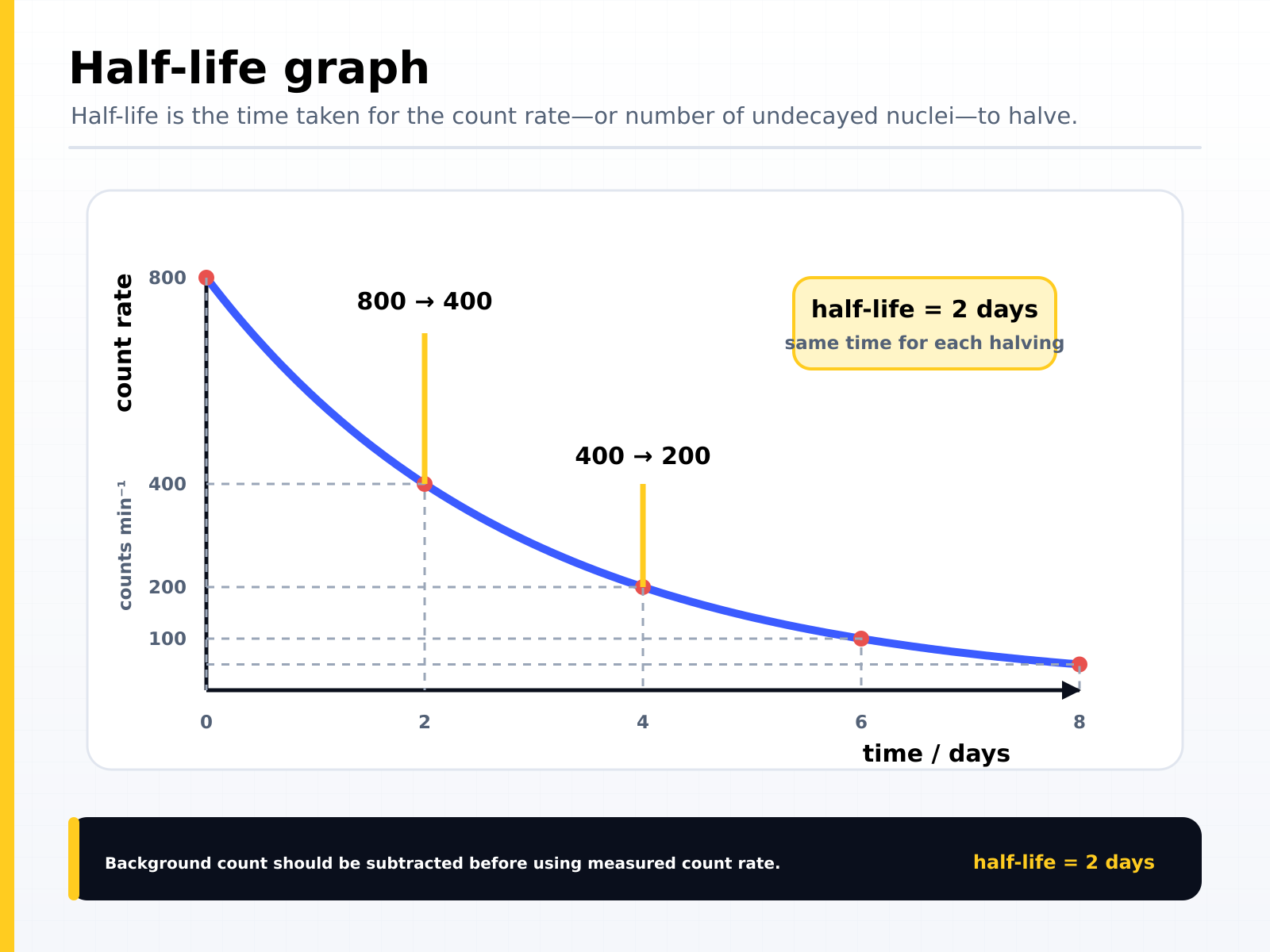
Half-life of an isotope – The time taken for half the nuclei of that isotope to decay.
Applications:
- Alpha particles: household fire alarms
- Beta particles: measuring thicknesses of materials
- Gamma rays: irradiating food, sterilisation of equipment, diagnosis & treatment of cancer
Safety precautions
Effects of ionising nuclear radiations on living things: cell death, mutations and cancer.
Safety precautions of ionising radiation
- Reducing exposure time
- Increasing distance between source and living tissue
- Using shielding to absorb radiation