Structure of an atom
- Positively charged nucleus, containing neutrons & protons.
- Negatively charged electrons in orbit around the nucleus.
Atoms may form positive ions by losing electrons or form negative ions by gaining electrons.
Gold foil experiment
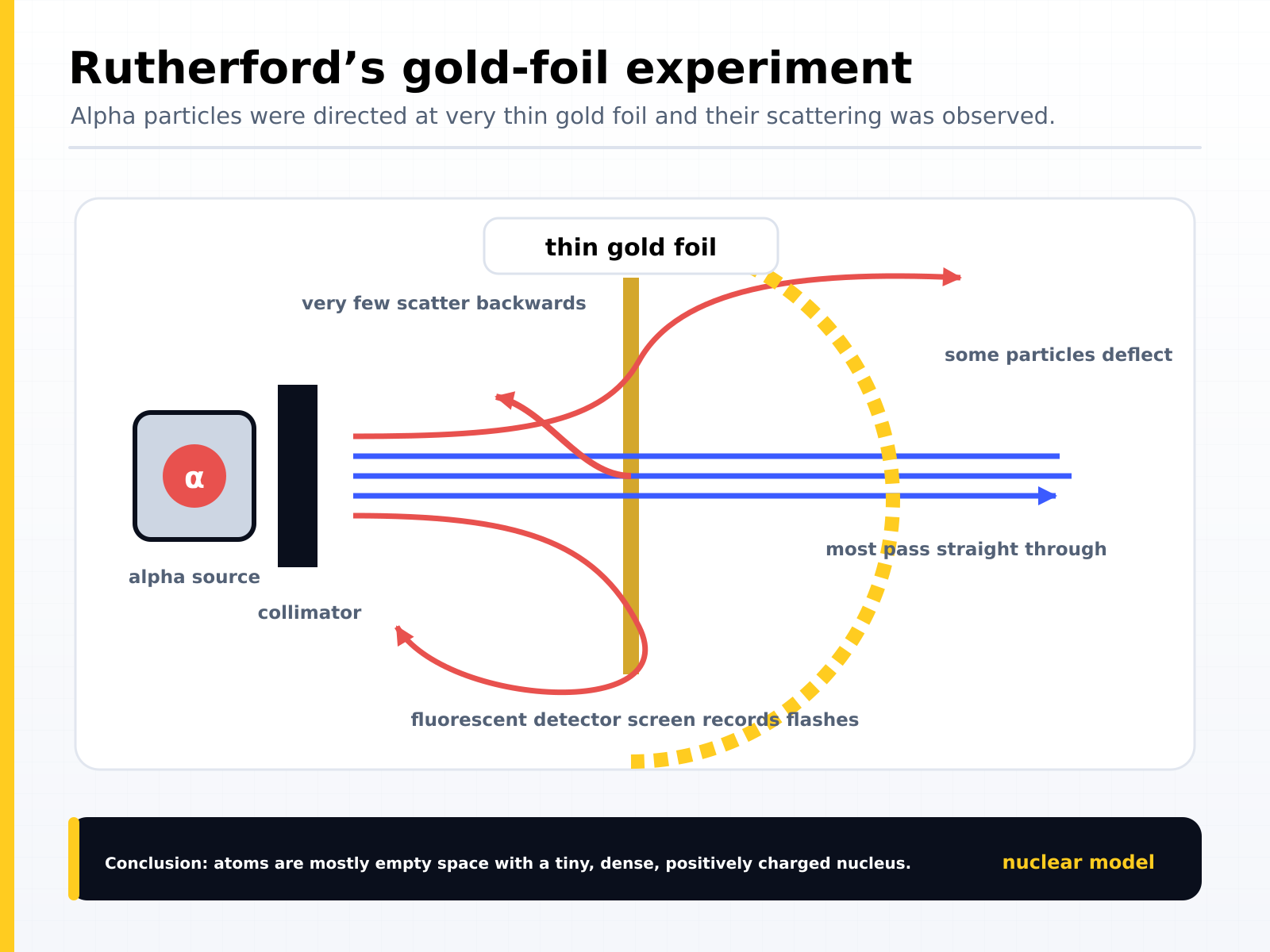
| What happened | Conclusion |
|---|---|
| Most of the alpha particles passed straight through the foil. | A very small nucleus surrounded by mostly empty space. |
| Some alpha particles came straight back off the foil. | Nucleus containing most of the mass of the atom. |
| Some alpha particles were deflected. | A nucleus that is positively charged. |
Relative charge
| Relative charge | |
|---|---|
| Proton | +1 |
| Neutron | 0 |
| Electron | -1 |
Proton number and nucleon number
- Proton number (atomic number) – total number of protons
- Nucleon number (mass number) – total number of protons + neutrons
Isotopes
- Isotope – Forms of an element that have the same number of protons but different numbers of neutrons.
An element may have more than one isotope.
Fission and fusion
- Fission – The splitting of nuclei
- Fusion – The joining of nuclei